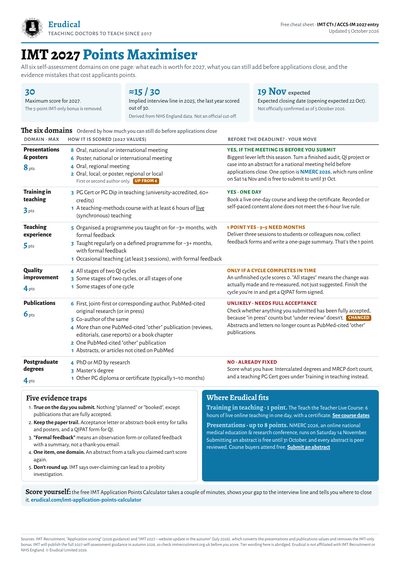
IMT’s self-assessment scores teaching in two separate domains. Training in teaching is worth 1 point for a course, or 3 points for a university-accredited PG Cert or diploma. Teaching experience is worth up to 5 points and has nothing to do with courses.
The rule that catches people out: for the 1 point, the training must involve at least six hours of synchronous (live) teaching. CPD accreditation is not what the criterion asks for — live hours are.
Plenty of doctors teach medical students every week and assume that experience alone will score. It will — but in a different box, under different rules, and only with the right evidence. This guide sets out what each teaching domain actually rewards, what you have to produce to claim it, and the realistic routes to the point if you are applying this round.
Teaching is scored in two separate places
The most common self-assessment error is claiming a teaching course under teaching experience, or claiming ward-round teaching as training. They are distinct domains and they stack: you can score in both.
Teaching is two of the six IMT domains. Calculate My Score → Work out your full total out of 30:
| Domain | What it rewards | Points available |
|---|---|---|
| Training in teaching | A course or qualification you completed about teaching | 1 (course) or 3 (PG Cert / diploma) |
| Teaching experience | Teaching you have delivered or organised, with formal feedback | 1, 3 or 5 |
Both sit inside a self-assessment scored out of 30 points. For 2027 entry, IMT has announced that the 5 bonus points for applying only to IMT are removed, so shortlisting is entirely the self-assessment, scored out of 30 (IMT Recruitment notice, 16 July 2026). IMT longlists for interview on a non-verified self-assessment — you score yourself, and you supply evidence if asked. That makes accuracy a self-interest issue, not a formality.
Training in teaching: what actually scores the point
3 points: “I have a higher qualification in teaching e.g. PG Cert or PG Diploma.” — it “must be a university accredited programme… and be worth an equivalent of at least 60 credit points or equivalent.”
1 point: “I have had training in teaching methods which is below the level of a PG Cert or PG Diploma.” — “This should be additional to any training received as part of your primary medical qualification. Training should be delivered with a duration of at least six hours (i.e. a one-day course) of synchronous (live) teaching time.“
Source: imtrecruitment.org.uk, application scoring. There is also a scope rule: “Training can only be included in this section if it was specifically focused on teaching.” A general medical-education qualification belongs under postgraduate qualifications instead.
Three things follow from that wording, and each of them costs applicants points every year.
1Six live hours, or nothing
A self-paced online course is not synchronous teaching time, however many hours of video it contains. Read literally, an entirely asynchronous course — free e-learning or a paid online-only product — does not meet the criterion. Check what live component you are buying before you pay.
2Accreditation is not the test
CPD accreditation appears nowhere in the criterion. It is still worth having as an independent quality signal, and some specialties and employers ask for it — but it does not substitute for the hours. Treat it as necessary, not sufficient.
3Medical school doesn’t count
Training “should be additional to any training received as part of your primary medical qualification”. Teaching sessions embedded in your MBBS are not claimable here.
Teaching experience is the other five points
This domain rewards teaching you have delivered, and the tiers turn on two things: how sustained it was, and whether you collected formal feedback.
| Points | What it takes |
|---|---|
| 5 points | Organising a teaching programme lasting three months or more, with formal feedback |
| 3 points | Regular teaching within a defined programme lasting three months or more |
| 1 point | Occasional teaching, with formal feedback |
The practical lesson: three months and a feedback form are what separate 1 point from 3 or 5. Ad-hoc bedside teaching with nothing written down is the most commonly wasted effort on the whole application. If you are teaching anyway, put it inside a defined programme, run it for a term, and collect structured feedback each session.
What you actually have to produce
Self-assessment is not verified at longlisting, but evidence is required at the application stage, and the requirement is specific.
“Completion of training: Evidence of completion will normally be a certificate from the course provider… Course delivery: You will need to provide a course outline which confirms the duration and how the programme is delivered.”
And the sanction, in the same guidance: “If you supply no evidence, or no evidence for three or more of your scored achievements, your application will not proceed.”
Note the second document. A certificate on its own does not prove six synchronous hours — the course outline does. If a provider cannot give you a written outline stating duration and delivery mode, you cannot evidence the claim, whatever you paid. Ask for it before you book, not in December.
For teaching experience, the equivalent evidence is the feedback itself: structured forms, a summary of a programme you ran, or a supervisor’s confirmation. Keep it as you go; reconstructing a term’s feedback the week before a deadline rarely works.
A caution about ST3 and other specialties
Everything above is the IMT framework. There is no single cross-specialty ST3 self-assessment: each specialty publishes its own guidance and person specification, and the wording differs — some accept online-only training, some ask for more hours, some score teaching qualifications only. Anyone telling you “ST3 requires a one-day course” is generalising.
Check your own specialty’s current self-assessment document before you spend anything. Our application points guide breaks the requirements down specialty by specialty. Note too that IMT’s guidance is updated annually. For 2027 entry, IMT has already announced three changes: the 5 bonus points for applying only to IMT are removed, so shortlisting is entirely the self-assessment, scored out of 30; presentations rise to a maximum of 8; and publications fall to 6 (IMT Recruitment notice, 16 July 2026). Full 2027 guidance is due in autumn 2026.
Your three routes to the teaching point
A PG Cert or diploma
The only route to 3 points. It must be university accredited and worth at least 60 credits, which in practice means a year or more of part-time study and several thousand pounds. Right if medical education is your career direction; disproportionate if you need the point for this round.
A classroom course
A face-to-face one- or two-day course clears the six-hour bar comfortably. The trade-off is cost and logistics: royal college courses run £399–£610 depending on membership, and you lose a clinical day plus travel.
Online course plus a live day
Self-paced modules for the syllabus, a full live day for the synchronous hours. The pragmatic middle: it satisfies the criterion, fits around a rota, and costs a fraction of a classroom course. Verify the live day is genuinely live and at least six hours.
Erudical’s course is built for this criterion. 20 self-paced modules (12+ hours, six weeks’ access) plus a full live online day, 09:00–17:00 — six hours of live teaching across a full eight-hour day, which meets the six-hour minimum. £199 for both, CPD accredited, provider 13684.
See the course and datesHow to choose a course that actually scores
Five checks, in the order that matters:
- Live hours. How many hours of synchronous teaching, on what date? “Interactive” and “tutor-supported” are not the same as live. Six is the floor for IMT.
- A course outline you can download. It must state duration and delivery mode. No outline, no evidence.
- A dated certificate of completion naming the provider.
- A syllabus that looks like teacher training — adult learning theory, objective setting, feedback models, lesson planning, and bedside, small-group and large-group teaching.
- A date you can actually make, far enough before the self-assessment closes that a clash does not cost you the point.
If you are weighing a paid course against the free options, we compared them honestly in free vs paid teach the teacher courses, and the paid providers against each other in our comparison of the best Teach the Teacher courses for doctors.
Timing, and paying for it
Applicants lose this point on logistics, not ability. A live day is a fixed date: if the last one before your deadline is full, the point is gone for the round. Book the live date first and work backwards — the self-paced content can be completed around it. Still in FY1? The IMT portfolio plan for FY1 doctors shows where the course fits alongside QI, teaching and a presentation.
And check whether you need to pay at all. Most UK trainees have a study budget, most never spend it on a teaching course, and a teaching course is usually an eligible claim. Our study budget guide sets out the sequence, the paperwork and the emails to send.
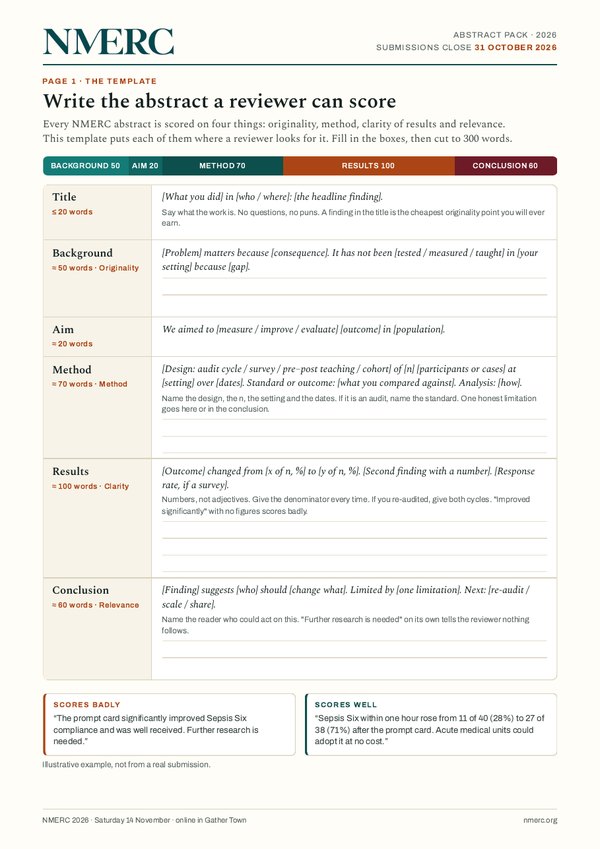
The course is the 1; the presentation is the 8. The teaching course scores in the training-in-teaching domain. Presentations are a separate domain, and for IMT 2027 a national oral presentation scores up to 8 (this applies to IMT; ST3 values differ). It only counts if you have given it before the application window closes. Erudical enrolment includes a place at NMERC 2026, a national online conference on 14 November where you can present an oral or a poster. How each tier scores is set out in presentation points for IMT and ST3. For the route to one, see how to get a national presentation for IMT.
Frequently asked questions
How many points is a teach the teacher course worth for IMT?
One point, under training in teaching, provided the training involved at least six hours of synchronous live teaching and you can evidence it with a certificate and a course outline. Three points are reserved for a university-accredited PG Cert or diploma worth at least 60 credits.
Do I need a PG Cert to score teaching points?
No. A PG Cert or diploma is the only route to the top tier, but a one-day course secures a point without committing to a year of part-time study. Whether the extra two points justify the time and cost depends on how close you are to the interview cut-off and whether medical education is your career direction.
Does the course have to be CPD accredited?
IMT’s criterion does not require CPD accreditation — it specifies at least six hours of synchronous teaching. Accreditation remains a useful independent quality signal and some specialties and employers ask for it, so treat it as worth having but not as the thing being scored.
Is a self-paced online course enough?
Not for IMT as the criterion is written. Asynchronous e-learning is not synchronous teaching time, whatever the total hours. If you are buying an online course, confirm what live component is included and how long it runs before you pay. Other specialties set their own wording, so check yours.
Will teaching medical students count on its own?
It counts — but under teaching experience, not training in teaching, and the tier depends on structure. Occasional teaching with formal feedback scores 1 point; regular teaching within a defined programme lasting three months or more scores 3; organising such a programme scores 5. Teaching with no feedback collected is hard to claim at any tier.
What evidence will I be asked for?
For a course: a certificate of completion from the provider, plus a course outline confirming the duration and how the programme was delivered. A letter from the organiser confirming attendance is accepted where a certificate is unavailable. IMT states that if you supply no evidence for three or more of your scored achievements, your application will not proceed.
Does this apply to ST3 applications too?
Not automatically. There is no single ST3 self-assessment framework — each specialty publishes its own guidance and the teaching requirements differ. Use the IMT wording as the strictest common case, then confirm against your own specialty’s current document.
When should I complete the course?
Early enough that a full live date does not cost you the point. Live days are fixed dates with finite places, so book the live session first and fit the self-paced modules around it, rather than starting the modules and hoping a date is still open.
The bottom line
Teaching is one of the more winnable domains on an IMT application, and the two halves need different work. The point for training in teaching is a purchase decision, and the only question that matters is whether the course delivers six live hours and hands you an outline to prove it. The three to five points for teaching experience are not purchasable at all: they take a defined programme, three months, and feedback you collected at the time. Start the second one now; the first one you can still fix this round.
Need the live hours and the paperwork in one booking? Erudical’s Teach the Teacher course is £199 for the self-paced modules and a full live online day, with a certificate and a published course outline.
Enrol — £199IMT self-assessment wording checked against imtrecruitment.org.uk on 16 September 2026. Frameworks are revised annually and ST3 requirements vary by specialty — always confirm against your own specialty’s current guidance before booking.