“Train the trainer” means very different things depending on who’s asking. For a manual-handling instructor or a fire marshal it’s a health-and-safety qualification. For doctors and NHS clinical staff it means something more specific: learning how to teach effectively in a medical context, and being able to evidence that training for your portfolio and specialty applications. This guide clears up the confusion and explains what actually counts for clinicians.
“Train the trainer” vs “teach the teacher” — are they the same?
In medical education the terms are used almost interchangeably: both describe a course that trains you to teach. The phrase “train the trainer” is more common in corporate and H&S settings, while “teach the teacher” is the term you’ll see most often around NHS teaching and specialty applications. For a doctor, what matters is not the label but whether the course covers clinical teaching and gives you an accredited certificate.
What NHS doctors actually need from a course
A train-the-trainer course aimed at doctors should prepare you for the teaching you genuinely do: bedside teaching, small-group sessions, lectures and case-based discussion. Generic corporate or first-aid “train the trainer” courses won’t do this, and won’t carry weight in a medical portfolio. Look for content built around:
- Adult learning theory and how it applies to clinical teaching.
- Setting learning objectives for a session.
- Giving structured, constructive feedback.
- Planning and delivering bedside, small-group and large-group teaching.
What counts for your portfolio and applications
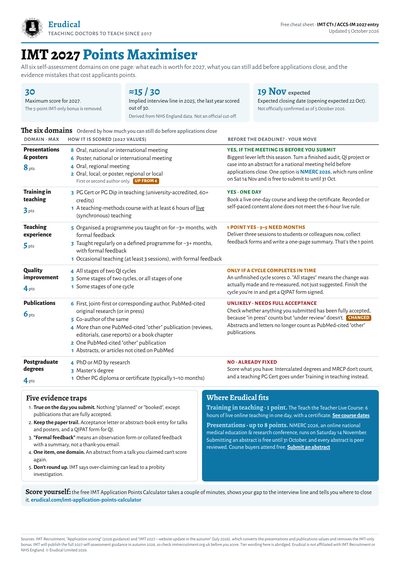
For ARCP, your e-portfolio and specialty applications, a recognised, ideally CPD-accredited teaching course evidenced by a certificate is what counts — not a generic H&S train-the-trainer day. The same course that scores a teaching point on IMT and ST3 applications also strengthens your portfolio as evidence of teaching competency. (See our detailed guide to teaching points for IMT and ST3 applications.)
NHS-run vs independent courses
Some trusts and deaneries run their own teaching courses, which are excellent when available — but places are limited, dates are fixed, and they may not issue a portfolio-ready certificate. Independent online courses fill the gap: they run on your schedule, carry CPD accreditation, and issue a formal certificate. The best choice is whichever you can actually complete before your application or ARCP deadline.
How to choose the right train-the-trainer course as a doctor
- Medical context: the syllabus should be about clinical teaching, not corporate training.
- CPD accreditation and a certificate of completion for your portfolio.
- Sufficient depth — a substantial course (12+ hours) rather than a single webinar.
- Flexibility to finish around your rota.
- Value — classroom courses often exceed £390; online accredited options are far cheaper.
The practical option for busy clinicians
Erudical’s teach the teacher course for doctors is a train-the-trainer course designed specifically for the NHS context: over 12 hours of clinical-teaching content, CPD accredited since 2020, self-paced, with a live interactive session and a formal certificate — rather than the £390-plus typical of classroom courses.
Frequently asked questions
Is a corporate “train the trainer” course any use for doctors?
Generally no. It won’t cover clinical teaching and won’t carry weight in a medical portfolio or application. Choose a course built for healthcare.
Does it need to be NHS-run to count?
No. An independent, CPD-accredited course with a certificate counts for your portfolio and applications.
Will it help with ARCP as well as applications?
Yes — evidence of teaching training supports your e-portfolio and ARCP, not just specialty applications.
Want a train-the-trainer course built for the NHS? Enrol on the CPD-accredited Teach the Teacher course for doctors.