Submit · free · closes 31 October 2026
Submit an Abstract to NMERC 2026
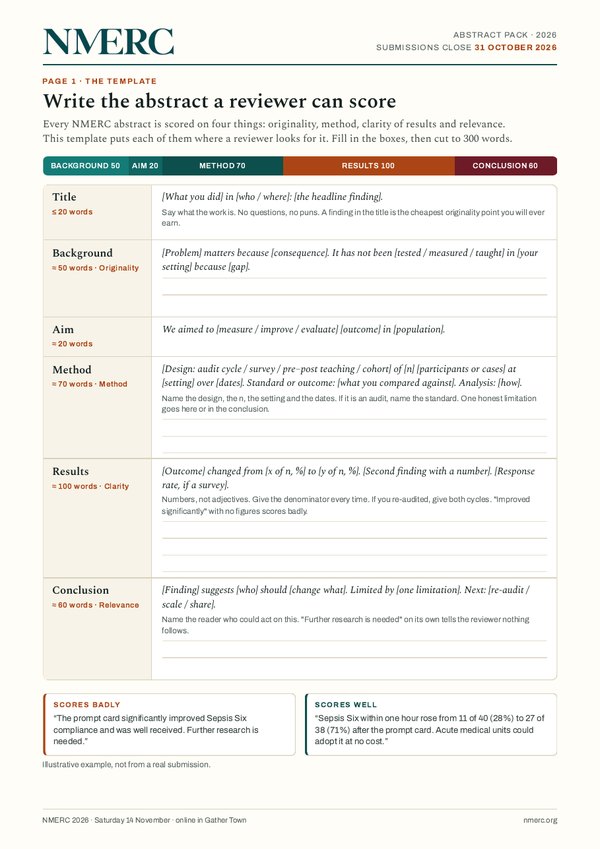
Every abstract is scored against a published rubric and reviewed before a decision is issued. This page is that rubric, in full.
Open the Submission Form Decision within 5 days · rolling
The NMERC 2026 Abstract Rubric
Four axes. Each is scored independently, and the total decides both whether your abstract is accepted and which room it is accepted into.
Originality
Does the work add something that was not already known?
Scores well when
The question had not been answered in this setting, or an existing answer is tested somewhere it had not been tested before.
Scores badly when
The finding is already established and the abstract does not say what this adds to it.
Method
Can the design support the conclusion drawn from it?
Scores well when
The design fits the question, the sample and setting are stated, and the limits are acknowledged rather than hidden.
Scores badly when
A strong claim rests on a design that cannot carry it, or the method is described too vaguely to judge.
Clarity of results
Can a reader tell what you found, and how confidently?
Scores well when
The finding is stated in numbers or plain terms, with enough context to know whether it is large or small.
Scores badly when
Results are promised but not given, or the reader reaches the end still unsure what happened.
Relevance
Does it matter to medical education or to clinical practice?
Scores well when
Someone reading it could change what they teach or what they do, and the abstract says who.
Scores badly when
The work is sound but nothing follows from it, and the abstract does not attempt to say why it matters.
The rubric is published in full so that trainees, supervisors and educators can see exactly what is being marked.
Oral or Poster
You state a preference on the form. Two rooms, two different bars, and we would rather be clear about the difference than let you assume they are the same.
The lecture hall
Competitive, selected on score
A limited number of oral slots. The highest-scoring abstracts take them, so a good abstract can still miss out on volume alone.
Format
Timed talk, questions after
On the day
Your session, at the time you are given
The poster hall
Accepted if it meets the standard
Not a competition against other submissions. Meet the rubric standard and you present, which is why the poster hall is deliberately the larger track.
Format
Walk-up discussion at your board
On the day
Free to roam and explore for most of the day. We just ask you to be at your board, camera on, for two slots: 11:00–12:00 and 14:30–15:30
What to Send
One form, one abstract, about ten minutes. Nothing needs to be finished to a journal standard — it needs to be legible and honest about what you did.
Title
What the work is, not a joke or a question.
Abstract
Background, method, results, conclusion.
Authors
Everyone who should be credited, with the presenting author named.
Track
Lecture hall, poster hall, or either.
Who Can Submit
Doctors in training
Foundation doctors and core or specialty trainees. There is no membership requirement and no fee.
No geography limits
Open to doctors wherever you trained or work. The conference is online, so you can join from anywhere.
What Happens Next
STEP ONE
You submit
The form closes on 31 October 2026. There is no fee and no account to create.
STEP THREE
You hear within five days
Accepted to a room, or turned down with feedback on where it fell short.
STEP FOUR
You present on 14 November
The confirmatory letter and certificate follow by 16 November at 16:00. See both →
Submit early
Decisions are rolling rather than issued in one batch at the end of October. An abstract sent in September is answered in September, which leaves you time to rework and resubmit if it comes back short.
Send Us an Abstract
Free, to either room, whether or not you attend. Submissions close on 31 October 2026.
Open the Submission Form What it costs, and what you leave with → Erudical alumni attend free →

 NMERC 2026Saturday 14 November 2026 · online in Gather Town
Organised by Erudical. All submissions are free.
NMERC 2026Saturday 14 November 2026 · online in Gather Town
Organised by Erudical. All submissions are free.