Clinical Oncology ST3 · 2027 criteria
Clinical Oncology ST3 self-assessment 2027: points calculator and scoring guide
Pick the option that fits your evidence at each step to see your score out of 51, and what you can still add before the deadline.
Applications close 4pm, Thu 10 Dec 2026
- 527 doctor reviews
- 4.7/5 rated for relevance
Clinical Oncology ST3 points calculator
The 2027 Clinical Oncology ST3 self-assessment asks for a single answer in each of its seven domains, and NHS England doesn’t publish a total: the domain maxima add up to 51. Consultants verify your evidence and can change your score, the recruiters aim to interview everyone unless capacity is exceeded, and your verified score is then combined with your interview scores to rank you. Oriel takes applications between 19 November (10am) and 10 December 2026 (4pm), both Thursdays, evidence goes up between 11 December 2026 and 4 January 2027, and whatever you claim has to be finished on the day you press submit.
Clinical Oncology ST3 self-assessment (evidence verified by consultants) points at a glance
Your score is the total of the domain scores, out of a maximum of 51.
No percentage published. “After the evidence verification process, we aim to offer all applicants an interview. However, if capacity is exceeded, only the highest scoring applicants will be invited to interview” and “A combination of your verified evidence scores, and scores at interview will be used to determine your final total score and ranking”.
| Domain | What scores (official wording) | Max |
|---|---|---|
| Postgraduate degrees and qualifications |
Scores the single best option you can evidence, up to 4 points. Single best option only. | 4 |
| Presentations/posters |
Scores the single best option you can evidence, up to 8 points. Single best option only (max 8). First or second author only. “If you have more than one achievement in an area which only allows you to choose an option for one ... you should select the option corresponding to your highest scoring achievement.” The same work may also score in another domain: “If you have an achievement which could potentially fit under more than one domain, for example winning a prize for a poster or doing a presentation based on a publication, it is acceptable to claim under both options.” | 8 |
| Publications |
Scores the single best option you can evidence, up to 10 points. Single best option only (max 10). “In press” counts; submitted does not. | 10 |
| Teaching experience |
Scores the single best option you can evidence, up to 7 points. Single best option only (max 7). Scored separately from Training in teaching (own word count, 250 words). | 7 |
| Training in teaching |
Scores the single best option you can evidence, up to 6 points. Single best option only (max 6). Multiple courses may be combined for the 2-point tier only if they are “complementary and not covering similar topics”. | 6 |
| Quality improvement (QI) |
Scores the single best option you can evidence, up to 8 points. Single best option only (max 8). Only the cycles you were directly involved in count. | 8 |
| Leadership and management |
Scores the single best option you can evidence, up to 8 points. Single best option only (max 8). Every tier needs 6 or more months in the role and a demonstrable positive impact. | 8 |
| Total | Not published as a single figure: this is the sum of the domain maxima. | 51 |
Dates for this round
- Advert appears source
- Applications open source
- Applications close (self-assessment cannot be amended after you submit) source
- Evidence verification upload window opens source
- Evidence verification upload window closes (time not stated) source
- Interviews (online, Qpercom) source
- Initial offers released source
- Hold deadline source
- Upgrade deadline source
- Hierarchical deadline source
What you can still add before 10 December 2026
What each of these adds is the difference between the option you would reach and the one you already hold, so it can be nothing if you hold that option already. The calculator works out the gain from your own answers.
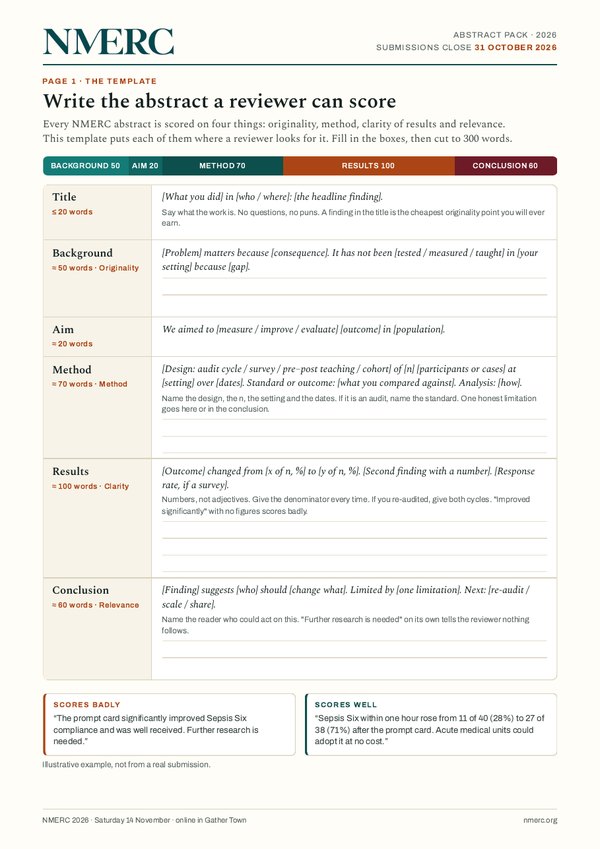
- Presentations/posters. Submit an abstract to a national meeting held before you apply, e.g. NMERC 2026 (free abstract submission at nmerc.org/submit, decision within 5 days, presented online on Sat 14 Nov 2026). Present, then submit your Oriel application between 10am 19 Nov and 4pm 10 Dec 2026. Upload the evidence letter and the abstract book (both list every co-author with their author position), plus your certificate if you presented, in the evidence window (11 Dec 2026 to 4 Jan 2027). An oncology-related topic scores 8 (oral) or 6 (poster); anything else 6 or 4. The talk on Sat 14 Nov 2026 is delivered before the application window opens at 10am 19 Nov 2026, so it is already a completed achievement at submission.
- Teaching experience. Deliver some ad hoc teaching (e.g. to medical students or FY doctors) and collect feedback before you submit: “I have taught medical students or other healthcare professionals occasionally.” = 2. Teaching on Erudical's Teach the Teacher course is another option: we always want more teachers, so contact us. The 3-month tiers are out of reach unless you have already started. Start by 30 November 2026. Advisory, not an official date: allows time to teach and collect feedback before the 4pm 10 Dec 2026 close.
- Training in teaching. Attend an Erudical live day (09:00–17:00, 6 hours live) and finish the self-paced course (over 12 hours, 6 weeks' access), then ask for the combined 18-hour certificate: 2 points. In the 100-word box, say that the training totals more than 2 days whole time equivalent and what each part covered. The live day alone scores 1. Courses must be completed before you submit (applications close 4pm Thu 10 Dec 2026): “courses not yet taken ... should not be included”. For 2 points, choose a live course date that leaves time to finish the self-paced course and get the combined certificate before you submit; the live day alone scores 1.
- Quality improvement (QI). Only the 1-point tier is realistic: be involved in 2 or more aspects (e.g. data collection and analysis) of a single QI cycle that is completed before you submit. Start by 31 October 2026. Advisory, not an official date: a cycle needs planning, data, analysis and a change, all completed before the 4pm 10 Dec 2026 close.
Evidence traps
- Your self-assessment is fixed when you submit. Anything you haven't finished by then (a course, a talk) can't be added later, even if it happens before the close.
You cannot amend this section after should you make a mistake on your application form or gained an achievement after the submission of your application.
source - Paying for a slot doesn't count. A poster or talk you got only because you paid a fee scores 0, even at a national meeting.
In situations where you are solely presenting or showing your poster because you have paid a fee you may only select the “none/other” option.
source - Teaching talks don't count as presentations. The presentations domain is for novel data: research, a complex case or a QI project.
This section should not include presentations primarily aimed at teaching.
source - Stacking courses to reach “more than 2 days” only works if they cover different ground. The Erudical self-paced course (over 12 hours, 20 modules, its own assignments) contains much more than the live day, so the two are complementary.
This does not necessarily need to be a single course but where multiple courses have been attended, these must be complementary and not covering similar topics.
source - ‘National’ has a test: the meeting must be open to anyone in the country and publish a list of abstracts. A Scotland-wide (or Wales-wide) meeting counts as national.
International/national meetings should involve a document listing the abstracts of the presentations and posters included at that meeting. National meetings must be open to anyone in the country and international meetings must be open to anyone from a range of countries.
source
Sources
- 2027 Clinical Oncology ST3 Self-assessment Guidance (NHS England Medical Hub), Page last reviewed: 29 September 2026; next review due 29 September 2028
- Clinical Oncology: Recruitment timelines (Round 2), Page last reviewed: 28 September 2026
- Overview of Clinical Oncology (Summary for 2027 recruitment), Page last reviewed: 29 September 2026
- Clinical Oncology: Applying, Page last reviewed: 29 September 2026
- Clinical Oncology: Interviews, Page last reviewed: 28 September 2026
- Clinical Oncology ST3 person specification 2027, 2027 recruitment
- 2025 Competition ratios (Round 2 table), 2025
- 2025 Clinical Oncology ST3 Self-assessment Guidance (Wayback snapshot 1 Jun 2025; comparison only), Page last reviewed: 13 November 2024
- Erudical Teach the Teacher course (product facts only, not a scoring source), live page
- Erudical teach the teacher certificate page (combined 18-hour certificate), live page
- Erudical application points table, Clinical Oncology ST3 row (cross-check only), live page + screen snapshot application-points-61-rows-2026-10-10.json
- NMERC 2026 (dates, eligibility, abstract book), live pages /nmerc/, /nmerc/submit/, /nmerc/certificates/
Gains you can finish before you submit on Oriel
Clinical Oncology’s window opens after both NMERC and the last listed Erudical live day, which leaves room for two good gains. Training in teaching is the most certain: our live day on its own counts as brief training for 1 point, and the live day plus the self-paced course, with the combined 18-hour certificate, counts as substantial training for 2, as long as both parts are done before you submit (live days before your deadline: 24 October, 31 October, 7 November, 15 November, 28 November and 5 December). Presentations can move further, because an oncology-related oral at a national meeting scores 8 and an oncology poster 6, so an oncology abstract accepted by NMERC and presented in mid-November is a finished achievement before the window even opens. If you’ve no teaching at all, some ad hoc sessions with feedback reach “I have taught medical students or other healthcare professionals occasionally.” for 2, and teaching on our Teach the Teacher course is another way in, since Erudical always wants more teachers for it. NMERC and Erudical roles may qualify. See the NMERC and Erudical websites and contact us for details. In quality improvement, only the 1-point tier is realistic from a standing start. Degrees, publications and leadership roles need months, or a paper that is already fully accepted.
Claims the verifying consultants reject
The self-assessment can’t be changed once it’s in (“You cannot amend this section after should you make a mistake on your application form or gained an achievement after the submission of your application.”), so submit after your course and your talk, never before. A slot you only got by paying scores nothing, a talk built around teaching belongs in Teaching experience, and a paper that has only been submitted “cannot gain any marks at the short-listing stage”.
Worked example: an IMT2 who moves from 18 to 23
This hypothetical IMT2 doctor has no postgraduate degree and has given a first-author non-oncology oral at a regional meeting. They’re co-author of one PubMed-cited case report outside oncology, have taught at the bedside regularly for 4 months with a supervisor’s letter, and have had no training in teaching. They’ve been involved in all aspects of two cycles of a non-oncology QI project and have been hospital mess president for 8 months. On the 2027 guidance:
- Postgraduate degrees and qualifications: none, 0.
- Presentations and posters: non-oncology oral at a regional meeting, 3.
- Publications: one PubMed-cited other publication, not oncology, 3.
- Teaching experience: regular teaching for about 3 months or longer, 4.
- Training in teaching: no course yet, 0.
- Quality improvement: involved in every aspect of two QI cycles, 4.
- Leadership and management: a local role for 6 months or more, 4.
That’s 18 of a possible 51. Finishing the live day and the self-paced course and getting the combined 18-hour certificate takes Training in teaching from 0 to 2. Presenting an oncology-related poster at NMERC, such as a re-audit on the acute oncology unit, takes Presentations from 3 to 6, a gain of 3 rather than 6 because the regional oral already scored 3. The total becomes 23, a gain of 5. With the live day alone, Training in teaching would be 1 and the total 22; an oncology oral in place of the poster would lift Presentations to 8, a gain of 5 in that domain alone; and a non-oncology poster would add just 1.
The calculator below totals your answers out of 51 and works out what a course or an NMERC abstract would add for you. We’ll show your result and email you a copy.
Go to the Clinical Oncology ST3 calculator at the top of this page
Prefer the seven domains on one printable sheet? Pop your email in and we’ll send it.
Email me the printable version
Check your inbox. Your printable cheat sheet is on its way to .
While you wait, work out your score with the calculator. If the email isn't there in a few minutes, check your junk folder.
Does a teach the teacher course count for Clinical Oncology ST3?
Yes, in the Training in teaching domain. “I have had brief training in teaching methods lasting no more than 2 days.” scores 1, and “I have had substantial training in teaching methods lasting more than 2 days.” scores 2. The glossary defines substantial training as formal training “lasting more than 2 days (whole time equivalent)”, and adds that “This does not necessarily need to be a single course but where multiple courses have been attended, these must be complementary and not covering similar topics.” Our live day (09:00 to 17:00, 6 hours of live teaching) and the self-paced course (over 12 hours across 20 modules, with its own assignments) are complementary, because the self-paced course covers a great deal more than the live day, so together, with the combined 18-hour certificate, they score 2. Either part alone scores 1. The course adds 0 if you already hold that tier or higher (a PG Cert in teaching, worth 5, is one example). Both parts must be finished, and the combined certificate already issued, before you submit; ask us for the certificate once both are complete. The guidance also says “Evidence of attendance and reflection on learning should be available.”, so upload the certificate, keep your assignments as reflection, and use the 100-word box to say that the training totals more than 2 days whole time equivalent and what each part covered. The details are on the Erudical teach the teacher course page, and our teaching points by specialty table compares Clinical Oncology with other specialties.
An oncology abstract at NMERC, five days before the window opens
NMERC’s orals and posters are presented online on Saturday 14 November 2026, and the Clinical Oncology window opens at 10am on 19 November, so your talk or poster is already complete when you apply, as the guidance requires: “Any qualifications not yet gained, courses not yet taken, presentations not yet given should not be included at this point.” The guidance sets two tests for a national meeting, “International/national meetings should involve a document listing the abstracts of the presentations and posters included at that meeting. National meetings must be open to anyone in the country”, and NMERC meets both: any doctor or medical student may submit and attend, and its abstract book lists every accepted oral and poster. Abstracts can be submitted at nmerc.org/submit, decisions come within 5 days, presenting is free, and abstracts are selected by scored review. You must be first or second author, and the work has to deliver novel data, “for example, research, a complex clinical case or a quality improvement project”, because “This section should not include presentations primarily aimed at teaching.” From a standing start, an oncology oral gains 8 and an oncology poster 6, while non-oncology work gains 6 for an oral or 4 for a poster; if you already score in Presentations, the gain is the difference. Your NMERC evidence letter and the abstract book, which both name all co-authors and where each sits in the author order, are issued by 16 November, weeks before the upload opens, and whoever presents the work also receives a certificate. See the NMERC page for how to submit.
Clinical Oncology ST3 self-assessment questions
How is the Clinical Oncology ST3 self-assessment scored for 2027?
There are seven domains and you pick one answer in each: postgraduate qualifications (max 4), presentations and posters (8), publications (10), teaching experience (7), training in teaching (6), quality improvement (8) and leadership (8). Oncology-related work scores more in presentations, publications and QI. NHS England doesn’t publish a total, and adding the domain maxima gives 51. Consultants check your evidence and can change the score, which is then combined with your interview scores for ranking.
What does a national oral or poster score in Clinical Oncology ST3?
As first or second author at a national or international meeting, an oncology oral scores 8, a non-oncology oral 6, an oncology poster 6 and a non-oncology poster 4. Regional and local work scores between 2 and 4. The meeting must be open to anyone in the country and have a list of abstracts, and the talk must have happened before you submit.
When do Clinical Oncology ST3 2027 applications open and close?
The window opens on Thursday 19 November 2026 at 10am and shuts on Thursday 10 December 2026 at 4pm. Evidence upload runs from Friday 11 December 2026 to Monday 4 January 2027, and interviews are online on 24 and 25 March 2027.
How competitive is Clinical Oncology ST3?
In 2025 Round 2 there were 276 applications for 105 posts, a competition ratio of 2.63, according to NHS England’s competition ratios.