IMT application points calculator · 2027 entry · free
Find out where your IMT application really stands
Answer six questions about your portfolio. You'll get your score out of 30, how it compares with the 8,728 applications scored in 2025, and a plan for the points you can still add before applications close on 19 November.
Takes about two minutes. Built on the 2027 scoring IMT Recruitment published on 30 September 2026.
Source. NHS IMT recruitment: application score data, rounds 2013–2026. 2025 Round 1: 8,728 applications considered, 3,850 interviewed, median 14. Checked 21 September 2026.
Your free review
Check your IMT application
Six steps, one for each scored domain. Pick the highest option you can evidence. Your review appears at the end.
What you get
What's in your review
Your score, and how far you are from the line.
In 2025 you needed 15 out of 30 to be interviewed. We'll show you where you sit against that, and against everyone who applied.
Points you may already have.
People under-claim more often than you'd think. A QI project where you did every stage of one cycle is worth 3 points, not 1. If your answers suggest something like that, we'll flag it.
What you can still do before 19 November.
We only list things you can finish and evidence in time, each with the date you'd need to start by. If something takes six months, we'll tell you.
What's worth paying for.
Most of the fixes are free. Where a paid option helps, we list every provider we know of and what they charge, including us.
Under-claiming
Points people forget to claim
Each of these comes straight from the scoring rules, and each one is easy to miss.
QI claimed as 1 when it's worth 3
If you did every stage of one QI cycle, from the first data collection through the change to the re-audit, that's 3 points. The 1-point tier is for some stages of one cycle, and it's easy to pick it by mistake if the project feels unfinished.
Teaching with no feedback
Every teaching tier needs formal feedback. If you've taught but never collected any, that scores 0. Ask for feedback on three sessions you've taught and the occasional-teaching tier is worth 1 point, so collect the forms now.
A second-author presentation
Presentations count if you were first or second author. Third author doesn't count. If you were second author on an oral presentation at a regional meeting, that's 4 points.
Key dates
The dates that matter
Everything here happens before applications close. Dates drop off once they've passed.
IMT 2027 applications open
Live teaching course
Live teaching course
NMERC abstracts close
Live teaching course
NMERC conference, online
Last live teaching course before applications close
IMT applications close at 4pm
IMT applications are expected to close at 4pm on Thursday 19 November 2026. Confirm the date on imtrecruitment.org.uk.
Over 50 doctors have checked their IMT application with this since September.
What you can still do
Closing a gap before 19 November
A few points can still be earned before applications close, though most routes take months. Here's every route we know of, with what it costs and the catch.
| Route | Domain | Points | Cost | Time needed | By 19 November |
|---|---|---|---|---|---|
| Free, and still possible | |||||
| Claim a complete QI cycle correctly | Quality improvement | 3, often claimed as 1 | Free | None. You've already done the work. | Yes |
| Collect feedback forms from three sessions you've already taught | Teaching experience | 1 | Free | Days | Yes |
| Present at a local meeting, such as a departmental meeting or grand round | Presentations | 2 | Free | Depends on your department's calendar | Yes, if a slot exists |
| Present at a regional meeting | Presentations | 4 | Usually free to submit | Depends on the meeting calendar | Tight |
| Submit an abstract to NMERC, Saturday 14 November, online | Presentations | Oral 8, poster 6, only if accepted | Free to submit. Attendance £149, free if you hold the Erudical course. | Abstract by 31 October. Decision within five days. | Yes. Acceptance isn't certain. |
| Run the second cycle of a QI project you've already started | Quality improvement | 3 becomes 4 | Free | Needs a re-audit | Tight |
| Have your trust's study budget reimburse a teaching course | Training in teaching | 1 | Nil after reimbursement | As for the course | Yes |
| NHS-funded or deanery teaching course | Training in teaching | 1 | Free | Check the six live hours and the certificate | Only if dates exist |
| Teaching courses | |||||
| Any Teach the Teacher course with at least six live hours. Compare every provider and price | Training in teaching | 1, whichever you choose | £145 to £610 | One or two days. Our last live date before applications close is Sunday 15 November. | Yes |
| Too late for this round | |||||
| Organise a teaching programme and teach on it | Teaching experience | 5 | Free | About three months, so it needed a mid-August start | No |
| A PubMed-cited publication | Publications | Up to 6 | Free | Months | No |
| PG Cert in teaching | Training in teaching | 3 | University fees | About a year | No |
| A Masters, MD or PhD | Degrees | 3 or 4 | University fees | Years | No |
On teaching courses
Every Teach the Teacher course is worth the same 1 point, whether it costs £145 or £610. What matters is six hours of live, synchronous teaching, so check that before you buy anything on-demand. Ours is £199 and is worth 1 point, the same as the rest. Our last live date before applications close is Sunday 15 November. Every provider, compared.On NMERC
The National Medical Education and Research Conference is peer-reviewed and online, on Saturday 14 November. Oral presentations are given in a lecture hall, and in the poster hall you stand by your board while people come and ask about it. Submitting an abstract is free and closes on 31 October. Each abstract is scored against a published rubric, and some are turned down. An accepted oral presentation is worth 8 points and a poster 6. If your abstract isn't accepted, there are no points for it, but you still get the reviewers' scores so you can see why.Sources. Course prices from each provider's public listing, checked 21 September 2026. Applications are expected to close on Thursday 19 November 2026. Confirm the date on imtrecruitment.org.uk.
The data
The data behind the review
Everything the review is built on comes from IMT Recruitment's and NHS England's own documents. Open any section to read it.
Your score only gets you to interview
Your self-assessment score decides one thing: whether you're invited to interview.
After that it isn't used again. Offers are ranked on interview marks alone, so someone on 30 and someone on 15 start the interview level.
Nobody normally checks your evidence at shortlisting. You make your claims, they shortlist, and the claims can be audited later. Claim what you can prove. Over-claiming gets all the attention, but under-claiming loses people points too.
Sources. IMT Recruitment: application scoring and assessment methods. NHS IMT recruitment: total score distributions, rounds 2013–2026.
IMT training points 2027: the scoring scale, every point
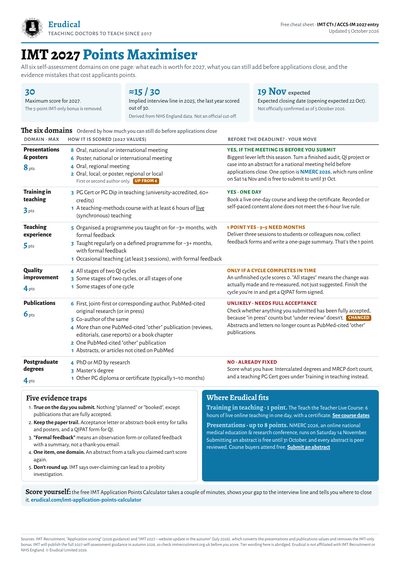
IMT training points are scored out of thirty, across six domains. Two things moved for 2027. Publications came down from 8 to 6. Presentations went up from 6 to 8. The five bonus points for applying only to IMT are gone.
Under the 2027 scale, a poster at a national meeting (6 points) is worth more than a PhD (4). Odd, but those are the rules.
Postgraduate degrees and qualifications
- 4PhD or MD by research
- 3Masters-level degree such as an MSc, MA or MRes, eight months or more full-time equivalent
- 1Another postgraduate diploma or certificate, roughly one to ten months
- 0None of these
Evidence · Certificate, or a letter from the awarding body.
Publications 2027: was 8
- 6First, joint-first or corresponding author of PubMed-cited original research, published or in press
- 5Co-author of PubMed-cited original research
- 4More than one other PubMed-cited publication: editorials, reviews, case reports
- 4One or more book chapters, not self-published
- 2One other PubMed-cited publication
- 1Abstracts, non-peer-reviewed articles, or articles not cited on PubMed
- 0None of these
Evidence · PubMed screenshot and link. If in press, the publisher's acceptance. For chapters: cover, contents page, author list and ISBN.
Presentations and posters 2027: was 6
- 8Oral presentation at a national or international meeting, as first or second author
- 6Poster at a national or international meeting
- 4Oral presentation at a regional meeting
- 2Oral presentation at a local meeting
- 2Poster at a regional or local meeting
- 0None of these
Evidence · Organiser's letter or certificate, the abstract-book listing, and the slides or poster.
Teaching experience
- 5Organised a teaching programme with local tutors and taught on it regularly for about three months or more, with formal feedback
- 3Taught regularly within a defined programme for about three months or more, with formal feedback
- 1Taught occasionally, with formal feedback from at least three sessions
- 0None of these
Evidence · Feedback summary, a letter on headed paper confirming your role, and the programme timetable.
Training in teaching
- 3PG Cert or PG Dip in teaching, university-accredited, 60 credits or more
- 1Training in teaching methods below that level, with at least six hours delivered live
- 0None of these
Evidence · Certificate, plus a course outline showing the hours and how it was delivered.
Quality improvement
- 4Every stage of two cycles of a QI project
- 3Some stages of two cycles, or every stage of one cycle
- 1Some stages of one cycle
- 0None of these
Evidence · QIPAT form, or a supervisor's document on headed paper.
Two rule changes that catch people
Abstracts and letters no longer count as PubMed-cited other publications. An abstract can still take the 1-point tier, unless it came from a presentation you're already claiming. The Medical Training (Prioritisation) Act applies at shortlisting and at offers. IMT Recruitment says it can't yet describe the effect, so we haven't tried to either.Source. IMT Recruitment: application scoring for 2027 recruitment, published 30 September 2026, checked 10 October 2026.
Where 8,728 people landed in 2025
2025 is the only recent round scored out of 30 with no bonus, which makes it the fairest comparison for 2027.
The mean was 13.75 and the median 14. Every score from 0 to 30 was used by somebody.
3,850 of those applicants were interviewed, which is 44 in every 100. The interview cut-off was 15.
Of the 3,850 who were interviewed, 89% were judged appointable.
2026, for context only
2026 was scored out of 35 because of the bonus, so it can't share an axis with anything here. 8,251 applications were considered, with a mean of 19.77 and a median of 21, and 3,754 were interviewed.Sources. NHS IMT recruitment: application score data, rounds 2013–2026; total score distributions, rounds 2013–2026.
IMT applications have quadrupled since 2019. Posts haven't moved.
In 2019, 2,105 applications were considered. In 2025 it was 8,728. Posts went from 1,597 to 1,677.
In 2019, 1,823 of those 2,105 applicants were interviewed. In 2025, 3,850 of 8,728 were.
| Round | Bar | Applications | Posts | Remark |
|---|---|---|---|---|
| 2013 | 2,639 | n/a | ||
| 2014 | 2,730 | 1,545 | ||
| 2015 | 2,495 | 1,609 | ||
| 2016 | 2,381 | 1,706 | ||
| 2017 | 2,217 | 1,716 | 89% of posts filled | |
| 2018 | 2,337 | 1,729 | 96% filled | |
| 2019 | 2,105 | 1,597 | Round 1 filled 75%; a Round 2 was needed | |
| 2020 | 2,714 | 1,635 | Last year with a Round 2 | |
| 2021 | 3,512 | 1,569 | ||
| 2022 | 3,939 | 1,640 | 99% filled | |
| 2023 | 4,292 | 1,686 | 100% filled · 3,642 interviewed | |
| 2024 | 6,174 | 1,698 | 100% filled · 3,682 interviewed | |
| 2025 | 8,728 | 1,677 | 100% filled · 3,850 interviewed | |
| 2026 | 8,251 | n/a | Scotland recruited separately · 3,754 interviewed |
Applications consideredPosts, same scalen/a: not in the source document for that year
We don't put scores from different years on one chart. Over the years the scale has been out of 64, 68, 58, 40, 35 and 30, and comparing them leads to bad advice.
Sources. NHS IMT recruitment: application score data, rounds 2013–2026. NHS IMT fill rates by region, 2014–2025 (posts, ACCS and IMT combined). NHS England competition ratios, 2025: 8,841 applications, 1,678 posts, ratio 5.27. No ratio has been published for 2026.
Where the 1,677 IMT posts were in 2025
London had 288 and Peninsula had 42. Every region filled every post. Nobody publishes applications by region, so there's no way to know which region is least competitive. Be wary of anyone who says otherwise. Hover over a region, or tap it, to see its posts.
up to 6061–9091–135136–200over 200
- London288
- Yorkshire and the Humber154
- East of England134
- Kent, Surrey and Sussex131
- Scotland117
- North West109
- West Midlands93
- East Midlands87
- Wales75
- North East75
- Mersey73
- Northern Ireland73
- Wessex66
- Thames Valley60
- Severn51
- Peninsula42
- ACCS posts, all regions49
- Total, every post filled1,677
Source. NHS IMT fill rates by region, 2014–2025. This document totals 1,677 posts, and NHS England's ratio document says 1,678. We print each beside the figures it came with. Region shapes are simplified.
Quick answers
IMT application points: common questions
How many points do you need for an IMT interview?
In 2025 the interview cut-off was 15 out of 30. 8,728 applications were considered and 3,850 candidates were interviewed, which is 44 in every 100. The 2027 cut-off will be set by the 2027 applicants, so treat 15 as the target.
What is the maximum IMT application score for 2027?
30 points across six domains: postgraduate degrees (4), publications (6), presentations and posters (8), teaching experience (5), training in teaching (3) and quality improvement (4).
What changed in IMT application scoring for 2027?
Publications fell from 8 points to 6. Presentations rose from 6 to 8. The five bonus points for applying only to IMT were removed. Abstracts and letters no longer count as PubMed-cited other publications.
Does the IMT application score count after the interview?
No. The self-assessment score only decides who is invited to interview. Offers are ranked on interview marks alone.
How competitive is IMT?
In 2025 there were 8,841 applications for 1,678 posts, a competition ratio of 5.27. Applications considered for shortlisting rose from 2,105 in 2019 to 8,728 in 2025, while posts stayed almost flat.
Is a Teach the Teacher course worth points for IMT?
Yes, 1 point under training in teaching, as long as the course includes at least six hours of live teaching. Every qualifying course earns the same single point. A PG Cert in teaching earns 3.
Is the review really free?
Yes. You'll get your review on screen and by email, and we'll send you IMT deadline reminders until applications close. Unsubscribe any time.
Sources
Sources and method
This tool is independent. It isn't affiliated with or endorsed by the NHS, NHS England or any deanery. The data comes from their published documents, credited here, and the calculations are ours.
Method. Your score is the sum of the highest tier you can evidence in each of the six domains. IMT Recruitment does not publish the interview cut-off, so we calculate it from their figures: 3,850 interviewed out of 8,728 applications considered, read against the published median of 14, puts the 2025 cut-off at 15. Last checked 21 September 2026.
Published by Erudical Limited, company no. 12733660, registered in England and Wales.
The source documents
- NHS IMT recruitment: application score data, rounds 2013–2026Applications considered, means, medians and the 2025 distribution chart.Download the PDF ↗
- NHS IMT recruitment: total score distributions, rounds 2013–2026Candidates fully assessed at interview and the appointable split.Download the PDF ↗
- NHS IMT fill rates by region, 2014–2025Posts by region and by year, and fill rates.Download the PDF ↗
- NHS England competition ratios, 20258,841 applications, 1,678 posts, ratio 5.27.Open the ratios page ↗
- IMT Recruitment: application scoring, and the IMT 2027 summary of changes (16 July 2026)Domain descriptors, evidence rules and the 2027 point conversions.Open the scoring guidance ↗
- IMT Recruitment: IMT 2027 summary of changesPublications 8 to 6, presentations 6 to 8, bonus removed.Open the summary ↗