Obstetrics and Gynaecology ST3 · 2027 criteria
Obstetrics and Gynaecology ST3 self-assessment 2027: points calculator and scoring guide
Pick the option that fits your evidence at each step to see your score out of 31, and what you can still add before the deadline.
Applications expected to close 4pm, Thu 10 Dec 2026Everything done and dated by 10am, Thu 19 Nov 2026
- 527 doctor reviews
- 4.7/5 rated for relevance
O&G ST3 points calculator
The O&G ST3 self-assessment has six domains and a maximum of 31, and it acts as a hurdle before it acts as a score: “You must achieve a minimum raw score of 18 out of 31 in the self-assessment stage to be eligible to proceed in the recruitment process.” Above that line, interview invitations follow “verified self-assessment score ranking and interview capacity”, and the verified score then makes up 20% of your final score, with each of the two interview stations worth 40%. The date to plan around comes earlier than you’d expect, because everything you claim must be finished, and its evidence dated, by the day the application window opens. For the August 2027 intake that’s expected to be 10am on Thursday 19 November 2026, the start of NHS England’s national Round 2, with the window shutting at 4pm on 10 December.
O&G ST3 verified self-assessment points at a glance
Your score is the total of the domain scores, out of a maximum of 31.
'Your verified self-assessment score will make up 20% of your final Obstetrics and Gynaecology ST3 score. You must achieve a minimum raw score of 18 out of 31 in the self-assessment stage to be eligible to proceed in the recruitment process.' Interviews: 'Interview station 1 total score represents 40% of the total score', and station 2 is the other 40%. Shortlisting: 'Eligible applicants will be invited to interview based on verified self-assessment score ranking and interview capacity.'
| Domain | What scores (official wording) | Max |
|---|---|---|
| Postgraduate Medical Qualifications |
Scores the single best option you can evidence, up to 5 points. Highest applicable statement only (0-5). There are two separate 3-point statements, and they don't add together. 'do not score the same qualification in more than one domain'. PG Certificates in Education score in Domain 4 only ('PG Certificates in Education may be scored under this Domain only'). | 5 |
| Quality improvement projects (QIP) |
Scores the single best option you can evidence, up to 6 points. Highest applicable statement only (0-6). Time-limited to 3 working years. The live page says 'November 2022 onwards, if you have been working full-time with no career breaks' (see open_questions). | 6 |
| Research |
Scores the single best option you can evidence, up to 6 points. Highest applicable statement only (0-6). No time limit ('For Domains 1, 3 and 4, there is no limit on the age of the evidence you provide'). | 6 |
| Teaching |
Scores the single best option you can evidence, up to 4 points. Highest applicable statement only (0-4). No time limit on evidence. A teaching course scores 2. A course can't take this domain above 2. | 4 |
| Academic publications |
Scores the single best option you can evidence, up to 5 points. Highest applicable statement only (0-5). Time-limited to 5 working years. 'Non PubMed indexed publications can only score under criteria score 1.' | 5 |
| Presentations and poster presentations |
Scores the single best option you can evidence, up to 5 points. Highest applicable statement only (0-5). There is no 2-point statement. Time-limited to 3 working years. | 5 |
| Total | 31 |
Dates for this round
- Evidence cut-off (everything completed and dated by the window OPENING date) expected source
- Applications open expected source
- Applications close expected source
- Date not published yet Self-assessment evidence upload window expected source
- Date not published yet Interviews expected source
What you can still add before 19 November 2026
What each of these adds is the difference between the option you would reach and the one you already hold, so it can be nothing if you hold that option already. The calculator works out the gain from your own answers.
- Quality improvement projects (QIP). If you already have a completed QIP, present it at a national meeting before the window opens (e.g. NMERC 2026 on 14 Nov 2026). One QIP then moves from 'presented locally/regionally' to 'presented nationally' (e.g. 1 -> 3, or 4/5 -> 6). Claim that presentation here, not in Domain 6. The talk on 14 Nov 2026 is before the expected window opening of 19 Nov 2026, and every claim must be 'fully completed by no later than the application window opening date'.
- Research. If you have already recruited participants or helped with data collection, complete a Good Clinical Practice (GCP) course so that you 'hold certified Good Clinical Practice (GCP)'. That takes you from 1 to 2. Start by 12 November 2026. The certificate must be dated no later than the application window opening date (expected 19 Nov 2026). This start date leaves a week's buffer.
- Teaching. Attend a Train-the-Trainers-type course and upload the certificate. Erudical's teach-the-teacher course qualifies as an equivalent: a live online day (09:00-17:00, '6 hours of live teaching with an expert') plus a separate self-paced course ('Over 12 hours of content included', 20 modules). Each has its own certificate. Choose a live date before the expected opening (19 Nov 2026). Keep teaching feedback to upload with the certificate. The certificate must be 'dated no later than the application window opening date' (expected 10am, 19 Nov 2026), so attend a live course date before then; an earlier date leaves more time for the certificate to arrive.
- Presentations and poster presentations. Submit an abstract (free) to NMERC 2026 at nmerc.org/submit and present it online on 14 Nov 2026. An oral meets the 5-point statement and a poster meets the 4-point one. Keep the final programme that names you, your slides or poster, the evidence letter and the abstract book. The presentation (14 Nov), the evidence letter and the abstract book (issued by 16:00 on 16 Nov) are all dated before the expected window opening of 19 Nov 2026.
Evidence traps
- The deadline is the day applications OPEN (expected 19 Nov 2026), not the day they close. Anything finished or dated after that is rejected.
Any item/activity claimed for in any Domain must have been fully completed by no later than the application window opening date and any evidence subsequently used to demonstrate a claimed item/activity must be dated no later than the application window opening date. Claims for future items/activity and resulting evidence dated after the application opening window will be rejected.
source - If you upload only the certificate, a teaching course claim can be marked down to informal teaching. Add an overview of the teaching you've delivered, with feedback.
Overview of lectures delivered, and feedback received – if you do not provide this, your score will be amended to informal teaching.
source - Conference abstracts don't count as publications. An abstract-book entry scores under Presentations, not Academic publications.
Do not include publication of a poster or an oral presentation abstract as these will not be counted as evidence.
source - A QIP presentation counts once: under Quality improvement projects or under Presentations, never both. Use it where it scores more.
QiP presentations may not normally be claimed under this Domain, however, if you have not been able to claim for a QiP presentation under Domain 2, providing you have the required evidence you may claim for it under this Domain instead. It may not be counted under both Domains.
source
Sources
- ST3 O&G self-assessment verification process: Domain breakdown (NHS England Medical Hub), Page last reviewed 8 September 2026. The content is identical to the Wayback copy of 10 Feb 2026 (2026 round), apart from the review date and the removal of the PDF scoring form. Every tier still shows 'Maximum number of pieces of evidence required: To be confirmed'.
- ST3 O&G self-assessment verification process: Overview, Page last reviewed 4 November 2025
- ST3 O&G self-assessment verification process: Evidence, Page last reviewed 11 September 2025
- ST3 O&G self-assessment verification process: Time limited domains, Page last reviewed 11 September 2025 (dates still set for the 2026 round)
- Self-assessment for ST3 Training (O&G), Page last reviewed 24 September 2026; refers to 'Round 2 (August 2027 intake)'
- Applying to ST3 Training (O&G), Page last reviewed 24 September 2026; refers to the '2027 National Recruitment round'
- Interviews (O&G ST3), including total scoring and appointability, Page last reviewed 11 September 2025 (2026 round)
- Recruitment timelines (O&G ST3), Shows the August 2026 intake only: 'Details of future rounds will be added once available.' Last reviewed 14 April 2026
- Recruitment timeline, Recruitment timelines for 2027, Round 2 (NHS England Medical Hub), 2027 Round 2 tab
- Obstetrics and Gynaecology ST3 2027 person specification, 2027 recruitment
- 2025 competition ratios (NHS England Medical Hub), 2025, Round 2 table: O&G ST3, 504 applications, 60 posts
- Wayback copy of the domain breakdown (2026 round), for year-on-year comparison, Snapshot 10 Feb 2026; page last reviewed 14 November 2023
- Erudical teach-the-teacher course page, Live page
- NMERC 2026 home, submit, programme, help and certificates pages (Erudical), Live pages
Gains to bank before the window opens on 19 November
Qualifications and publications are close to fixed, since a degree has to be fully completed and a paper accepted, with the letter dated, by the opening date. Three domains can still move. Teaching rises from informal teaching (1) to 2 with a Train the Trainers type course, or by 2 from a blank; Erudical’s live days before the expected opening are 24 October, 31 October, 7 November and 15 November, and an earlier one leaves time for the certificate to arrive. Presentations can jump furthest: an NMERC abstract delivered on Saturday 14 November scores 5 as an oral or 4 as a poster, so a doctor whose best is several local talks (3) gains 2 or 1, and one with a single departmental talk (1) gains 4 or 3. In Research, anyone who has already recruited participants or helped collect data moves from 1 to 2 by holding a Good Clinical Practice certificate, so start a GCP course by about 12 November to have it dated in time. In practice that means presenting on 14 November and finishing the course before the window opens on the 19th, since anything dated later is rejected.
How O&G checks what you claim
You choose “the most accurate statement” in each domain on Oriel, and only applicants at 18 or above who pass longlisting upload evidence, to the Qpercom portal in a fixed window (6 to 20 January in the 2026 round). Assessors can move a score up or down, evidence that’s missing or tagged to the wrong domain scores 0, and over-scoring by 5 or more starts a probity investigation that can leave you with an overall score of 0. Watch the time limits too: QIP and presentation evidence must fall within the last 3 working years and publications within 5, while qualifications, research and teaching have none.
Worked example: a clinical fellow three short of 18
This applicant is a clinical fellow with MRCOG Part 1, which doesn’t score in Domain 1. They’ve done two QIPs, one presented at a regional meeting, are a co-investigator on a multicentre study, and co-authored two PubMed-indexed papers. They teach medical students informally and have feedback for it, and they’ve given two departmental presentations on topics other than their QIPs. Scored on the published domain breakdown:
- Postgraduate medical qualifications: 0, because MRCOG is excluded.
- Quality improvement projects: 5, for “2 quality improvement projects, with at least one presented regionally”.
- Research: 3, for “Had ongoing commitment to research as a co-investigator or recruited a significant number of patients during the period of study”.
- Teaching: 1, for “Carried out informal teaching of colleagues, including nurses and medical students”.
- Academic publications: 3, as co-author of more than one PubMed-indexed postgraduate paper.
- Presentations and poster presentations: 3, for “Presented at a local meeting on more than one occasion”.
That’s 15 out of 31, below the minimum, so on these claims the application stops at longlisting. Finishing a teaching course before 19 November puts Teaching up one, to 2, because the course counts as an equivalent, provided the teaching feedback goes in with the certificate. Giving a talk at NMERC on 14 November about work outside the QIPs moves Presentations from 3 to 5, a gain of 2. The total becomes 18, exactly the published minimum, which gets the application to verification without promising an interview. With a poster instead of a talk, Presentations would reach 4 and the total 17. Presenting the regional QIP at NMERC is the other route, claimed in Domain 2, where it lifts QIP from 5 to 6.
Answer each of the six domains with what your evidence proves, and the calculator totals your score out of 31, shows how far it sits from 18, and lists the gain from anything you can finish before the window opens. We’ll show your result and email you a copy.
Go to the O&G ST3 calculator at the top of this page
Get the O&G ST3 table as a one-page PDF, plus a heads-up if O&G revises its domain breakdown, by leaving your email.
Email me the printable version
Check your inbox. Your printable cheat sheet is on its way to .
While you wait, work out your score with the calculator. If the email isn't there in a few minutes, check your junk folder.
Does a teach the teacher course count for O&G ST3?
Yes. The Erudical course qualifies in Domain 4, Teaching, as an equivalent under “Attended a Train the Trainers course, Generic Instructors course (GIC) or equivalent”, which is worth 2 of the domain’s 4. The statement sets no minimum length, provider or live hours. The course adds 0 if you already hold that tier or higher, which covers organising PROMPT or another multidisciplinary programme (3) and a PG Certificate in medical education (4). From informal teaching it adds 1, and from nothing it adds 2. Two evidence rules decide whether the 2 survives verification. The certificate must be dated no later than the window opening date, so finish the course before 19 November. And Domain 4 uses one evidence list for every statement, including this warning: “Overview of lectures delivered, and feedback received – if you do not provide this, your score will be amended to informal teaching.” So upload feedback from teaching you’ve delivered alongside the course certificate. Erudical’s teach the teacher course combines one live online teaching day (09:00 to 17:00) with a self-paced course, and you get a certificate for each. Our page on how teaching courses score in other specialties compares O&G with the rest.
NMERC on 14 November, five days before O&G opens
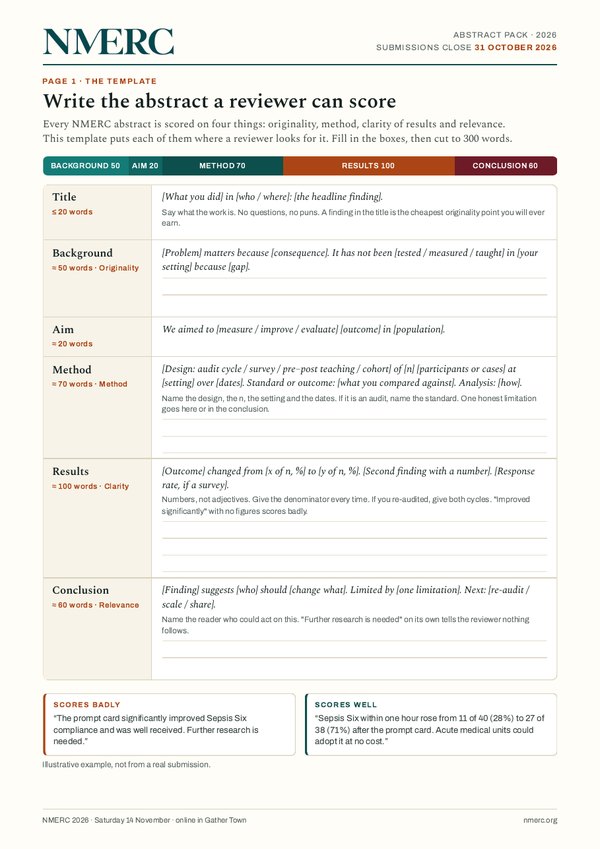
NMERC is held on Saturday 14 November 2026, online in Gather Town. It costs nothing to present, and any doctor or medical student may submit regardless of where they’re based. Abstracts can be submitted at nmerc.org/submit. Presenters get their evidence letter, certificate and the abstract book by 16:00 on Monday 16 November, which keeps every document dated before the expected 19 November opening. An oral meets “Delivered an oral presentation at a regional, national or international meeting” (5, the domain maximum) and a poster meets “Delivered a Poster presentation at a regional, national or international meeting” (4); your gain is that figure minus your current Domain 6 score. For evidence, O&G wants a programme page “naming you as a presenter” and “a copy of the presentation material”; the NMERC programme lists each presenting author by name, and both the letter and the abstract book give every co-author in author order. A QIP can be presented instead and claimed in Domain 2 as presented nationally, taking a single QIP to 3 or a pair to 6, but “It may not be counted under both Domains.” O&G hasn’t confirmed its own 2027 opening date yet, and this timing relies on the expected Round 2 date. Your own abstract talk can’t double as teaching, since the guidance says “Do not include presenting a QIP project as teaching, nor presenting own research at a meeting.” An abstract may not be accepted.
Teaching you deliver is what the higher Domain 4 statements reward, and Erudical is always keen to hear from doctors who want to teach its online course. NMERC and Erudical roles may qualify. See the NMERC and Erudical websites and contact us for details.
What O&G ST3 applicants ask
What’s the minimum O&G ST3 self-assessment score?
At least 18 out of 31, both when you self-score and after verification: “Self scoring below 18 marks will result in your application being longlisted out”, and anyone who falls below it after verification and appeals is longlisted out too. Reaching 18 makes you eligible, and interview places then go by verified score ranking and capacity. In the 2025 Round 2 there were 504 applications for 60 O&G ST3 posts, a ratio of 8.40.
What does a national presentation score for O&G ST3?
A talk given at a regional, national or international meeting earns the domain’s top mark of 5, and a poster earns 4. Local talks score 3 if you’ve given more than one and 1 for a single one, and there’s no 2-point statement. Presentations must come from the last 3 working years, and a QIP presentation normally belongs in Domain 2 instead.
When is the O&G ST3 self-assessment deadline for 2027?
The day applications open, expected at 10am on 19 November 2026 for the August 2027 intake. The guidance says “Any item/activity claimed for in any Domain must have been fully completed by no later than the application window opening date”, and evidence dated later is rejected. The O&G timeline page hasn’t added 2027 dates yet, so the expected date comes from the national Round 2 timeline, which O&G matched exactly in 2026.