There is no single “teaching qualification” for UK doctors. There is a ladder, and most doctors only need the bottom rung. A one-day teaching-methods course scores the training-in-teaching point on a specialty application. A university PGCert scores more, costs roughly twenty times as much and takes a year or more.
This page sets out every rung — short course, PGCert, PGDip, MSc, Advance HE Fellowship and recognised trainer status — what each one actually is, what it costs, and what it does and does not score. Figures checked against the awarding bodies on 21 September 2026.
The ladder at a glance
| Rung | What it actually is | Typical time | Typical cost | IMT / PHST self-assessment |
|---|---|---|---|---|
| Teaching-methods course (Teach the Teacher / Train the Trainer) | A short course below PGCert level, usually one live day, often with self-paced material | 1 day, plus any self-study | £130–£610 | 1 point |
| PGCert in medical or clinical education | University accredited, 60 credits at level 7 | 1–2 years part-time | £4,400–£5,700 | 3 points |
| PGDip | 120 credits at level 7 | About 2 years part-time | Roughly two 60-credit blocks | 3 points |
| MSc / MMedEd | 180 credits at level 7 | About 3 years part-time | Roughly three 60-credit blocks | 3 points (already met at PGCert) |
| Advance HE Fellowship (AFHEA, FHEA, SFHEA, PFHEA) | Professional recognition against the PSF 2023, not a credit-bearing award | Varies; portfolio submission | £155–£1,130 by direct application | Not a match for the 3-point tier on its own |
| Recognised trainer | Role-based recognition for named supervisors, conferred locally | Once you hold the role | Usually employer-funded | Not scored as a teaching qualification |
Point values are the Internal Medicine Training and Physician Higher Specialty Training self-assessment tiers for 2026 recruitment. Other specialties score teaching differently — see teaching points for every specialty.
Rung 1: a teaching-methods course
This is what “Teach the Teacher” and “Train the Trainer” courses are. They are not qualifications in the academic sense and they carry no university credit. What they carry is a dated certificate showing that you were trained in how to teach, which is exactly what the self-assessment asks for at the one-point tier.
IMT’s wording for that tier is: “I have had training in teaching methods which is below the level of a PG Cert or PG Diploma.” Two conditions sit underneath it, and both catch people out:
See how a teaching qualification fits into your total IMT score. Calculate My Score →
- It must be additional to your medical degree. IMT: “This should be additional to any training received as part of your primary medical qualification.” The teaching you did as a medical student does not count.
- It must contain at least six hours of live teaching. IMT: “Training should be delivered with a duration of at least six hours (i.e. a one-day course) of synchronous (live) teaching time.” A self-paced online course, however long, does not meet this on its own.
- It must be about teaching. IMT: “Training can only be included in this section if it was specifically focused on teaching.” A clinical skills course or a leadership course does not count here, whatever its length.
Physician Higher Specialty Training uses word-for-word the same tiers and the same six-hour rule.
What a course costs
Prices run from £130 to £610, and what separates them is format rather than quality. At the cheap end, The Clinicians’ RoadMap is £150, or £130 with code ROADMAP20, for a one-day live online course. In the middle, Erudical is £199 for an 8-hour live day containing 6 hours of live teaching, 20 self-paced modules and a place at the NMERC 2026 conference. At the top, the Royal College of Physicians runs a two-day workshop at £610 in person or £540 online for non-members.
Seven other UK providers sit between them. All ten, with live teaching hours, CPD hours and what each price actually includes, are compared on Teach the Teacher courses compared.
Prices checked on each provider’s own page, 21 September 2026. They change; check before booking.
Rung 2: a PGCert in medical education
A PGCert is a real university award: 60 credits at level 7, the same framework as any other postgraduate certificate. It is the first tier that scores three points rather than one, and the self-assessment is specific about what qualifies. IMT: “For a qualification to count, it must be a university accredited programme, the eligibility criteria must specify that only graduate entrants can apply, and be worth an equivalent of least 60 credit points or equivalent.”
Published 2026/27 fees for UK applicants, part-time and mostly online:
| Provider | Fee | Duration | Mode |
|---|---|---|---|
| Keele — Clinical Education PgCert | £4,400 (2026/27) | 1 year | Online, part-time |
| Cardiff — Medical Education PGCert | £4,700 (2026/27) | 1 year | Part-time distance learning |
| Dundee — Medical Education PGCert | £4,636 per 60 credits | Up to 24 months | Online |
| Edinburgh — Clinical Education | £5,700 per year (2026/27) | Not stated per award | Online |
Edinburgh publishes one fee covering the MSc, PgDip and PgCert together rather than a separate PgCert figure. Dundee’s fee page states the amount per 60 credits without naming an academic year. Checked 21 September 2026.
When a PGCert is the right answer. If you intend to build a career in medical education — a training programme director post, a university teaching role, a medical school appointment — a PGCert is the credential that opens those doors and a short course is not. It is also the right answer if you are applying to a specialty that weights higher qualifications heavily: Oral and Maxillofacial Surgery ST1, for instance, scores a PGCert in education but gives a short teaching course nothing for 2027, and Histopathology ST1 scores a PGCert or PGDip at 3 against 1–2 for a short course.
When it is not. If the immediate objective is the training-in-teaching point on one application, a PGCert buys you two extra points for roughly £4,500 and a year. That is a reasonable thing to want and a poor way to buy points.
Rung 3: PGDip and MSc
A PGDip is 120 credits and a taught Master’s is 180, so a PGCert, PGDip and MSc are usually the same programme taken to different depths — you exit at the point you choose. On Dundee’s published rate of £4,636 per 60 credits, that is roughly two blocks for a PGDip and three for an MSc.
For recruitment scoring, note that the extra credits usually buy nothing: IMT and PHST award three points for “a PG Cert or PG Diploma”, and there is no higher tier above it. Two specialties do differentiate further — Clinical Radiology ST3 scores a three-year Master’s at 6 against 5 for a PGCert or PGDip, and Histopathology ST1 scores a Master’s at 5 against 3. Everywhere else, the PGCert is where the scoring stops.
Rung 4: Advance HE Fellowship
Fellowship is a different kind of thing from the rungs above it. Advance HE describes it as “professional recognition for teaching excellence in higher education”, awarded “based on evidence of personal professional practice that meets the requirements of the Professional Standards Framework 2023 (PSF 2023)”. There are four categories, in ascending order: Associate Fellow (AFHEA), Fellow (FHEA), Senior Fellow (SFHEA) and Principal Fellow (PFHEA).
There are two routes. You can gain it automatically by completing an accredited programme at an institution — many PGCerts in medical education are accredited this way, so you finish with both. Or you can apply directly to Advance HE with a peer-reviewed account of your practice and a referee. Direct application fees, from Advance HE’s own fee table:
| Category | Direct, member institution | Direct, non-member |
|---|---|---|
| Associate Fellow | £155 | £310 |
| Fellow | £225 | £450 |
| Senior Fellow | £335 | £670 |
| Principal Fellow | £565 | £1,130 |
What it scores. Fellowship gained by direct application carries no university credit, so it does not meet the three-point criterion, which requires a university accredited programme worth the equivalent of at least 60 credit points. Fellowship gained through an accredited PGCert scores because the PGCert scores. Advance HE does not itself describe Fellowship as a qualification or a degree; it describes it as recognition. If Fellowship is the only teaching credential you hold, ask the recruitment office how they will score it rather than assuming.
Rung 5: recognised trainer status
This one is widely misunderstood, so it is worth stating precisely. The GMC sets the criteria for trainer recognition and covers four roles: named educational supervisors, named clinical supervisors, those responsible for overseeing students’ progress at each medical school, and lead coordinators at each local education provider.
But the GMC’s own current position is that it does not approve most of them: “Under the Medical Act, we can approve and publish a list of GP trainers.” and “We don’t currently approve specialty, foundation and undergraduate trainers, but we have a process to recognise these trainers. This is a local process that involves postgraduate training organisations, local offices and medical schools making sure trainers meet the required criteria.”
Recognition is assessed against seven areas drawn from the Academy of Medical Educators’ professional standards, covering safe and effective patient care through training, establishing an environment for learning, teaching and facilitating learning, assessment, supporting educational progress, guiding professional development, and the trainer’s own continuing development as an educator. In practice you acquire it when you take on a supervisory role, through your employer — it is not something you buy, and it is not a self-assessment scoring item.
So which rung do you need?
- You are applying to a specialty this year and want the teaching point. Rung 1. Take a course with at least six hours of live teaching, get the certificate, cite it. Anything further is a career decision, not an application decision.
- You are applying to a specialty that scores higher qualifications separately — OMFS ST1, Histopathology ST1, Clinical Radiology ST3. Check the tiers on the points-by-specialty table before deciding; a PGCert may genuinely be worth it.
- You want a career in medical education. Rung 2, then 3 if you want it. Pick a programme that is Advance HE accredited so the Fellowship comes with it.
- You have been asked to supervise trainees. Rung 5, through your trust or deanery. Do rung 1 as well if you have not already — continuing development as an educator is one of the seven areas.
- You need CPD evidence for appraisal. Any of them. The GMC sets no minimum: “We do not mandate the number of CPD points you should collect for revalidation because your CPD activities need to be tailored to your scope of practice and needs.” What matters at appraisal is the reflection, not the hours.
Where Erudical sits on the ladder
Erudical is a rung-one course, and it is built to the rung-one criterion rather than around it. Enrolment is £199 and includes an 8-hour live day containing 6 hours of live teaching — the IMT and PHST minimum — plus 20 self-paced modules worth over 12 hours, three marked assignments, and a place at the NMERC 2026 conference. It is accredited by The CPD Certification Service, provider number 13684, for up to 24 CPD hours in total.
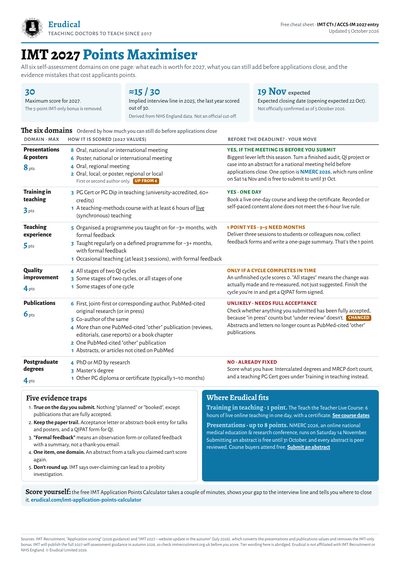
The conference place is why the arithmetic differs from every other course on the list. Training in teaching and presentations are two separate domains in the IMT self-assessment, so they add. The course scores 1 point for training in teaching, and a national oral presentation scores up to 8 points under the published IMT 2027 conversion. That is 1 for the course plus up to 8 for a national oral presentation, so up to 9 of the IMT 2027 self-assessment points for £199. On the published 2026 tiers the same two domains total up to 7. See how presentation points are scored for the conditions, which are real: the presentation has to be accepted, and it has to have happened before you submit.
If the teaching point is not accepted, the fee is refunded in full under the points guarantee — money back within 14 working days, and no claim has been made in eight years and more than a thousand doctors.
£199 for the course, the modules and a place at NMERC 2026
Six hours of live teaching, the IMT and PHST minimum. Points accepted or your money back.
Frequently asked questions
Do I need a PGCert in medical education as a UK doctor?
Not for the training-in-teaching point on a specialty application. IMT and PHST award 1 point for a course below PGCert level with at least six hours of live teaching, and 3 points for a PGCert or PGDip. A PGCert costs roughly £4,400–£5,700 and takes a year or more, so it buys two extra points at a very high price per point. It is the right choice if you want a career in medical education, a university teaching role, or if you are applying to a specialty that scores higher qualifications separately, such as Oral and Maxillofacial Surgery ST1 or Histopathology ST1.
What is the cheapest teaching qualification for a doctor?
A short teaching-methods course. Prices on 21 September 2026 ranged from £130 (The Clinicians’ RoadMap with code ROADMAP20) to £610 (Royal College of Physicians, in person). Erudical is £199 and includes a place at the NMERC 2026 conference, which no other course on that list includes. Cheapest and best value are different questions: what you are buying is a certificate that satisfies a published criterion, so check the live teaching hours before you check the price.
How many credits is a PGCert?
60 credits at FHEQ level 7, under the QAA’s higher education credit framework. A PGDip is 120 and a taught Master’s is 180. IMT’s three-point tier asks for a programme “worth an equivalent of least 60 credit points or equivalent”, which a PGCert meets and a short course does not.
Does FHEA count as a teaching qualification for IMT?
Not on its own at the three-point tier. IMT requires a university accredited programme, restricted to graduate entrants, worth at least 60 credit points. Advance HE Fellowship gained by direct application is professional recognition against the Professional Standards Framework 2023 and carries no university credit. Fellowship gained through an Advance HE accredited PGCert does score, because the PGCert does. If Fellowship is your only teaching credential, ask the recruitment office how they will treat it.
Does a self-paced online teaching course count for IMT?
Not on its own. IMT requires “at least six hours (i.e. a one-day course) of synchronous (live) teaching time”. Self-paced modules can sit alongside a live day and add CPD hours and depth, but the live component is what satisfies the criterion. This is the single most common reason a teaching certificate is not accepted.
Is the GMC’s recognised trainer status a teaching qualification?
No. It is role-based recognition for named clinical and educational supervisors and two undergraduate roles, assessed against seven areas from the Academy of Medical Educators’ standards. The GMC states that it approves and publishes a list of GP trainers only, and that for specialty, foundation and undergraduate trainers recognition is “a local process that involves postgraduate training organisations, local offices and medical schools”. You acquire it with the role, through your employer. It is not a scored item in a self-assessment.
How much CPD does my appraisal actually require?
No fixed amount. The GMC’s own wording is: “We don’t require you to be a member of a college or faculty CPD scheme, to undertake a specific number of hours of CPD each year or to acquire a particular number of CPD credits.” What is required is that you carry out CPD every year, that it covers your whole scope of practice, and that you reflect on it. This is the opposite of a recruitment self-assessment, which awards points against fixed, countable thresholds. The two are not the same currency.
Which teaching qualification scores most on an IMT application?
A PGCert, PGDip, MSc or MMedEd, all at 3 points — the scoring stops at PGCert level, so a Master’s scores the same as a PGCert for IMT. A short teaching-methods course scores 1. Teaching experience is scored in a separate domain worth up to 5, and it requires evidence of formal feedback. The two teaching domains add together, and so do presentations, which are worth up to 8 for a national oral under the IMT 2027 conversion.
Next: what a teaching course scores in your specialty, how presentation points work, or the nine providers compared.
Sources: IMT Recruitment — application scoring · PHST Recruitment — application scoring · Advance HE Fellowship · GMC — approval of trainers · QAA credit framework
Checked against IMT Recruitment, PHST Recruitment, the GMC, Advance HE, the QAA credit framework and each provider’s own fee page on 21 September 2026. IMT’s scoring page states that it “pertains to 2026 recruitment and will be updated for the 2027 recruitment year in the autumn of 2026”; we will update this page when it is.