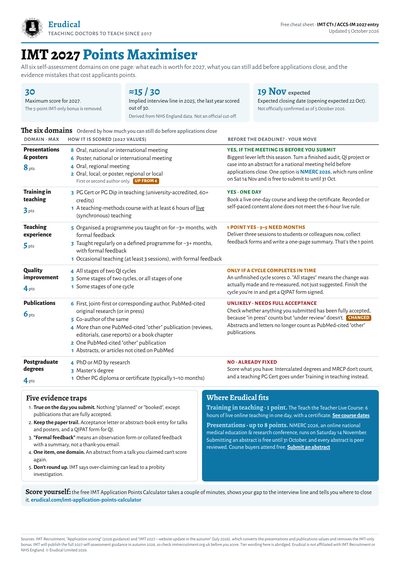
To get a national presentation for IMT, take finished work with new data (an audit, a QI project, research or an unusual case), submit an abstract to a meeting open to anyone in your UK nation, and present it before applications close. It is the biggest single score on the IMT 2027 application: up to 8 for an oral and up to 6 for a poster.
This guide covers what counts as national, where foundation doctors can present, how to time it and the evidence to keep. For the full scoring table, see how presentations are scored for IMT and ST3.
Abstract ready? Submit it to NMERC 2026 → Free to submit, oral or poster, closes 31 October 2026.
What counts as a national presentation for IMT
What makes a meeting national is who is allowed to take part, not how many people turn up. IMT’s definition, from its application scoring guidance:
“National meetings must be open to anyone in the country and international meetings must be open to anyone from a range of countries. For the purposes of scoring in this section, the home UK nations will be treated as separate nations.”
So a Scotland-wide or Wales-wide meeting counts as national, and a deanery teaching day or a trust audit meeting is regional or local, whatever it calls itself. IMT’s guidance adds five conditions:
- It must be a medical meeting: generally doctors or other healthcare professionals attending, away from their normal workplace, for professional development.
- It must report new data: research, a complex case or a quality improvement project. A presentation that mainly teaches does not count.
- You must be first or second author. For a poster you need not present it yourself, but there must have been a defined opportunity for discussion at the meeting.
- The meeting must publish its abstracts. National and international meetings should have a document listing the abstracts presented. IMT says national claims without one cannot be claimed.
- You must not have paid to present. If you presented only because you paid a fee, the presentation scores 0.
Six steps to a national presentation
- Pick work that has a result. A completed QI cycle, an audit with data, a research project or an unusual case. Agree authorship with the team before you write, so that you are first or second author.
- Choose a meeting open to anyone in your nation. On the call for abstracts, check who can submit, the deadline, whether an abstract book is published, and whether work presented elsewhere is accepted.
- Write the abstract to the meeting’s format. Usually background, method, results and conclusion, within a word limit. State the result in numbers and say who should act on it.
- Submit early and track the decision. Many meetings close for abstracts months before they run. Meetings that decide on a rolling basis give you time to rework a rejected abstract and try again.
- Present it before your application closes. Acceptance alone does not count. An oral is a timed talk with questions; a poster means being at your board during the discussion sessions.
- Collect the evidence that week. The organiser’s letter or certificate, the abstract-book listing, and your abstract and slides or poster.
Where foundation doctors can present nationally
Most routes run once a year, so the call for abstracts matters more than the date of the meeting. These are the main options open to foundation doctors.
| Route | Who can submit | What to check |
|---|---|---|
| National specialty society meetings, such as those of the Society for Acute Medicine, the British Geriatrics Society or the British Thoracic Society | Usually trainees as well as consultants; varies by society | The abstract deadline, any membership requirement, and whether an abstract book is published |
| The UK Foundation Programme’s National Foundation Doctors Presentation Day | Current foundation doctors | That year’s eligibility, submission window and format; selection is competitive |
| National trainee and student-run conferences | Varies | That the meeting is open to anyone in your nation and publishes its abstracts |
| NMERC 2026, the National Medical Education & Research Conference | Doctors in training: foundation doctors and core or specialty trainees | Free to submit; closes 31 October 2026; online on Saturday 14 November 2026 |
Timing: work back from the closing date
IMT’s rule on timing is strict: “An achievement gained even on the day after the closing date for applications cannot be counted.” The presentation has to have been given when you submit. You can amend your application while the window is open, so a presentation given during the window can be added before it closes.
IMT has not yet officially published the 2027 application window. In the 2026 round, applications closed on 20 November at 16:00. Confirm this year’s closing date on the IMT Recruitment website.
If you are applying next year, there is less pressure: IMT counts achievements gained after you started your medical degree, so a presentation given in FY1 can go on the application you make in FY2. Our IMT portfolio plan for FY1 doctors shows where it fits.
One option: NMERC 2026
NMERC 2026, the National Medical Education & Research Conference, is organised by Erudical and runs online on Saturday 14 November 2026. It is timed so that a presentation given there has happened before IMT applications are expected to close.
- Who can submit: doctors in training, meaning foundation doctors and core or specialty trainees, wherever they trained or work. There is no membership requirement.
- Cost: submission is free, to either track, whether or not you attend. Attending costs £149, and is free for anyone who has taken the Erudical course.
- Deadline: 31 October 2026. Decisions are rolling, within five days of submitting, so an abstract that comes back short can be reworked and resubmitted before the deadline.
- Two tracks: oral slots are limited and selected on score; posters are accepted if they meet the published standard. Acceptance is not guaranteed on either.
- Evidence: a confirmatory letter signed by the conference chair, a certificate, and an abstract book listing every accepted oral presentation and poster, issued by 16 November 2026 at 16:00.
- One rule to note: work submitted to NMERC should not have been presented at another conference.
Submit an abstract to NMERC 2026
Free, oral or poster. Closes 31 October 2026, with a decision within five days.
Writing an abstract that gets accepted
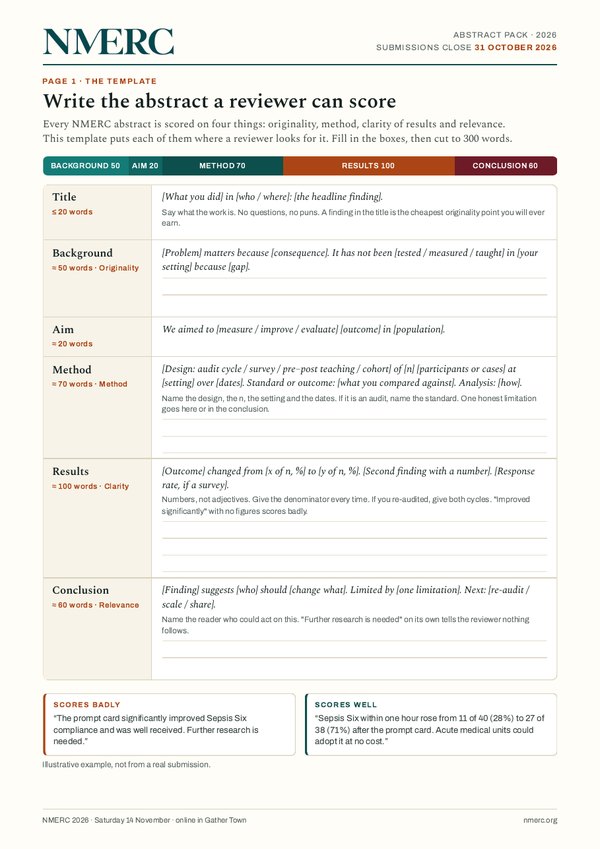
Most meetings mark abstracts on the same few questions. NMERC publishes its abstract rubric in full, and its four axes are a useful check for any meeting:
- Originality: say what your work adds, even if it is an established question tested in a new setting.
- Method: state the design, sample and setting, and name the limits instead of hiding them.
- Clarity of results: give the finding in numbers or plain terms, with enough context to judge whether it is large or small.
- Relevance: say who should change what they teach or do as a result.
Give the abstract a title that says what the work is. It needs to be clear and honest about what you did, not finished to journal standard.
Presentation points are one part of a 30-point score. Calculate My Score → Add up all six domains and see where you stand against the 2025 cut-off of 15.
Frequently asked questions
How long before the IMT deadline should I submit an abstract?
Work back from the meeting, not from the IMT deadline. Many national meetings close for abstracts months before they run, and the presentation itself must have happened before IMT applications close. If you are applying this autumn, look for meetings that run before the closing date: NMERC 2026 takes abstracts until 31 October and runs on 14 November.
Can foundation doctors present at national conferences?
Yes. Many national specialty meetings accept abstracts from foundation doctors, the UK Foundation Programme runs a national presentation day for current foundation doctors, and NMERC 2026 accepts abstracts from foundation doctors and core or specialty trainees.
Does an online conference count as national for IMT?
IMT’s guidance defines a national meeting by who can take part, not by the venue, and does not address online meetings directly. It describes presentations as attended live by an audience. Check that the meeting is open to anyone in your UK nation and publishes its abstracts.
Can I claim an abstract that has been accepted but not yet presented?
No. A presentation counts once it has been given. IMT says presentations not yet given should not be included, and an achievement gained the day after the closing date cannot be counted.
Does being second author count?
Yes. First and second authors can both claim a presentation; third author cannot. For a poster you need not have presented it yourself, but there must have been a defined opportunity for discussion at the meeting.
Can I present the same work at two conferences?
It adds nothing to your score, because IMT scores your single highest presentation. Some meetings, NMERC included, do not accept work that has already been presented elsewhere, so check before you submit.
Last checked against IMT Recruitment’s application scoring guidance (2027 values, published 30 September 2026): 8 October 2026.
Related: IMT presentation points, IMT portfolio plan for FY1 doctors, NMERC letters and certificates and the IMT application points calculator.