Physician Higher Specialty Training (PHST) ST3/ST4 · Latest published criteria
Physician Higher Specialty Training (PHST) ST3/ST4 self-assessment 2027: points calculator and scoring guide
Pick the option that fits your evidence at each step to see your score out of 38, and what you can still add before the deadline.
Applications expected to close 4pm, Thu 10 Dec 2026
- 527 doctor reviews
- 4.7/5 rated for relevance
PHST ST3 points calculator
The PHST self-assessment gives up to 38 points across seven domains, and evidence that’s well organised earns a further 2, so your application score is out of 40 and makes up 20 of the 100 marks used to rank you after interview. The values here are PHST’s 2026 matrix, which was still the live version on 10 October 2026; PHST has said its 2027 update will leave the process “largely unchanged”. Applications for ST3 and ST4 posts starting between August and December 2027 are expected to open at 10am on Thursday 19 November 2026 and close at 4pm on Thursday 10 December 2026, and you upload evidence after the close in each specialty’s own window.
PHST ST3 self-assessment points at a glance
Your score is the total of the domain scores, out of a maximum of 38.
"There are 38 points available across the domains." plus "a further two marks available for evidence which is organised satisfactorily". Every PSRO specialty page: "Application score / 40 | 0.5 | / 20" of "Total score / 100" (20% of the ranking score; interview 80%). Commitment to specialty, where used at shortlisting: "20/60 (33%) of the marks available at the shortlisting stage", not carried into the final score.
| Domain | What scores (official wording) | Max |
|---|---|---|
| Postgraduate degrees and qualifications |
Scores the single best option you can evidence, up to 4 points. Single best option only: "If you have more than one achievement in an area which only allows you to choose an option for one, you should select the option corresponding to your highest scoring achievement." There is no 2-point option. | 4 |
| MRCP(UK) |
Scores the single best option you can evidence, up to 8 points. Alternatives: "Where you have an alternative UK specialty examination which is specified on the person specification, you can substitute the MRCP(UK) with the corresponding examination for that specialty." Irish BST + MRCPI or GIM specialist-register eligibility: "you should select the top option if you have fully completed this at time of application." | 8 |
| Presentations / posters |
Scores the single best option you can evidence, up to 6 points. One option only (highest achievement). National definition: "International/national meetings should involve a document listing the abstracts of the presentations and posters included at that meeting. National meetings must be open to anyone in the country and international meetings must be open to anyone from a range of countries. For the purposes of scoring in this section, the home UK nations will be treated as separate nations." | 6 |
| Publications |
Scores the single best option you can evidence, up to 8 points. One option only. 'In press' counts: "an exception is publications which have been completely accepted and are 'in press'." Submitted articles do not: "Submitted article - this cannot gain any marks at the short-listing stage". | 8 |
| Teaching experience |
Scores the single best option you can evidence, up to 5 points. Without feedback nothing scores: "If your teaching experience does not have evidence of feedback, you will only be able to choose the 'none/other' option". | 5 |
| Training in teaching |
Scores the single best option you can evidence, up to 3 points. No 2-point tier: below a 60-credit PG Cert the maximum is 1, however many courses you have done. | 3 |
| Quality improvement |
Scores the single best option you can evidence, up to 4 points. "If you have been involved in a long-running multi-cycle project, you can only claim points based on the cycles in which you were directly involved." and "If your project has not yet completed a single cycle, you can only select the 'none/other' option." | 4 |
| Total | 38 |
Dates for this round
- 2027 ST3/ST4 round (PHST round 1, posts Aug–Dec 2027): applications open — Medical Hub pan-specialty date; PHST's own 2027 timeline not yet published expected source
- 2027 ST3/ST4 round: applications close (latest point to have completed anything you claim on the form) expected source
- 2027 ST3/ST4 round: interview window opens source
- 2027 ST3/ST4 round: interview window closes source
- 2027 ST3/ST4 round: initial offers released by source
- PHST alignment note: PHST expects its 2027 timeline to mirror the pan-specialty dates expected source
- Following round (PHST round 2, posts Jan–Mar 2028): applications open source
- Following round (PHST round 2, posts Jan–Mar 2028): applications close source
What you can still add before 10 December 2026
What each of these adds is the difference between the option you would reach and the one you already hold, so it can be nothing if you hold that option already. The calculator works out the gain from your own answers.
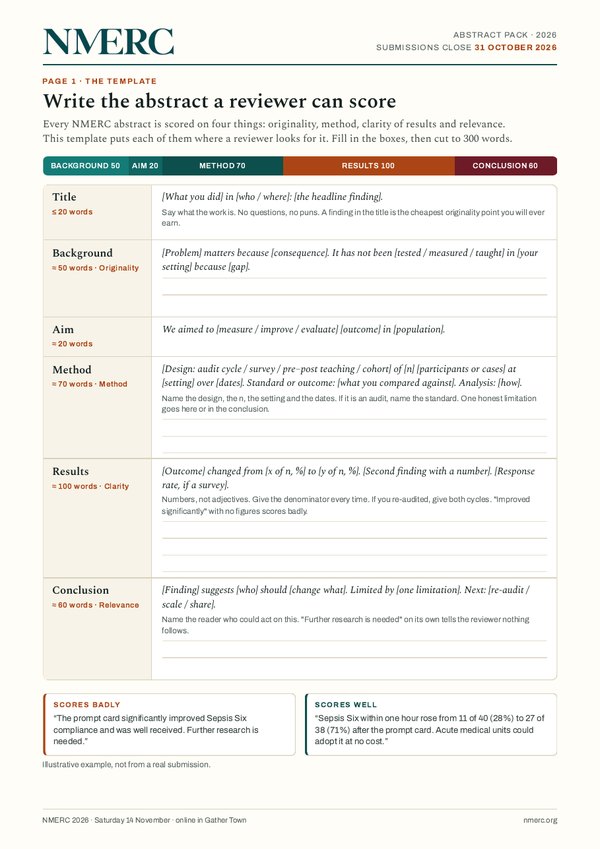
- Presentations / posters. Submit an abstract of original research, a QI project or a complex case to a national meeting that is held, and publishes an abstract list, before the 2027 application closes (expected 10 Dec 2026). NMERC 2026 (online, 14 Nov 2026, free to submit at nmerc.org/submit) fits this window if the abstract is accepted. Gets you to: National/international poster, 1st or 2nd author. The NMERC 2026 presentation (Sat 14 Nov 2026) is delivered before the expected 2027 opening (19 Nov 2026) and closing (10 Dec 2026) dates. "presentations not yet given, etc. should not be included at this point."
- Teaching experience. The 1-point tier only: deliver at least three teaching sessions to students or healthcare professionals and collect formal feedback (feedback forms with a summary, or a Developing the Clinical Teacher/Teaching Observation form). The 3- and 5-point tiers need about three months, which cannot be completed before the expected 10 Dec 2026 close. Gets you to: Occasional teaching (3+ sessions) with feedback. Start by 19 November 2026. Practical latest start so three sessions with feedback are complete before the expected 10 Dec 2026 close; only sessions already delivered go on the form. Sessions delivered after you submit can still count at the evidence stage: PHST says "if an achievement is gained between the submission of the application form and the deadline for loading evidence for that specialty, you are permitted to load evidence and can be scored accordingly".
- Training in teaching. Attend a live, one-day teaching-methods course with at least six hours of synchronous teaching and keep the certificate plus a course outline showing duration and live delivery. Gets you to: Teaching-methods training below PG Cert (6+ h live). Attend a live course date before you submit (applications are expected to close at 4pm on 10 Dec 2026). "courses not yet taken ... should not be included at this point." If you attend after submitting, PHST also says "if an achievement is gained between the submission of the application form and the deadline for loading evidence for that specialty, you are permitted to load evidence and can be scored accordingly".
- Quality improvement. 1-point tier only, and only realistically: take on two or more aspects (e.g. data collection and analysis) of a single QI cycle that completes before submission, with a QIPAT or supervisor letter. Two full cycles in ~8 weeks is unlikely. Gets you to: Participating in QI activity. Start by 17 October 2026. A full cycle (plan, data, analysis, change) needs most of the ~8 weeks to the expected 10 Dec 2026 close; this is a practical estimate, not a published date.
Evidence traps
- Self-paced hours don't count toward the six-hour minimum for the training-in-teaching point. Only live, synchronous teaching time counts.
Training should be delivered with a duration of at least six hours (i.e. a one-day course) of synchronous (live) teaching time.
source - Teaching without formal feedback scores zero, however much of it you did. Attending a course doesn't score in Teaching experience either.
If your teaching experience does not have evidence of feedback, you will only be able to choose the 'none/other' option; although you will be able to describe your experience on your application form.
source - The form can't be edited once submitted, so leave off anything that hasn't happened yet. Evidence is different: PHST says "if an achievement is gained between the submission of the application form and the deadline for loading evidence for that specialty, you are permitted to load evidence and can be scored accordingly".
When you come to submit your application, all information within it must be accurate at the time of submission - any qualifications not yet gained, courses not yet taken, presentations not yet given, etc. should not be included at this point.
source - A teaching talk, or a slot you paid for, scores 0 in Presentations. The work must present novel data.
Whether it is a presentation or a poster, your achievement should include delivery of novel data; e.g. research, a complex clinical case or a quality improvement project. This section should not include presentations primarily aimed at teaching.
source - Poorly organised evidence costs the 2 organisation marks and can even prevent shortlisting. Upload only what justifies each claim, attach it to the right domain and include the pro formas.
There will be a further two marks available for evidence which is organised satisfactorily and if presentation is sufficiently poor, this could lead to an application not being shortlisted, regardless of other scoring.
source
Sources
- PHST Recruitment – Self-assessment and application scoring, 2026 recruitment content (page footer © NHS England 2026); 2027 update not yet published
- PHST news – PHST 2027 - Website update, 31/07/2026
- PHST news index (no item after 13/08/2026), latest item 13/08/2026
- PHST – HST Recruitment timeline (2026 Round 1 and Round 2 only), 2026
- PHST – Evidence documents, 2026
- PHST – Assessment methods, 2026
- PHST – Applying FAQs, 2026
- PHST – Specialties overview (PSRO and non-PSRO lists, Group 1/2), 2026
- PHST news – 2026 Round 2 specialty participation and information, 10/07/2026
- PHST specialty pages (26) – Planning your application / Interview dates & posts / Interview & scoring, e.g. Cardiology, 2026 R1 and R2
- NHS England Medical Hub – Recruitment timelines (2027), 2027 timelines
- Medical Hub – Person specifications 2027 (27 PHST specs checked), 2027
- Medical Hub – Cardiology ST4 2027 person specification, 2027
- Medical Hub – Allergy ST3 2027 person specification, 2027
- Medical Hub – Cardiology ST4 2026 person specification, 2026
- Erudical – Medical Online Teach the Teacher course (timetable, live hours), live
- Erudical – NMERC 2026 (+ /help/, /certificates/, /submit/, /alumni/), live
What you can still add before 10 December 2026
Postgraduate degrees and MRCP(UK) are already fixed for this round, because they only count what has been awarded or passed, and publications only count what is published or fully accepted “in press”. The surest gain is +1 in Training in teaching, from a live teaching-methods day of at least six hours (Erudical’s live dates before the close: 24 October, 31 October, 7 November, 15 November, 28 November and 5 December). The biggest is in Presentations, where an abstract submitted to NMERC and delivered as an oral on 14 November could gain 6 if you have nothing there now, 4 over a local oral or 2 over a national poster. If you score 0 in Teaching experience or Quality improvement, three taught sessions with formal feedback (started by about 19 November) or two aspects of a single QI cycle (started by about 17 October) can each gain 1. PHST doesn’t publish those start dates; they’re our practical estimates. Erudical is always looking for teachers for its Teach the Teacher course: contact us.
Aim to finish each of these before you submit, because the form can’t be amended afterwards. PHST does leave room for evidence that comes later: “if an achievement is gained between the submission of the application form and the deadline for loading evidence for that specialty, you are permitted to load evidence and can be scored accordingly”. So a teaching day or a run of sessions with feedback that falls after you submit can still be scored, as long as its evidence goes up in your specialty’s upload window.
Evidence traps, domain by domain
The PHST form can’t be amended once submitted, and the evidence goes up later through a separate self-assessment portal (PHST says “Oriel will not be used for evidence documents”), one specialty at a time, as PDFs or images of up to 5MB with a pro forma for five of the seven domains. Assessors score what that evidence proves, so these are the lines in PHST’s own wording that can cost points:
- Postgraduate degrees: “Intercalated degrees cannot be scored in any section of self-assessment.” A teaching PG Cert belongs in Training in teaching, and there’s no credit for part of a course: “It is not permissible to claim points for partially completed qualifications – eg 1 year of a three-year degree.”
- MRCP(UK): “No score is given for passing MRCP(UK) Part 1, as this is an essential eligibility requirement at time of application.” PACES alone is worth 6 while Part 2 Written alone is worth 2, and college membership without the diploma doesn’t count: “If you hold membership or fellowship of one of the three UK colleges of physicians (Edinburgh, Glasgow and London), without having completed the MRCP(UK) diploma, this does not qualify”.
- Presentations: PHST defines a national meeting by country, and “For the purposes of scoring in this section, the home UK nations will be treated as separate nations.” A national claim without the meeting’s abstract list “may be downgraded during the evidence verification process.”
- Publications: group authorship and manuscripts under review score nothing. “Collaborating author – being a collaborative author does not score any points unless you are specifically named as a main author, co-author or corresponding author.” Also: “Submitted article – this cannot gain any marks at the short-listing stage”.
- Teaching experience: PHST won’t set a minimum number of sessions for the higher tiers and says “What is important is that a lasting commitment to a meaningful teaching programme can be demonstrated.” Supporting letters must be “on a headed document from the organisation.”
- Training in teaching: there’s no 2-point option. The 3-point tier needs a full qualification: “For a qualification to count, it must be a university accredited programme, the eligibility criteria must specify that only graduate entrants can apply, and be worth an equivalent of least 60 credit points or equivalent”.
- Quality improvement: “Your project must demonstrate use of recognised QI methodology, e.g. Plan Do Study Act (PDSA) cycles or equivalent.” Collecting data alone is not enough: “You cannot choose this option if you were only involved in a single aspect of a single cycle project; for example you only collected data in a single cycle of a project.”
Worked example: an IMT3 doctor on 17 points
Take an IMT3 doctor applying in the 2027 ST3/ST4 round and scoring themselves on the 2026 PHST matrix. They have full MRCP(UK), no higher degree, a first-author oral at a local hospital meeting, one PubMed-cited case report, occasional teaching with feedback forms, no teaching course and full involvement in two cycles of a QI project.
- Postgraduate degrees and qualifications: none/other, 0
- MRCP(UK): Part 2 Written and PACES passed, 8
- Presentations / posters: local oral as first author, 2
- Publications: one PubMed-cited case report, 3
- Teaching experience: occasional teaching (3+ sessions) with formal feedback, 1
- Training in teaching: none, 0
- Quality improvement: all aspects of two cycles, 3
That’s 17 out of 38. Attending a live teaching-methods day of six or more synchronous hours moves Training in teaching from 0 to 1, a gain of 1. Giving a first-author oral at a national meeting with an abstract book, such as NMERC on 14 November 2026 if the abstract is accepted for an oral slot, moves Presentations from 2 to 6, a gain of 4, because only the best presentation is scored. Together they take this doctor to 22, a gain of 5; if the abstract is accepted as a poster instead, Presentations goes from 2 to 4 and the total is 20. Both are easiest to claim if they happen before you submit the form, though the later-evidence rule quoted above still applies if one falls afterwards. Since the application score is halved into the 100-mark total, the 5-point gain is worth 2.5 marks there. The 2 marks for evidence organisation sit outside the 38 and aren’t included.
Choose the option you can evidence in each PHST domain to see your total out of 38 and the gain from each addition you could still make. We’ll show your result and email you a copy.
Go to the PHST ST3 calculator at the top of this page
For a printable copy of the PHST scoring, and an email if it changes for 2027, leave your address below.
Email me the printable version
Check your inbox. Your printable cheat sheet is on its way to .
While you wait, work out your score with the calculator. If the email isn't there in a few minutes, check your junk folder.
Does a teach the teacher course count for PHST ST3?
Yes, for 1 point in Training in teaching, at the tier “I have had training in teaching methods which is below the level of a PG Cert or PG Diploma”, with PHST’s condition that “Training should be delivered with a duration of at least six hours (i.e. a one-day course) of synchronous (live) teaching time.” Erudical’s live online day runs from 09:00 to 17:00 and is advertised as “6 hours of live teaching with an expert”; the published timetable has 6.5 hours of sessions after breaks. Our self-paced course isn’t live teaching, so its hours don’t count towards the six and it adds nothing in this domain. Attend the live day before you submit if you can (PHST’s rule on achievements gained before the evidence deadline covers a day that falls after), then upload the certificate and a course outline confirming its duration and live delivery. The course adds 0 if you already hold that tier or higher, for example from an earlier qualifying course or a 60-credit PG Cert worth 3, and it can’t score in Teaching experience, which rewards teaching you’ve delivered with formal feedback. The live dates before the close are 24 October, 31 October, 7 November, 15 November, 28 November and 5 December: see the Teach the Teacher course for PHST ST3. To compare what the same course scores elsewhere, see teaching points by specialty.
Presenting at NMERC on 14 November 2026
A presentation in which you were first or second author scores 6 as an oral and 4 as a poster at a national or international meeting. NMERC 2026 runs online on Saturday 14 November 2026, five days before PHST applications are expected to open, so an accepted talk will already have been delivered when you submit; abstracts can be submitted at nmerc.org/submit, and the letter and abstract book issued by 16 November list every co-author with their author position, while certificates go to presenters. Your gain is the step up from your current Presentations score, so it’s 4 over a local oral and nothing if you already hold a national oral. PHST’s conditions still apply. “National meetings must be open to anyone in the country”, and the meeting needs a document listing its abstracts. The work must be your own data: “your achievement should include delivery of novel data; e.g. research, a complex clinical case or a quality improvement project.” Orals must be “attended synchronously by an audience of healthcare professionals”, and for a poster “there must have been a defined opportunity for discussion during the conference/meeting at which it is displayed.” PHST expects that “Typically, you will be invited or selected to give a presentation or show your poster.” NMERC selects abstracts on merit, so acceptance isn’t guaranteed. PHST describes a meeting audience as “typically” attending away from their normal place of work and doesn’t address online meetings either way.
NMERC will also publish an optional full write-up for each abstract, linked from it. Whether a published write-up fits PHST’s 1-point publications option, “I have published one or more abstracts, non peer-reviewed articles or published articles that are not PubMed-cited”, is your call.
The 27 specialty entries that use this self-assessment
PSRO coordinates 26 physician specialties, with combined infection training recruited at both ST3 and ST4, and every one uses the same self-assessment. In PSRO’s words, “All specialties follow a similar framework for assessment. Where they deviate is in the interview question areas and timing and whether the specialty will assess commitment to specialty at the shortlisting stage.” Where commitment is assessed, two assessors add 20 marks and “it will make up 20/60 (33%) of the marks available at the shortlisting stage for the specialties that use it”, but it “will not form part of the final score used for ranking and offers”. “Applicants assessed as ‘not appointable’ by either of the two assessors will not be shortlisted”, and commitment credit favours “achievements/activities which do not require a financial outlay or do not arise as part of posts/placements”. Round 1 is for posts starting August to December and round 2 for January to March (the Medical Hub calls these rounds 2 and 3). No specialty has published 2027 dates yet, so the table shows 2026. Remember that “In 2027, applicants will only be able to submit a maximum of five applications per recruitment round.”, and for combined infection training, “If you are eligible, and wish to be considered, for both ST3 and ST4 programmes, you will need to submit two applications”. Clinical oncology, intensive care medicine, nuclear medicine, paediatric cardiology and pharmaceutical medicine recruit outside PSRO and aren’t covered here.
| Specialty (entry) | 2026 rounds | Commitment assessed at shortlisting |
|---|---|---|
| Acute internal medicine (ST4) | 1 and 2 | Yes |
| Allergy (ST3) | 1 and 2 | Not stated |
| Audiovestibular medicine (ST3) | 1 only | No |
| Cardiology (ST4) | 1 only | No |
| Clinical genetics (ST3) | 1 only | Yes |
| Clinical neurophysiology (ST3) | 1 only | No |
| Clinical pharmacology and therapeutics (ST4) | 1 and 2 | No |
| Combined infection training (ST3) | 1 and 2 | Yes (infection-wide) |
| Combined infection training (ST4) | 1 and 2 | Yes (infection-wide) |
| Dermatology (ST3) | 1 and 2 | No |
| Endocrinology and diabetes mellitus (ST4) | 1 and 2 | Yes |
| Gastroenterology (ST4) | 1 and 2 | Yes |
| General internal medicine (ST4) | 1 and 2 | Yes |
| Genitourinary medicine (ST4) | 1 and 2 | No |
| Geriatric medicine (ST4) | 1 and 2 | Decided after applications close |
| Haematology (ST3) | 1 and 2 | Yes |
| Immunology (ST3) | 1 and 2 | Yes |
| Medical oncology (ST3) | 1 only | Yes |
| Medical ophthalmology (ST3) | 1 only | Yes |
| Neurology (ST4) | 1 and 2 | No |
| Palliative medicine (ST4) | 1 and 2 | Yes |
| Rehabilitation medicine (ST3) | 1 and 2 | Yes |
| Renal medicine (ST4) | 1 and 2 | Yes |
| Respiratory medicine (ST4) | 1 and 2 | No |
| Rheumatology (ST4) | 1 only | Yes |
| Sport and exercise medicine (ST3) | 1 only | No |
| Stroke medicine/GIM (ST4) | 1 and 2 | No |
PHST self-assessment FAQs
How is the PHST self-assessment scored for ST3/ST4 applications?
You choose one option in each of seven domains, and only your highest-scoring achievement counts in each. The 2026 maxima are postgraduate degrees 4, MRCP(UK) 8, presentations 6, publications 8, teaching experience 5, training in teaching 3 and quality improvement 4; as PHST puts it, “There are 38 points available across the domains.” Assessors check every claim against your uploaded evidence, and well-organised evidence earns 2 more marks. Every PSRO specialty page shows the application score out of 40 weighted by 0.5, which makes it 20 of the 100 marks used for ranking, with the interview carrying the other 80. If a specialty has more applicants than interview places, candidates are invited “in order of their verified score”.
Does a teach the teacher course give points for ST3 (PHST)?
It gives 1 point in Training in teaching, provided the course had at least six hours of live, synchronous teaching and you upload a certificate and a course outline showing its duration and live delivery. Only a university-accredited, graduate-entry PG Cert or PG Diploma in teaching of 60 credits reaches the top 3. A course you attended doesn’t score in Teaching experience, which needs teaching you delivered with formal feedback.
Has the 2027 PHST self-assessment been published?
Not as of 10 October 2026. PHST’s July update says “The information on the PHST website is for 2026 recruitment and will be updated in October for the 2027 recruitment year. However, the process will be largely unchanged and you can still use it when planning your application for 2027.” We’ll update this page when the 2027 version appears. The 2027 person specifications are out, and they change how teaching is treated: in 2026 the essential criterion was “Evidence of teaching experience and/or training in teaching.”, while in 2027 the essential criterion is “Experience of teaching” and “Evidence of training in teaching.” moves to desirable. The self-assessment point for a teaching course is unaffected unless the 2027 matrix changes.
What does ST3 mean for a doctor applying to a medical specialty?
ST3 or ST4 is the entry point to higher specialty training after core training. Group 2 physician specialties, such as dermatology, haematology and medical oncology, recruit at ST3 after two years of IMT or equivalent. Group 1 specialties, such as cardiology, gastroenterology and respiratory medicine, recruit at ST4 after the full three years of IMT and dual train in general internal medicine. All 27 PSRO-coordinated entries use this self-assessment. If you’re still applying to IMT itself, its scoring is different (a national oral is worth 8 in IMT’s 2027 matrix), so use our IMT points calculator instead.