See which evidence of foundation competence you need for a CT1 or ST1 application, whether the post you plan to use for a CREST counts, and whether you are likely to be in the priority group for 2027 posts. It takes about two minutes and uses your own dates.
CREST and prioritisation checker
Question 1Use this checker to see which evidence of foundation competence you need for a CT1 or ST1 application, whether the post you plan to use for a CREST counts, and whether you are likely to be in the priority group for 2027 posts. It takes about two minutes and uses your own dates.
It follows the Medical Hub’s foundation competence rules and its 2027 prioritisation guidance. It is a guide, not a decision: recruiters make the final call.
FPCC, CREST or Dean’s declaration: the short version
| If you… | You need |
|---|---|
| are on the UK Foundation Programme now | your Foundation School’s name (FPCC before the start date) |
| completed the UK Foundation Programme within 3½ years of the post start date | your FPCC |
| completed it longer ago, or never did UK foundation training | a CREST |
| started UK foundation training but didn’t finish it | a Dean’s Supporting Declaration |
| hold an NTN or DRN in a UK training post now | nothing more |
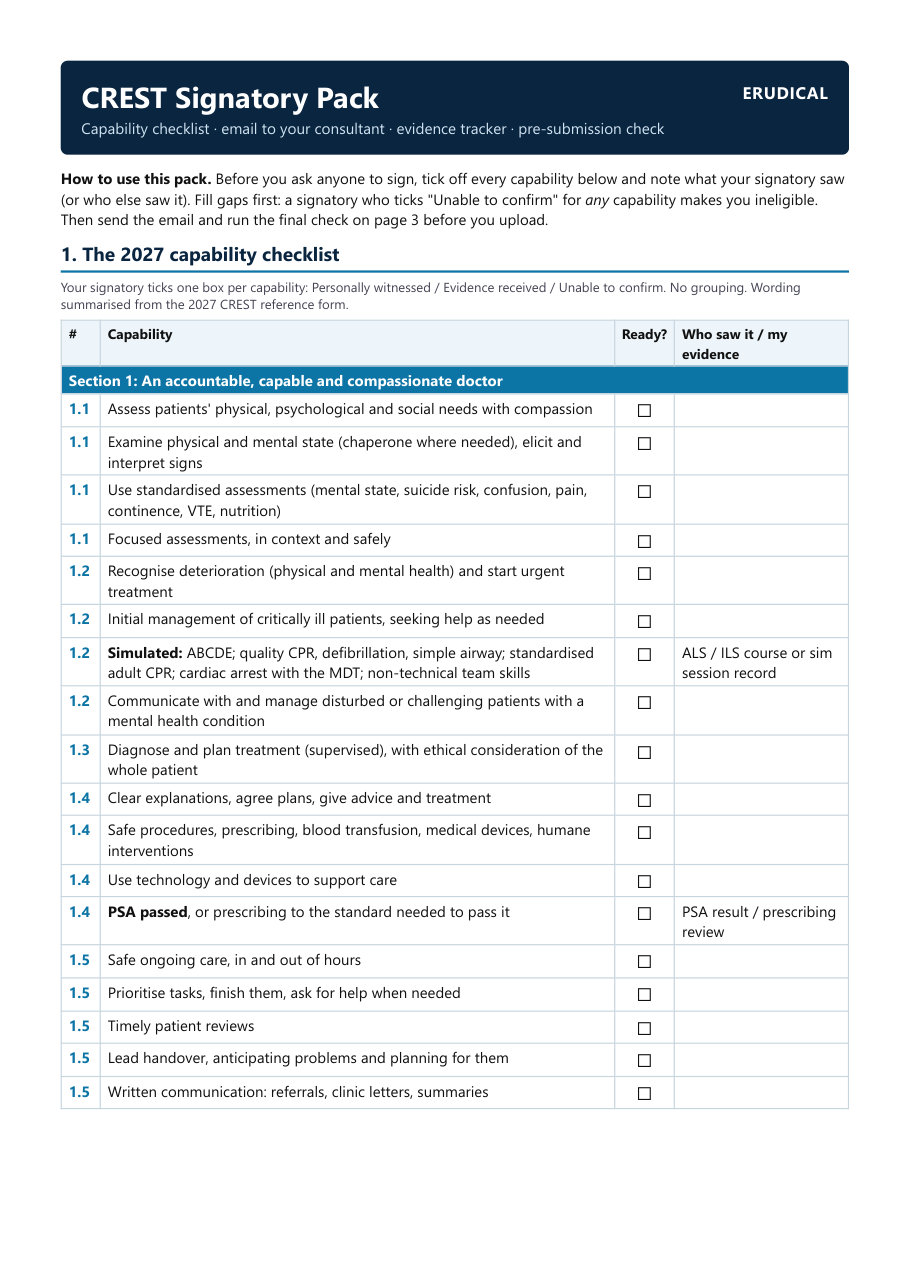
The full rules, the capabilities on the form and the mistakes that get forms rejected are in our CREST form guide. If you need a CREST, read who can sign a CREST form before you ask anyone.
How the checker works out your dates
The 3½-year window is counted back from the advertised post start date. For an August start, it opens in February three and a half years earlier. Your FPCC must be dated inside that window to use it, and the 3 months with your CREST signatory must sit wholly inside it, be continuous and whole-time equivalent, and be finished before you apply.
The checker works in months, so if a date is within a month of the cut-off it tells you to check the exact day. Part-time work stretches the period: 3 months whole-time equivalent at 60% is five months on the calendar.
How it works out prioritisation
For 2027 posts, you are in the priority group if any one of these applies: your medical degree is from the UK, Ireland, Iceland, Liechtenstein, Norway or Switzerland; you are a British citizen, a Commonwealth citizen with the right of abode, an Irish citizen, or you hold indefinite leave to remain or leave under the EU Settlement Scheme; or you have completed (or are on) a qualifying UK programme, which for CT1 and ST1 means the UK Foundation Programme. Dependant or partner status doesn’t count. The detail, including how offers work for people outside the group, is in am I prioritised for specialty training?
Eligible? Now check your points
Your application score decides who is shortlisted and offered first. See exactly where yours comes from, specialty by specialty.
Frequently asked questions
Do I need a CREST if I did foundation training abroad?
Yes. Foundation training outside the UK isn’t the UK Foundation Programme, so you show foundation competence with a CREST signed by a consultant who supervised you in a qualifying post within the 3½-year window.
My FPCC is more than 3½ years old. What now?
You need a CREST instead, signed by a consultant who supervised you for at least 3 continuous months, whole-time equivalent, within the 3½ years before the post starts.
I’m still in the post I want to use. Can I apply?
Only once you have completed the 3 months and your signatory has confirmed every capability. Certificates saying competences will be achieved before the start date are not accepted.
Does being prioritised mean I’ll get a post?
No. The guidance says prioritisation does not guarantee an offer and does not change your rank. It changes the order in which interviews and posts are offered.
Checked against the Medical Hub’s foundation competence, CREST and 2027 prioritisation pages. See the official foundation competence guidance and the prioritisation guidance.