You are in the priority group for UK specialty training if any one of three things applies: your primary medical qualification (PMQ) is from the UK, Ireland, Iceland, Liechtenstein, Norway or Switzerland; you hold a qualifying immigration status, such as British citizenship or indefinite leave to remain; or you have completed, or are currently on, a relevant UK training programme. One route is enough.
Prioritisation applies at two points: the offer of an interview and the offer of a training place. For GP ST1, Core Psychiatry CT1 and Academic Clinical Fellowship (ACF) Round 1 it applies at the offer stage only. ST1 Public Health is excluded.
This guide sets out the official rules for 2027 recruitment, how UK graduate prioritisation works in Oriel, and what you can still control whichever group you are in.
Applying for CT1 or ST1 with a CREST? Check your CREST eligibility → Being eligible and being prioritised are separate questions.
The law behind it
The Medical Training (Prioritisation) Bill became the Medical Training (Prioritisation) Act 2026 when it received Royal Assent on 5 March 2026. The detail for specialty recruitment is in the Medical Training (Prioritisation for Specialty Training Programmes) Regulations 2026, laid on 14 September 2026.
The rules applicants follow are on the NHS Medical Hub page Prioritisation for specialty recruitment. Guidance on prioritisation has changed during the year, and some older pages describe it differently, so check the Medical Hub page for the current position. This guide follows it.
The three routes into the priority group
1. Where your primary medical qualification is from
You are prioritised if your PMQ is from:
- The UK, unless all or most of your training was outside the British Isles.
- Ireland, unless all or most of your training was outside Ireland.
- Iceland, Liechtenstein, Norway or Switzerland.
2. Your immigration status
You are prioritised if you are any of the following. The wording is the official wording:
- “a British citizen”
- “a Commonwealth citizen who has the right of abode in the United Kingdom under section 2 of the Immigration Act 1971”
- “an Irish citizen who does not require leave to enter or remain in the United Kingdom under that Act”
- “a person with indefinite leave to enter or remain in the United Kingdom”
- a person with leave under residence scheme immigration rules: the EU Settlement Scheme (section 17 of the European Union (Withdrawal Agreement) Act 2020)
Other visas are not on the list. The Medical Hub page is explicit about one group:
“Partner or Dependent status is not prioritised.”
Only the immigration status you hold on or before the application deadline counts.
3. A relevant UK training programme
You are prioritised if you have completed, or are currently on, a relevant qualifying UK programme. Which programmes count depends on the level you are applying for:
| Applying for | Qualifying UK programmes |
|---|---|
| CT1 or ST1 | The UK Foundation Programme only |
| ST3 or ST4 | The UK Foundation Programme; LAT posts in the specialty you are applying for; and relevant UK training programmes that are entry routes in that specialty’s person specification |
The Malta Foundation Programme, trust-based programmes, and non-training posts leading to an Alternative Certificate of Eligibility do not count as qualifying programmes.
Am I in the priority group?
Common situations, checked against the Medical Hub page. Where the official page does not cover a case, the table says so: ask the lead recruiter for your specialty instead of assuming.
| Your situation | Prioritised? | Why |
|---|---|---|
| UK graduate | Yes, unless all or most of your training was outside the British Isles | PMQ route |
| Irish graduate | Yes, unless all or most of your training was outside Ireland | PMQ route |
| Graduate of a medical school in Iceland, Liechtenstein, Norway or Switzerland | Yes | PMQ route |
| International medical graduate (IMG) who is a British citizen | Yes | Immigration status: “a British citizen” |
| IMG with indefinite leave to remain | Yes | Immigration status: indefinite leave to enter or remain |
| IMG with leave under the EU Settlement Scheme | Yes | Immigration status: leave under residence scheme immigration rules |
| IMG who is an Irish citizen, or a Commonwealth citizen with the right of abode | Yes | Immigration status, as worded in the list above |
| IMG on a Skilled Worker or Health and Care Worker visa only | No, unless another route applies | The visa is not on the immigration-status list. Check the PMQ and UK programme routes. |
| IMG on a dependant or partner visa | No, unless another route applies | “Partner or Dependent status is not prioritised.” |
| IMG who completed, or is on, the UK Foundation Programme | Yes, for CT1/ST1 (the UK Foundation Programme also counts for ST3/ST4) | Qualifying UK programme route |
| IMG whose experience is the Malta Foundation Programme, trust-grade jobs or other non-training posts | Not through the programme route | These are not qualifying programmes. You may still be prioritised by PMQ or immigration status. |
| ST3/ST4 applicant who did a LAT post in the specialty they are applying for | Yes, for that specialty | LAT posts in the applied-for specialty count for ST3/ST4 |
| ST3/ST4 applicant who completed UK core training | Yes, if that programme is an entry route in the specialty’s person specification | Relevant UK training programmes that are entry routes count for ST3/ST4 |
| Started a UK Foundation Programme or standalone F2 but did not complete it | Not stated on the official page | Check with the lead recruiter for your specialty |
| Refugee status, humanitarian protection or another leave not named above | Not named in the official list | Check with the lead recruiter for your specialty |
| Granted indefinite leave or citizenship after the application deadline | Not for that round | Only immigration status held on or before the deadline counts |
How prioritisation works in practice
Prioritisation changes the order in which applicants are considered. It does not change how you are scored. The Medical Hub page puts it plainly:
“Prioritisation does not affect the rank applicants receive following interview.”
“Prioritisation does not guarantee that applicants in the priority group will be made an offer.”
- You apply as normal. Your status is determined automatically from the answers on your application form.
- Your status appears in Oriel. It is shown the day after the application deadline. If you think it is wrong, use the review form to dispute it.
- Interview offers. Where prioritisation applies at this stage, priority applicants are considered first. If you are not in the priority group and you are invited to interview, the Medical Hub page says you should still attend.
- Offers of a training place. Priority applicants are considered first. Non-priority applicants are considered once appointable priority applicants have been exhausted and vacancies remain.
Two points catch people out. First, only the immigration status you hold on or before the application deadline counts, so a status granted afterwards does not help in that round. Second, if you are rejected at shortlisting, you are not reinstated if your status changes later.
Which recruitment rounds and levels does it cover?
The Medical Hub page covers prioritisation for 2027 specialty recruitment. It applies at the offer of interview and the offer of a training place. For GP ST1, Core Psychiatry CT1 and ACF Round 1 it applies at the offer stage only. ST1 Public Health is excluded.
I qualified in the UK but trained mostly abroad. Am I prioritised?
The PMQ route does not apply to a UK graduate if all or most of their training was outside the British Isles (for an Irish graduate, outside Ireland). You may still be prioritised through your immigration status or a qualifying UK programme. If you are unsure how your training counts, check with the lead recruiter for your specialty.
If you need a CREST
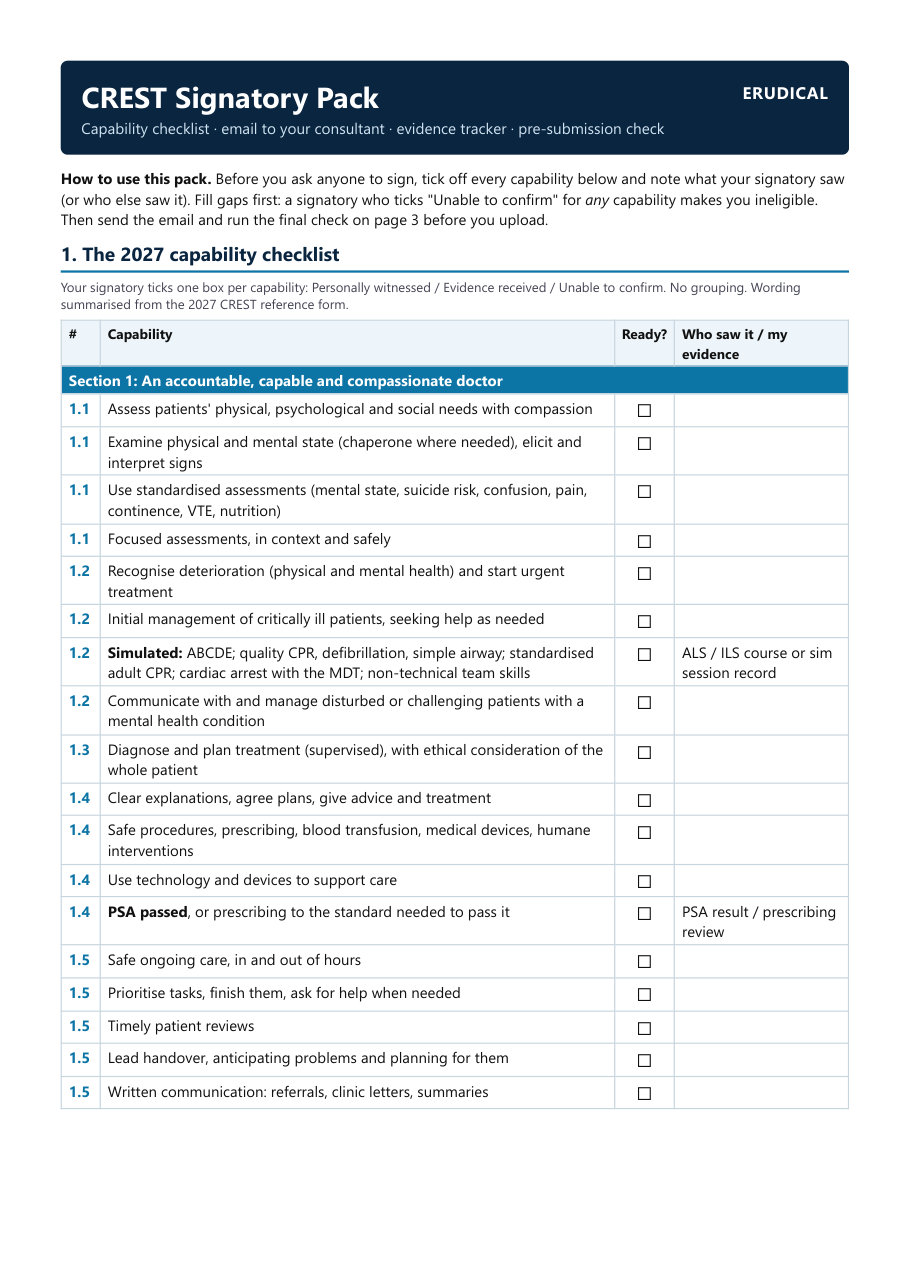
A CREST (Certificate of Readiness to Enter Specialty Training) is the evidence of foundation competence for applicants who have not completed a UK Foundation Programme. Doctors who completed a UK Foundation Programme use their FPCC instead, and doctors currently on one confirm their foundation school.
That has a direct consequence for prioritisation. For CT1 and ST1, the only qualifying UK programme is the UK Foundation Programme. If you need a CREST, the programme route does not apply to you, and whether you are prioritised depends on where your PMQ is from and your immigration status.
Keep the two questions apart:
- Eligibility is whether you can apply at all. If you cannot demonstrate every capability on the CREST, the Medical Hub CREST page says you “will not be eligible for Specialty Training at ST1 or CT1 level.”
- Prioritisation is the order in which eligible applicants are considered. A non-prioritised applicant with a valid CREST is still an eligible applicant.
Our CREST form guide explains the certificate and its rules, and the CREST eligibility checker helps you work out whether you meet them.
What you can still control
Prioritisation does not change your score. Once you are eligible, your self-assessment or portfolio points still decide where you stand at shortlisting, inside whichever group you are in, and your rank after interview is unaffected by your priority status. If you are not prioritised, a strong score matters more, not less.
Each specialty scores differently. Our specialty application points guides set out the domains for each one, and the IMT application points calculator adds up your score for Internal Medicine Training.
Teaching and presenting carry points in many specialties’ scoring, so check yours. Teaching also appears on the CREST itself, as the capability “Teach and present effectively”. A training certificate alone is not enough evidence for a CREST: your signatory still has to see, or receive evidence of, you teaching. Our Teach the Teacher course helps you teach well and leaves you with teaching you can show, and NMERC, the National Medical Education & Research Conference that Erudical runs, is one place to present your work.
Prioritised or not, your points decide shortlisting. Find your specialty’s points guide →
Frequently asked questions
Is the Medical Training (Prioritisation) Bill now law?
Yes. It became the Medical Training (Prioritisation) Act 2026 on Royal Assent on 5 March 2026. The Medical Training (Prioritisation for Specialty Training Programmes) Regulations 2026, laid on 14 September 2026, cover specialty training, and the NHS Medical Hub publishes how they apply to 2027 recruitment.
Does a Skilled Worker or Health and Care Worker visa put me in the priority group?
Not on its own. Those visas are not on the immigration-status list. You are still prioritised if another route applies, for example a PMQ from the UK, Ireland, Iceland, Liechtenstein, Norway or Switzerland, or completing the UK Foundation Programme when applying for CT1 or ST1.
If I am not prioritised, can I still get a training post?
Yes, it is possible. Non-priority applicants are considered once appointable priority applicants are exhausted and vacancies remain. If you are invited to interview, attend. Prioritisation does not guarantee an offer to anyone in the priority group.
Does prioritisation change my interview score or rank?
No. The Medical Hub page says prioritisation does not affect the rank applicants receive following interview. It changes the order in which applicants are considered for offers, not how they are scored.
My indefinite leave to remain was granted after the deadline. Does it count?
Not for that round. Only the immigration status you hold on or before the application deadline counts, and a rejection at shortlisting is not reinstated if your status changes later.
How do I find out whether I have been prioritised?
Your status is worked out automatically from your application form and shown in Oriel the day after the application deadline. If you think it is wrong, use the review form to dispute it.
Last checked against the NHS Medical Hub page Prioritisation for specialty recruitment (reviewed 9 October 2026), the Medical Training (Prioritisation) Act 2026 and the Regulations: 30 October 2026. This page explains the published rules and is not legal or immigration advice.
Related: CREST form guide, CREST eligibility checker, specialty application points and the IMT application points calculator.