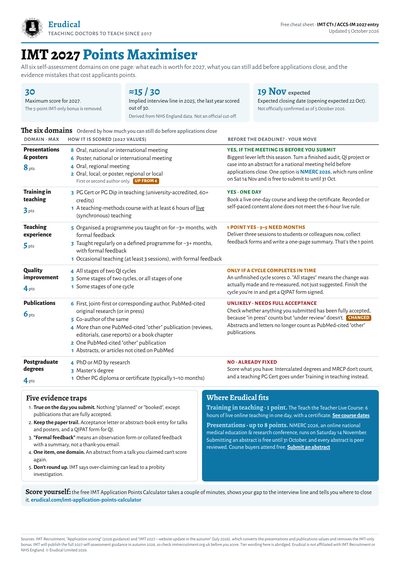
Every ST4 psychiatry route, from child and adolescent to old age, shares one self-assessment of ten domains with a raw maximum of 46. A clinician verifies your evidence and the verified score is weighted to 50 of a 200-mark final score, so it carries 25% alongside the interview (also 50) and the adjusted CASC (100). It’s used to rank you rather than to set a pass line, and NHS England says “There is no minimum score required for the verified self-assessment in order to be considered appointable.” The domains and points on this page come from guidance headed “This guidance is for February 2027 recruitment only.”, and nothing has yet been published for the August 2027 intake, so treat the values as the current version until it is. August 2027 applications should fall in the national Round 2 window, which NHS England has set for 19 November (10am) to 10 December 2026 (4pm), and since you score yourself at the time of application, aim to finish anything you want counted before you submit.
Psychiatry ST4 self-assessment (verified self-assessment; evidence uploaded to Qpercom) points at a glance
Your score is the total of the domain scores, out of a maximum of 46.
"Your verified self-assessment score will make up 25% of your final ST4 Psychiatry score. There is no minimum score required for the verified self-assessment in order to be considered appointable." (February 2027 intake overview). Scoring overview: "For the August 2026 recruitment round the maximum achievable raw score for this element is 46 marks. When weighted, this accounts for 25% of the overall score." Raw 46 x 1.08695 = 50; interview 50 (25%); adjusted CASC 100 (50%). February 2027 domain tops also sum to 46.
| Domain | What scores (official wording) | Max |
|---|---|---|
| Undergraduate Training - Additional Degrees |
Scores the single best option you can evidence, up to 3 points. One option only. "Qualifications in fields outside psychiatry and medicine can be submitted in this domain. A non-medical Masters’ degree fits this domain rather than Domain 3." | 3 |
| Undergraduate Training - Prizes and Awards |
Scores the single best option you can evidence, up to 4 points. Highest single tier only. | 4 |
| Postgraduate Medical Qualifications |
Scores the single best option you can evidence, up to 5 points. "You can get marks for only 1 qualification here. Multiple qualifications will not get added scores." | 5 |
| Postgraduate Training – Prizes and Awards |
Scores the single best option you can evidence, up to 4 points. Highest single tier only. | 4 |
| Leadership role within an organisation |
Scores the single best option you can evidence, up to 4 points. Highest single tier only. The 6-month minimum applies to both scoring tiers. | 4 |
| Clinical Governance, Audit and Quality Improvement as a postgraduate |
Scores the single best option you can evidence, up to 5 points. Highest single tier only. | 5 |
| Research |
Scores the single best option you can evidence, up to 6 points. Highest single tier only. | 6 |
| Teaching |
Scores the single best option you can evidence, up to 5 points. Highest single tier only. The course, formal teaching and formal non-medical teaching all score the same 2, so the course adds nothing if you already have evidenced formal teaching. | 5 |
| Academic Publications |
Scores the single best option you can evidence, up to 5 points. Highest single tier only. "Case reports in an electronic ‘publication such as e-BMJ Case Reports should count for a total of one point only, even if multiple case reports have been published." | 5 |
| Presentations and Poster Presentations |
Scores the single best option you can evidence, up to 5 points. Highest single tier only. Regional, national and international all score the same 5. There is no separate poster tier: the domain covers "Presentations and Poster Presentations", and an NMERC poster is claimed at the 5-point tier, like an oral. | 5 |
| Total | 46 |
Dates for this round
- February 2027 intake (Round 3): applications closed source
- February 2027 intake: evidence counts only if you held it by the close of the upload window source
- NMERC abstract submissions close (Erudical event, not official) source
- NMERC 2026 conference day, online (Erudical event, not official) source
- NMERC evidence letter, certificates and abstract book issued (Erudical event) source
- August 2027 intake (Round 2): applications open expected source
- August 2027 intake (Round 2): applications close (score yourself at the time of application) expected source
What you can still add before 10 December 2026
What each of these adds is the difference between the option you would reach and the one you already hold, so it can be nothing if you hold that option already. The calculator works out the gain from your own answers.
- Postgraduate Training – Prizes and Awards. Not something you can plan on. If you win a prize at NMERC 2026 (14 Nov 2026), claim it as "Personal award or recognition from a national recognised medical organisation or body" (4), with the prize certificate as evidence ("Award certificate or headed or signed letter confirming award."). Any other personal award you win before you submit also counts if you have the certificate or a headed or signed letter confirming it. Start by 31 October 2026. NMERC 2026 (14 Nov; abstracts close 31 Oct) awards prizes, and prize winners get an additional certificate. An NMERC prize is claimed at the national award tier (4). Use the prize certificate here and your presentation evidence in Domain 10: "You cannot use the same evidence in more than one domain."
- Clinical Governance, Audit and Quality Improvement as a postgraduate. Only if a cycle is already under way: finish the re-audit or re-measurement, and get the signed headed letter confirming any change, ideally before you submit (on the February 2027 intake rules, documents held by the close of the evidence upload window counted). No fixed start date: depends on how far your project has got. Expected application close 4pm Thu 10 Dec 2026.
- Research. Join a running study (for example an NIHR portfolio study at your trust) to recruit participants or help with data collection, and get a signed headed letter from the research supervisor or sponsor confirming your role, plus the project summary. No fixed start date: it depends on a study taking you on. Expected application close 4pm Thu 10 Dec 2026.
- Teaching. If you are on 0 or 1, attend the Erudical live Teach the Teacher day (09:00-17:00, online), ideally before you submit your application, and upload the course certificate. Alternatively deliver formal teaching (for example a lecture to health professionals) and get a signed headed letter plus an overview of the teaching and the feedback. Start by 15 November 2026. 15 Nov 2026 is the last Erudical live date listed on 10 Oct 2026. The August 2027 window is expected to close at 4pm on Thu 10 Dec 2026 (national Round 2), and the guidance says: "Please make sure you score yourself accurately at the time of application." The February 2027 intake guidance also counted documents held up to the close of the evidence upload window: "you must only score yourself points for documents that you have as at Wednesday 16 September 2026 (the close of the evidence upload window), or earlier." If the August 2027 guidance keeps that rule, a certificate gained after you submit but before the upload window closes can count; the assessor decides.
- Presentations and Poster Presentations. Submit an abstract to NMERC 2026 (free, closes 31 Oct 2026, decision within 5 days) and present it online on Sat 14 Nov 2026, as an oral or a poster. You get the evidence letter, certificate and abstract book by 16 Nov 2026, 16:00. Presenting before you submit your application is simplest. Upload two documents: your slides or poster, plus the NMERC letter (or the abstract book page). If it's an audit or QIP already credited in Domain 6, use different evidence for each domain. Start by 31 October 2026. NMERC abstract submissions close 31 Oct 2026. The presentation (14 Nov) comes before the expected Round 2 opening (10am Thu 19 Nov 2026) and close (4pm Thu 10 Dec 2026).
Evidence traps
- The published guidance is for the February 2027 intake only, and that round has closed. The August 2027 domains may change, so check them again when the psychiatry timeline adds the August 2027 round.
This guidance is for February 2027 recruitment only.
source - Evidence that doesn't match the instructions, or is tagged to the wrong domain, takes that domain to zero, not just down a tier.
If the evidence you have submitted for a domain does not match the specific requirements of the instructions, or you have tagged your evidence to the wrong domain, or you have omitted to upload your evidence, the score will be adjusted to zero.
source - Assessors read only the first few uploads, up to each domain's maximum. Put your best evidence first and don't pad.
Assessors are also instructed to look at the first few pieces of evidence up to the maximum number allowed.
source - One piece of evidence can't count twice. An audit you score in Domain 6, publish (Domain 9) and present (Domain 10) needs a different document in each domain.
You cannot use the same evidence in more than one domain.
source - Over-scoring by 5 or more points triggers a probity investigation. You can end up with an overall self-assessment score of zero.
If we consider that you have significantly over-scored yourself (awarded yourself 5 or more points than you have evidence for), we will make contact with you to investigate further.
source
Sources
- Self-assessment verification process instructions: Domain breakdown (NHS England Medical Hub), "This guidance is for February 2027 recruitment only." Page last reviewed 2 July 2026
- Self-assessment verification process instructions: Overview, February 2027 recruitment; reviewed 2 July 2026
- Self-assessment verification process instructions: Evidence, February 2027 recruitment; reviewed 2 July 2026
- Self-assessment verification process instructions: Time limited domains, February 2027 recruitment; reviewed 2 July 2026
- Higher Training in Psychiatry: Self-assessment, "The domains listed are correct for the February 2027 intake." Reviewed 2 July 2026
- Scoring overview: ST4 Psychiatry, States February 2026 and August 2026 round weightings; reviewed 11 November 2025
- Higher Training in Psychiatry: Recruitment timelines 2026/2027, Round 3 (Feb 2027) dates published; Round 2 (Aug 2027) "Details of future rounds will be added once available." Reviewed 2 July 2026
- Higher Training in Psychiatry: Recruitment timelines 2025/2026 (Wayback copy), Snapshot 10 Feb 2026; August 2026 intake dates (precedent)
- Specialty recruitment timeline (NHS England Medical Hub), Recruitment timelines for 2027, Round 2, 2027 Round 2 (ST3/ST4, Aug-Dec 2027 starts)
- General Adult Psychiatry ST4 2027 person specification (NHS England Medical Hub), 2027 recruitment
- 2025 competition ratios (NHS England Medical Hub), 2025 Round 2: Psychiatry (all specialties) ST4
- Erudical Teach the Teacher course page, Live page; dates listed to 15 Nov 2026
- NMERC 2026 home, submit and certificates pages (Erudical), Live pages
Raising a psychiatry score before the December close
Five domains are effectively settled by now: your undergraduate degree and prizes, any postgraduate qualification, a leadership role (which must be held “for at least 6 months”) and publications. The largest movement is in Domain 10, where one departmental talk scores 1 and the top statement, worth 5, covers regional, national and international meetings alike. Submit to NMERC before abstracts close on 31 October, present on Saturday 14 November, and that’s +4 for someone whose best is a departmental talk or +5 for anyone with nothing there yet. Teaching is the steadier gain: if informal teaching is all you can show, attending a Teaching the Teachers course moves Domain 8 from 1 to 2, and Erudical’s final live date currently scheduled ahead of the December close falls on 15 November. In Research, joining a study already running at your trust to recruit participants or collect data, with a signed headed letter from the supervisor, takes 0 to 1, and an audit cycle that’s already under way moves 0 to 2 once the re-audit is done, or to 3 with a signed headed letter confirming local change, ideally with both finished before you submit. A prize can’t be planned, but if you win one at NMERC it’s claimed in Domain 4 as “Personal award or recognition from a national recognised medical organisation or body” (4), using the prize certificate there and your presentation evidence in Domain 10, because “You cannot use the same evidence in more than one domain.”
What happens to your claims after you submit
You pick one statement per domain on Oriel, and only after longlisting do you upload evidence to Qpercom (“It is not possible to do this in advance of the advertised upload window”), where a clinician checks it and can move each score up or down. The rule that catches people out is how hard a mismatch is punished: “If the evidence you have submitted for a domain does not match the specific requirements of the instructions, or you have tagged your evidence to the wrong domain, or you have omitted to upload your evidence, the score will be adjusted to zero.” Assessors also read only “the first few pieces of evidence up to the maximum number allowed”, so lead each domain with your strongest document.
The cut-off for evidence has some give. The February 2027 intake guidance asked applicants to score themselves at the time of application, but it also counted documents held up to the end of the evidence window: “you must only score yourself points for documents that you have as at Wednesday 16 September 2026 (the close of the evidence upload window), or earlier.” If the August 2027 guidance keeps that wording, a course or presentation completed after you submit, and before the upload window closes, can still be scored, with the verifying clinician deciding.
Worked example: a CT3 on 13 out of 46
This applicant is a CT3 psychiatry trainee aiming for the August 2027 intake. They intercalated a BSc, won no prizes at medical school or since, and hold no postgraduate qualification. They’ve been a trainee rep for more than six months and have a headed letter saying so. They completed a two-cycle audit that changed local practice, helped collect data for a research study, teach medical students informally, co-authored one peer-reviewed paper and gave one departmental presentation. Domain by domain:
- Undergraduate additional degrees: 3, for “BSc or BA (or similar/higher)”.
- Undergraduate prizes and awards: 0.
- Postgraduate medical qualifications: 0.
- Postgraduate prizes and awards: 0.
- Leadership role within an organisation: 2, for “Held a Leadership role at a local level for at least 6 months”.
- Clinical governance, audit and QI: 3, for a completed cycle “which has resulted in local change.”
- Research: 1, for helping with data collection on a study.
- Teaching: 1, for informal teaching of colleagues and medical students.
- Academic publications: 2, as co-author of one peer-reviewed postgraduate paper.
- Presentations and poster presentations: 1, for “I have made a local/departmental presentation”.
That’s 13 out of 46. Attending the live teaching day by 15 November lifts Teaching by one mark, to 2. Presenting a different project at NMERC on 14 November, as a talk or a poster, lifts Presentations from 1 to 5, a gain of 4. Together they bring this trainee to 18, a gain of 5 raw marks, which on the published weighting (46 × 1.08695 = 50) is roughly 5.4 of the 200 final marks, or about 2.7% of the final score by our arithmetic. If they could already evidence formal teaching at 2, the course would add nothing and the gain would be 4. In the 2025 Round 2, psychiatry ST4 drew 683 applications for 491 posts, a ratio of 1.39, with no split published by specialty.
Work through all ten domains, picking what your documents can prove, and the calculator adds up your raw mark out of 46 and what each remaining option would add before you apply. We’ll show your result and email you a copy.
Work out your Psychiatry ST4 score
Ten psychiatry domains on one printable page, plus an alert if any of them changes: leave your email and we’ll send it.
Does a teach the teacher course count for Psychiatry ST4?
Yes, for 2 points in Domain 8, Teaching, which has a maximum of 5. The statement is “I have attended a Teaching the Teachers course, Generic Instructors course or similar”, and it sets no minimum length, provider or number of live hours. Domain 8 takes your single highest statement, and the course sits at the same 2 as “I have some experience in formal teaching Health Professionals (such as lectures)” and formal teaching to a non-medical audience, so the course adds 0 if you already hold that tier or higher; that includes a major contribution to a local (3) or a regional or national (4) teaching programme, or a PG Certificate in education (3). It helps the applicant who is on 0 or 1. The tier allows one piece of evidence (“Maximum number of pieces of evidence required 1”), so upload the course certificate on its own: it is the evidence for this statement. Attend the live online day (09:00 to 17:00) before you submit your application if you can; under the upload-window rule above, a certificate gained a little later may still count. The Teach the Teacher course for Psychiatry ST4 page lists the dates, and our comparison of what teaching earns in each specialty shows how the same course is valued elsewhere.
An NMERC talk or poster in Domain 10
On Saturday 14 November 2026 NMERC meets online, in Gather Town, and Round 2 is expected to open the following Thursday. There’s no charge to present, and submissions are open to doctors and medical students anywhere. Send an abstract by 31 October and you’ll hear back within five days; presenters receive an evidence letter, certificate and the abstract book by 4pm on Monday 16 November, so your talk or poster is done and documented before you apply. Domain 10’s top statement reads “I have presented at a regional, national, or international meeting”, worth 5, and the domain covers “Presentations and Poster Presentations” without a separate poster tier, so an NMERC poster scores 5 just as a talk does. What you gain is 5 minus your current Domain 10 score. Psychiatry wants two documents and says so plainly: “Please note that we need both pieces of evidence to grant a score.” Upload your slides or poster with the NMERC letter or the abstract book page. If the work is an audit you’re also scoring in Domain 6, a national presentation is allowed (“Marks can be awarded if a local audit/QIP has been presented regionally, nationally or internationally.”) as long as each domain gets its own document. The abstract book entry won’t count as a publication, since “Publication of a poster/oral presentation abstract (only) doesn’t score here”, and teaching talks belong in Domain 8. Presenting your abstract doesn’t count as teaching either, since Domain 8 excludes presenting your own research at a meeting. An accepted abstract isn’t guaranteed.
If you want to build Domain 8 evidence by teaching, Erudical is always looking for tutors for the live course day. NMERC and Erudical roles may qualify. See the NMERC and Erudical websites and contact us for details.
Questions about the ST4 psychiatry self-assessment
Does a poster count for the higher psychiatry self-assessment?
Yes. Domain 10 is titled “Presentations and Poster Presentations”, and its 0 statement reads “I have made no presentations nor shown any posters”. A poster shown at a regional meeting or anything larger meets the 5-point statement, which is the domain maximum. Present it before you apply if you can; on the February 2027 intake rules, documents held by the close of the evidence upload window counted. Case presentations and journal clubs don’t count, because they “are part of the curricula requirements and happen as part of a regular educational programme.”
What is the maximum ST4 psychiatry self-assessment score?
46 raw marks across ten domains: 3 for undergraduate degrees, 4 each for undergraduate prizes, postgraduate prizes and leadership, 5 each for postgraduate qualifications, audit, teaching, publications and presentations, and 6 for research. Multiplied by 1.08695 it becomes 50 of the 200-mark final score. Where applicants tie, the verified self-assessment is the third tie-break, after adjusted CASC and interview.
When do ST4 psychiatry applications open for August 2027?
The National Psychiatry Recruitment Office hasn’t posted August 2027 dates (“Details of future rounds will be added once available”, checked 10 October 2026). NHS England’s national Round 2, which covers ST3 and ST4 posts starting in August 2027, runs from the morning of 19 November (10am) until 4pm on 10 December 2026, and psychiatry’s August 2026 round used the Round 2 dates. In that round, evidence went to Qpercom later, from 16 February to 2 March 2026.