Oral and Maxillofacial Surgery ST1 · 2027 criteria
Oral and Maxillofacial Surgery ST1 self assessment 2027: points calculator and scoring guide
Pick the option that fits your evidence at each step to see your score out of 79, and what you can still add before the deadline.
Applications close 4pm, Thu 19 Nov 2026
- 527 doctor reviews
- 4.7/5 rated for relevance
OMFS ST1 points calculator
The OMFS ST1 self assessment for the August 2027 intake has 16 domains and no printed total: the published ranges add up to 79, and OMFS surgical experience alone is worth up to 15, split across three case categories. It isn’t an appointability hurdle, because “There is no set score you must achieve to be appointable in the portfolio assessment”, yet for everyone who passes the interview “The overall score will include 80% from the interview and 20% from the self assessment/evidence folder for an overall score and rank.” NHS England (South West) runs the national round on Oriel from 10am on Thursday 22 October to 4pm on Thursday 19 November 2026; your self-score is locked when you submit, and the evidence behind it goes to a separate portal between 23 November and 10am on 21 December 2026.
OMFS ST1 self assessment, verified against an evidence folder uploaded to the NHS England evidence portal points at a glance
Your score is the total of the domain scores, out of a maximum of 79.
The guidance states no total. The published domain ranges add up to 79 (OMFS surgical experience is published as one 1-15 domain; it is split here into its three 0-5 case categories). The self-assessment does not decide appointability: "There is no set score you must achieve to be appointable in the portfolio assessment" and "The score from the evidence review will contribute towards the overall interview score but will not demine suitability/appointability." For those who pass the interview: "The overall score will include 80% from the interview and 20% from the self assessment/evidence folder for an overall score and rank." To reach the offer stage you need "a minimum of 60% of the total interview score and no less than than 40% within each station."
| Domain | What scores (official wording) | Max |
|---|---|---|
| Intercollegiate examination |
Scores the single best option you can evidence, up to 4 points. Single best option, 0, 2 or 4. | 4 |
| OMFS educational activity and links to specialty |
Each item you can evidence adds its points, up to 5 points for the domain. Each option you have done adds 1 point, so 0-5. This is one of the two domains exempt from the single-best-achievement rule: "Apart from OMFS educational activity and links to specialty domain, if you have more than one achievement within a single domain then you should only claim points for whichever single achievement would give you the highest score". | 5 |
| Surgical courses (excluding OMFS courses) |
Each item you can evidence adds its points, up to 5 points for the domain. 1 point per course, maximum 5. ATLS "must be current"; exam preparation courses are excluded. | 5 |
| Surgical courses (OMFS) |
Each item you can evidence adds its points, up to 5 points for the domain. 1 point per OMFS course, maximum 5. No examples are listed for this domain. | 5 |
| OMFS surgical experience: Dentoalveolar surgery including emergencies |
Scores the single best option you can evidence, up to 5 points. One of three case categories (dentoalveolar, trauma, other) that together make up the published 1-15 range for OMFS surgical experience. Each category scores 1-5 on case numbers. The published bands overlap at 50, 75 and 100 cases. | 5 |
| OMFS surgical experience: Trauma including emergencies |
Scores the single best option you can evidence, up to 5 points. One of three case categories (dentoalveolar, trauma, other) that together make up the published 1-15 range for OMFS surgical experience. Each category scores 1-5 on case numbers. The published bands overlap at 50, 75 and 100 cases. | 5 |
| OMFS surgical experience: Other |
Scores the single best option you can evidence, up to 5 points. One of three case categories (dentoalveolar, trauma, other) that together make up the published 1-15 range for OMFS surgical experience. Each category scores 1-5 on case numbers. The published bands overlap at 50, 75 and 100 cases. | 5 |
| Evidence of surgical experience other than OMFS |
Scores the single best option you can evidence, up to 5 points. Single band, 0-5, on performed or assisted cases outside OMFS. | 5 |
| Postgraduate degrees and qualifications (excluding intercollegiate exams) |
Scores the single best option you can evidence, up to 5 points. Single best option. | 5 |
| Prizes and awards |
Scores the single best option you can evidence, up to 5 points. Single best option. | 5 |
| Quality Improvement Projects/Clinical Audit |
Scores the single best option you can evidence, up to 5 points. Single best option. Evidence must include proof that the project was presented. | 5 |
| Presentations |
Scores the single best option you can evidence, up to 5 points. Single best option. One national oral already reaches the maximum of 5. | 5 |
| Publications |
Scores the single best option you can evidence, up to 5 points. Single best option. Accepted papers count as "in press"; submitted papers do not. | 5 |
| Collaborative research |
Scores the single best option you can evidence, up to 2 points. Single best option. | 2 |
| Qualification in Medical Education |
Scores the single best option you can evidence, up to 3 points. Single best option. The lowest scoring option is a 60-credit PG Certificate. | 3 |
| Postgraduate Medical Teaching experience |
Scores the single best option you can evidence, up to 4 points. Single best option. Medical student teaching programmes are capped at 2. Online courses are excluded. | 4 |
| Leadership and management |
Scores the single best option you can evidence, up to 5 points. Single best option. Every option needs 6 months in the role and evidence of positive impact. | 5 |
| Outstanding achievement |
Scores the single best option you can evidence, up to 1 point. 0 or 1. | 1 |
| Total | Not published as a single figure: this is the sum of the domain maxima. | 79 |
Dates for this round
- Advert published source
- Applications open (Oriel) source
- Applications close (self-assessment fixed on submission) source
- Evidence portal opens source
- Evidence portal closes source
- Interviews (February 2027, dates to be confirmed) expected source
- Initial offers released source
- Hold deadline source
- Upgrade deadline source
What you can still add before 19 November 2026
What each of these adds is the difference between the option you would reach and the one you already hold, so it can be nothing if you hold that option already. The calculator works out the gain from your own answers.
- OMFS educational activity and links to specialty. Join BAOMS (or register with its groups for aspirant OMFS trainees) before you submit, and keep your member number for the evidence portal. Gets you to: BAOMS member or registered with its aspirant groups. Start by 19 November 2026. Only what you hold when you submit counts ("accurate at the time of submission"). Applications close 4pm Thursday 19 November 2026.
- Surgical courses (excluding OMFS courses). Attend another surgical course before you submit and keep the attendance certificate. Gets you to: Each surgical course attended. Only courses already taken count: "you should not select an answer based on ... courses not yet taken". Applications close 4pm Thursday 19 November 2026.
- Surgical courses (OMFS). Attend an OMFS surgical course before you submit and keep the attendance certificate. Gets you to: Each OMFS surgical course attended. Only courses already taken count. Applications close 4pm Thursday 19 November 2026.
- OMFS surgical experience: Dentoalveolar surgery including emergencies. Cases you log and have validated before you submit count. Get the summary sheet signed before the evidence portal closes. Scores are fixed when you submit: "The self assessment score cannot be changed at any stage between application and interview." Applications close 4pm Thursday 19 November 2026.
- OMFS surgical experience: Trauma including emergencies. Cases you log and have validated before you submit count. Get the summary sheet signed before the evidence portal closes. Scores are fixed when you submit: "The self assessment score cannot be changed at any stage between application and interview." Applications close 4pm Thursday 19 November 2026.
- OMFS surgical experience: Other. Cases you log and have validated before you submit count. Get the summary sheet signed before the evidence portal closes. Scores are fixed when you submit: "The self assessment score cannot be changed at any stage between application and interview." Applications close 4pm Thursday 19 November 2026.
- Evidence of surgical experience other than OMFS. Cases you log and have validated before you submit count. Scores are fixed when you submit: "The self assessment score cannot be changed at any stage between application and interview." Applications close 4pm Thursday 19 November 2026.
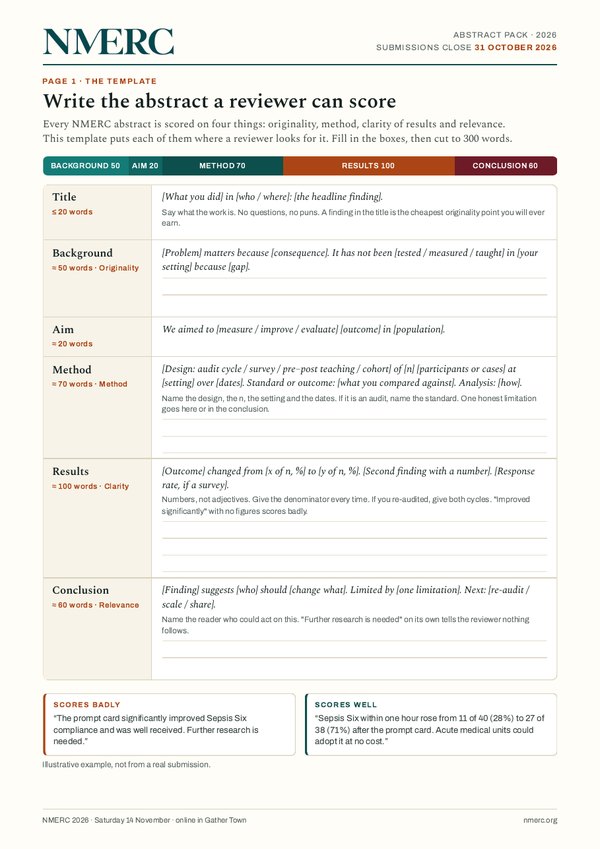
- Presentations. Submit an abstract to a national meeting held before 19 November 2026 and give it yourself, then submit your application. NMERC 2026: abstract submission is free (nmerc.org/submit), decisions within 5 days, presented online on Saturday 14 November 2026, and presenters get a certificate of presentation. Use a different project from the one you claim under QI/audit. Gets you to: Poster at a national or international meeting; Poster at a national or international meeting; Oral at a national or international meeting. The descriptors are in the past tense ("I have given", "I have presented") and "All achievements should be completed at time of application", so give the talk on 14 November and submit before 4pm 19 November 2026.
- Postgraduate Medical Teaching experience. Teach as faculty on (or organise) a face-to-face course of a full day or consecutive days that collects pre- and post-course feedback, and run it before 19 November 2026. Get a signed letter from a consultant supervisor describing your role. Gets you to: Faculty member on a course. The organiser option says "completed by application closing date" (4pm Thursday 19 November 2026), and scores are fixed at submission.
Evidence traps
- A teach the teacher course scores 0 for OMFS ST1 in 2027. Teaching only scores as a 60-credit PG Certificate or higher, or as organiser or faculty on a face-to-face course.
Postgraduate Certificate (PGCert) in education (minimum 60 credits) Points - 1
source - Your audit can't also be your presentation. If you claim a project under QI/audit, present a different one.
Any points claimed for oral or poster presentations in this section must be completely different projects to any QI or audit work used to claim points in any other section.
source - Slides are not evidence. Upload a summary of the presentation and the certificate of presentation.
Evidence must include summary of presentation and certificate of presentation (slides will not be accepted).
source - Your self-score is fixed the moment you submit. Anything you finish after 4pm on 19 November 2026 can't be added, even though the evidence portal stays open until 21 December.
The self assessment score cannot be changed at any stage between application and interview. Once you have submitted your application, you will no longer be able to amend the 'self assessment' section of your application.
source - A missing upload costs the whole domain. If a domain's evidence isn't in the portal by 10am on 21 December 2026, it scores zero.
If evidence for a domain is not uploaded to the portal before the deadline, then the evidence verification panel will award a score of zero for that domain
source
Sources
- Self assessment guidance (OMFS) - Oral and Maxillofacial Surgery ST1 (NHS England Medical Hub), Page last reviewed: 29 September 2026; next review due 29 September 2028. Sits under the ST1 pages whose timeline is 'Round 1 (August 2027 intake)'. No year label on the page itself.
- Recruitment timelines (OMFS ST1), Round 1 (August 2027 intake); page last reviewed 9 September 2026
- Selection process (OMFS ST1), Page last reviewed 10 September 2026
- Applying (OMFS ST1), Page last reviewed 10 September 2026
- Person specification and entry criteria for Oral and Maxillofacial Surgery ST1 2027 recruitment, 2027
- 2025 competition ratios (NHS England Medical Hub), Round 1 table: Oral and Maxillo Facial Surgery ST1, 77 applications, 22 posts
Where OMFS points can still move before 4pm on 19 November
Anything you claim must already be complete on the day you submit, since “you should not select an answer based on qualifications not yet given” and the score “cannot be changed at any stage between application and interview”. Presentations offers the biggest single jump: a selected national oral scores 5 and a national poster 4, so someone whose best is a regional poster (2) gains 3 or 2, and NMERC on 14 November is early enough, provided the abstract goes in at nmerc.org/submit and the application goes in after the talk. The two course domains pay 1 point per course up to 5 each, so a CCrISP, START Surgery or head and neck dissection course attended before you submit adds 1 if you’re below the cap; ATLS only counts if it’s current, and Royal College exam preparation courses don’t count at all. If you aren’t yet in BAOMS, joining (or registering with its groups for aspirant OMFS trainees) adds 1 in the specialty links domain, provided you keep the member number for the portal. Logbook cases you perform or assist and have validated before submitting count too, and a category sitting just under a band edge is worth chasing: taking trauma from 24 cases to 25 moves that category from 1 to 2. Teaching as faculty on a face-to-face course that runs over a full day, with pre- and post-course feedback, adds 2 for anyone without a teaching score, as long as the course has taken place before 19 November and you have a consultant supervisor’s signed letter describing your role. Degrees, prizes, publications, collaborative research, a second audit cycle and a six-month leadership role can’t realistically be finished in the time left.
Five ways an OMFS claim loses points at verification
The sheet lists every trap; these are the ones that cost OMFS applicants most. Your audit and your presentation must be separate pieces of work: “Any points claimed for oral or poster presentations in this section must be completely different projects to any QI or audit work used to claim points in any other section.” Presentation evidence is a summary and a certificate, and “slides will not be accepted”. Logbook evidence is the consultant-signed summary sheet with name, GMC number and date of validation, and the guidance is blunt: “Please do not provide a copy of your entire logbook.” Each achievement scores once, because “One achievement cannot be used to score points in multiple domains”. And a domain with nothing uploaded by 10am on 21 December gets nothing: “If evidence for a domain is not uploaded to the portal before the deadline, then the evidence verification panel will award a score of zero for that domain”. Upload your CV first, keep patient-identifiable data out of every file, and remember that verifiers can lower a score.
Worked example: a dual-qualified CT1 on 29
This hypothetical applicant has passed both MRCS and MFDS, does OMFS on call and belongs to BAOMS. They’ve attended BSS, CCrISP and a current ATLS plus one OMFS course, and their validated logbook shows 30 dentoalveolar, 20 trauma and 10 other OMFS cases, with 25 cases in one other surgical specialty. They hold a relevant PG Certificate and one top-20% merit, were involved in all aspects of two audit cycles, showed a poster at a regional meeting, co-authored one original research paper and collected data for a collaborative study. They have no education qualification and no course teaching, and they’ve held a local leadership role with impact for 8 months. Scored against the 2027 guidance:
- Intercollegiate examination: both MRCS and MFDS, 4.
- OMFS educational activity and links to specialty: on call work and BAOMS membership, 2.
- Surgical courses (excluding OMFS courses): three courses, 3.
- Surgical courses (OMFS): one course, 1.
- OMFS dentoalveolar cases: 30, in the 25 to 50 band, 2.
- OMFS trauma cases: 20, under 25, 1.
- Other OMFS cases: 10, under 25, 1.
- Surgical experience other than OMFS: 25 cases in a single specialty, 2.
- Postgraduate degrees and qualifications: relevant PG Certificate, 1.
- Prizes and awards: one top-20% merit, 2.
- Quality Improvement Projects/Clinical Audit: all aspects of two cycles, 3.
- Presentations: regional poster, 2.
- Publications: co-author of one original research paper, 3.
- Collaborative research: data collector, 1.
- Qualification in Medical Education: none, 0.
- Postgraduate Medical Teaching experience: none, 0.
- Leadership and management: local role for 8 months with impact, 1.
- Outstanding achievement: none, 0.
That’s 29 of the 79 the ranges allow. Attending a teach the teacher course changes nothing here, because no OMFS domain scores a course you sit as a delegate. An NMERC oral on a project other than the audit, selected and given on 14 November, moves Presentations from 2 to 5, so the total becomes 32, a gain of 3, as long as the application goes in after the talk and before 4pm on 19 November. A national poster instead would take Presentations to 4 and the total to 31. If they also fit in a fourth surgical course before submitting, that domain rises from 3 to 4 and the total from 32 to 33.
Work through each domain with your evidence beside you, answering the logbook one category at a time, and the calculator adds up your score against the 79 and shows what a talk or another course would gain before 19 November. We’ll show your result and email you a copy.
Go to the OMFS ST1 calculator at the top of this page
For the OMFS ST1 domains on one printable page, plus a note if the guidance changes, leave your email here.
Email me the printable version
Check your inbox. Your printable cheat sheet is on its way to .
While you wait, work out your score with the calculator. If the email isn't there in a few minutes, check your junk folder.
Does a teach the teacher course count for OMFS ST1?
No. A teach the teacher course scores 0 in the OMFS ST1 self assessment for the August 2027 intake, for every applicant, whatever they already hold. Teaching is scored in two domains, and neither has an option for a course you attend. Qualification in Medical Education begins at “Postgraduate Certificate (PGCert) in education (minimum 60 credits) Points – 1”, with 2 for a 120-credit PG Diploma and 3 for an MSc in Education; a one-day live course plus a self-paced course isn’t a postgraduate qualification. Postgraduate Medical Teaching experience rewards teaching you deliver, with “Contribution to a course as faculty member Points – 2” and 4 as principal organiser, on “a structured, educational, or professional development event over a day/consecutive day with both pre- and post-course feedback”. That domain also says “Online courses excluded”, so teaching on Erudical’s online course wouldn’t count for OMFS either. A PG Cert in medical education belongs only in Qualification in Medical Education, never under Postgraduate degrees. If you’re applying to more than one specialty, see which specialties do award points for a teaching course.
An NMERC oral or poster before you submit
NMERC runs online on Saturday 14 November 2026, which leaves five days before OMFS applications close. Presenting is free and it’s open to any doctor or medical student; abstracts can be submitted at nmerc.org/submit, with decisions within 5 days. A selected talk meets “I have given one or more oral presentations at national or international medical meetings after being invited/selected to do so Points – 5”, and a poster meets the matching poster option at 4. What you gain is the difference from your current Presentations score: an oral adds 3 to a regional poster, 4 to a local talk and 5 to an empty domain. The “Online courses excluded” line sits in the teaching domain alone, and the presentations domain has no equivalent. Order matters, because the options are written in the past tense and “All achievements should be completed at time of application unless the specific scoring section below indicates otherwise”: present on 14 November, then submit your Oriel application before 4pm on 19 November, since a talk given after you’ve submitted can’t be added. Choose a project you aren’t claiming under QI or audit. For a poster, “’Shown’ should be considered to mean a significant role in the production and content of the poster and attendance at any question-and-answer poster session during the conference/meeting at which it is displayed”, so be there for the poster session. If you contributed to a talk but didn’t present it, or to a poster but weren’t first author, you claim the regional options instead, 3 for a talk or 2 for a poster. OMFS wants a summary of the presentation and a certificate of presentation; NMERC presenters receive a certificate, the evidence letter and abstract book list every co-author with their author position, and for abstracts decided so far the letter says “reviewed by the Conference Chair”. Upload them before the portal closes at 10am on 21 December. Acceptance isn’t guaranteed. Details are on the NMERC page.
OMFS ST1 self assessment questions
How is the OMFS ST1 self assessment scored?
You self-score on your Oriel application, then upload evidence to the NHS England portal between 23 November and 10am on 21 December 2026, where “Each evidence folder will be reviewed by a representative from the specialty.” The published domains add up to 79. You take the single best achievement in each domain, except the specialty links domain and the two course domains, where each item adds a point. The score doesn’t decide appointability: to reach the offer stage you need at least 60% of the total interview score and at least 40% in each of the four 7-minute stations, and the final rank is then 80% interview and 20% self assessment.
How many points is a national presentation worth for OMFS ST1?
A selected oral at a national or international meeting scores 5 and a poster 4, the top two options in a domain capped at 5, so one national talk reaches the maximum. If you contributed to an oral but didn’t present it, or to a poster but weren’t first author, you claim the regional options (3 for an oral, 2 for a poster). A slot you only got by paying a fee scores 0. The project must be different from any audit or QI work you claim elsewhere.
When do OMFS ST1 applications close for 2027?
The advert is due by 5pm on Wednesday 21 October 2026, applications open at 10am on Thursday 22 October and close at 4pm on Thursday 19 November 2026, and your self assessment is fixed when you submit. Interviews are in February 2027, with dates still to be confirmed, and initial offers are released at 5pm on Tuesday 6 April 2027. In 2027 you can make no more than five applications in a recruitment round.
How competitive is OMFS ST1, and who can apply?
In 2025 there were 77 applications for 22 OMFS ST1 posts, a competition ratio of 3.50. OMFS is the dual-degree specialty, and the 2027 person specification requires “full General Dental Council (GDC) registration or a fully UK registerable dental qualification at the advertised post start date”. You rank the national posts later in the process, so you don’t choose a region when you apply.