If you’re applying for CT1 or ST1 without a UK Foundation Programme certificate from the last 3½ years, you will usually need a CREST. Check your route, your post and your priority status in about two minutes.
CREST and prioritisation checker
Question 1What is a CREST?
The CREST (Certificate of Readiness to Enter Specialty Training) is how you show foundation-level competence when you apply for CT1 or ST1 training without a recent UK Foundation Programme certificate. You’ll usually need one if you trained abroad and never did the UK Foundation Programme, or if you’re a UK graduate whose foundation training finished more than 3½ years before the post starts.
It has to be signed by a consultant (or equivalent) who supervised you for at least 3 continuous months, whole-time equivalent, “wholly within the 3.5 years prior to the advertised post start date”. Every capability on it must be confirmed. If your signatory ticks “Unable to confirm” for any one of them, you are not eligible.
Do you need a CREST?
Everyone applying at CT1 or ST1 has to show foundation competence, but only some people do it with a CREST. Which route you use depends on your foundation training:
| Your situation | What you submit |
|---|---|
| On the UK Foundation Programme now, finishing before the post starts | Just your Foundation School’s name. Any offer depends on you getting your FPCC before the start date. |
| Completed the UK Foundation Programme, FPCC within 3½ years of the post start date | Your Foundation Programme Certificate of Completion (FPCC) |
| Completed the UK Foundation Programme more than 3½ years before the post starts | A CREST |
| Never did UK foundation training (for example, you trained and worked abroad) | A CREST |
| Started UK foundation training (or a standalone F2 post) but didn’t finish it | A Dean’s Supporting Declaration from the Postgraduate Dean where you trained, not a CREST |
| In a UK specialty training post now, with an NTN or DRN | Nothing: you’re treated as assessed when you entered that post |
| Resigned voluntarily from this same specialty | ARCP evidence and the “Support for reapplication to a specialty training programme” form |
CREST applicants also need 12 months’ experience after full GMC registration (or the equivalent) by the time the post starts. The CREST is for CT1 and ST1. For ST3 and ST4 posts you show core-level competence instead, using the evidence set out in that specialty’s person specification.
The CREST eligibility checker walks you through this with your own dates, and also tells you whether you are likely to be prioritised for 2027 posts.
Which version of the form to use
The form was revised for 2027 recruitment “to give more detail on the Foundation Year 2 capabilities required”. The Medical Hub says: “For 2027 recruitment only the 2024 and 2027 versions of the CREST form will be accepted.” A 2024 form you already hold still has to meet the 2027 eligibility rules, and “From 2028 recruitment, the 2024 version will no longer be accepted.” If you are getting a new form signed now, use the 2027 version: download it from the Medical Hub CREST page.
A signed CREST can be reused in later rounds, as long as the conditions still hold for the new start date. In practice that usually means the post it relies on must still sit inside the 3½-year window for the later round.
The 3½-year window and the 3 months
Two time rules catch people out:
- The 3 months must be continuous and whole-time equivalent with the same consultant, in one post. You can’t add up shorter spells, and you submit one CREST, not several. Evidence for individual capabilities can come from other posts inside the window, listed in the form’s posts table.
- The whole period must sit inside the 3½ years before the advertised post start date. For an August start, that window opens in February three and a half years earlier. A post that began before then can only count if the part you rely on falls inside the window.
- It must be finished before you apply. The signatories’ guide says the 3 months must be completed by the application deadline, and every capability must already be achieved: “Certificates stating that competences will be achieved before the start date are not accepted.”
What doesn’t count
The form is blunt: “clinical attachments, observer posts, unpaid work and telemedicine posts CANNOT be used to evidence this requirement.” “Locum bank work cannot be used to confirm your competences.” A locum post can count, but only “where the post is continuous and meets all other criteria”.
Who can sign it
“This certificate can only be signed by a Consultant or equivalent.” The form counts GPs, Clinical Directors, Medical Superintendents, Academic Professors, locum consultants with a CCT or CESR who are on the specialist register, and SAS doctors acting as educational supervisors as equivalents. Your signatory can’t be your spouse, partner or a relative, and an overseas consultant can sign if they give you current proof of registration with their regulator (with a certified translation if it isn’t in English). Previous GMC registration isn’t accepted.
Your signatory doesn’t have to have seen every capability personally. They can rely on reliable evidence from colleagues, including trainees working satisfactorily at ST5 or above, as long as those people are listed on the form’s evidence page. The full rules, with a “can this person sign?” table, are in who can sign a CREST form.
What’s on the 2027 form
For each capability, your signatory ticks one box: Personally witnessed, Evidence received or Unable to confirm. They must not group capabilities together. The capabilities follow the UK Foundation Programme curriculum, in three sections:
Section 1: An accountable, capable and compassionate doctor
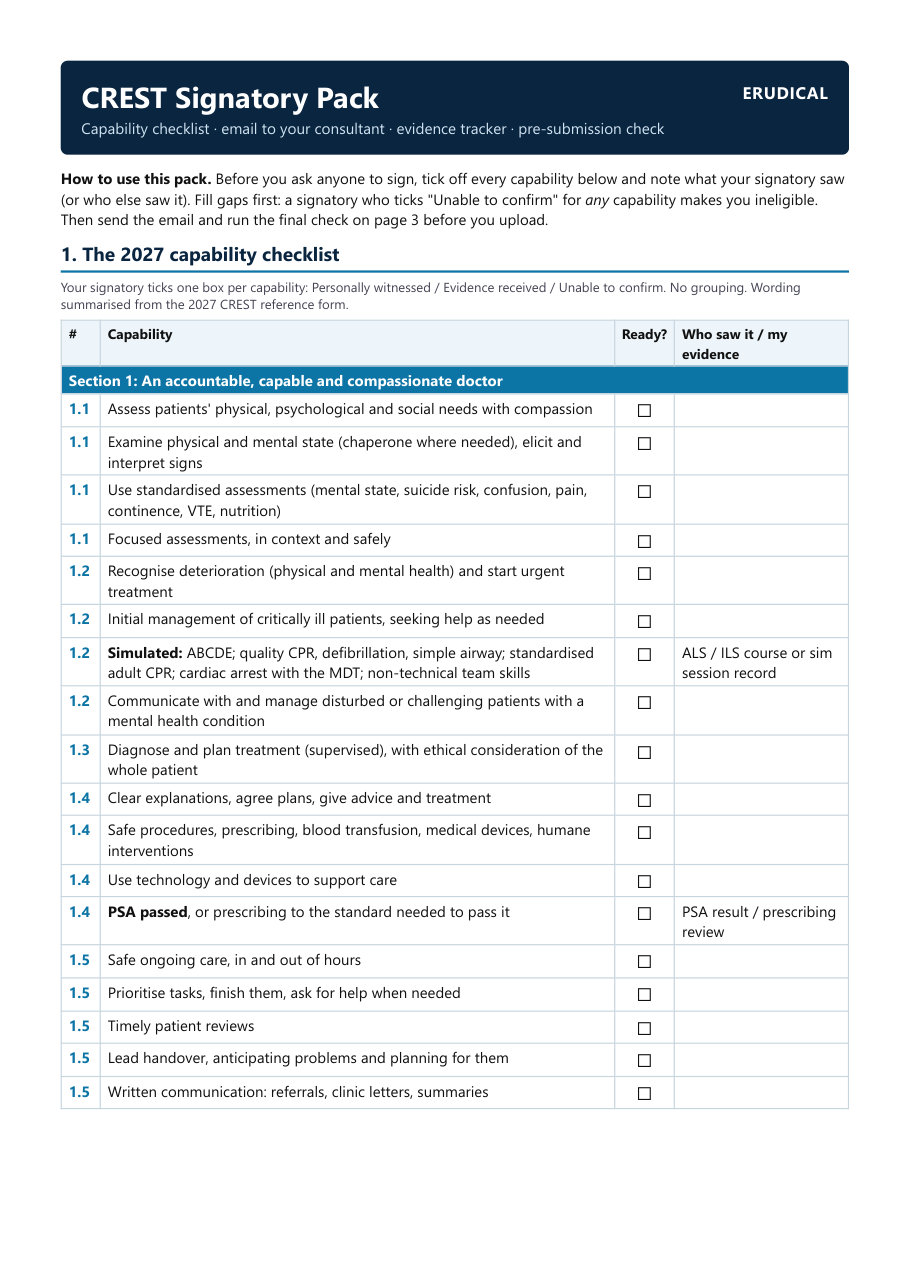
- 1.1 Clinical assessment: communicating with patients to assess their physical, psychological and social needs; examining physical and mental state with a chaperone where needed; using standardised assessments (mental state, suicide risk, confusion, pain, VTE, nutrition and so on); focused assessments done safely.
- 1.2 Clinical prioritisation: recognising and starting urgent treatment of deterioration; initial management of critically ill patients; in a simulated setting, ABCDE assessment, quality CPR and defibrillation, simple airway manoeuvres, managing a cardiac arrest with the team and non-technical team skills; managing disturbed or challenging patients with a mental health condition.
- 1.3 Holistic planning: diagnosing and making treatment plans, with appropriate supervision.
- 1.4 Communication and care: clear explanations and agreed plans; safe procedures, prescribing, transfusion and devices; using technology; and either a pass in the Prescribing Safety Assessment (PSA) or prescribing to the standard needed to pass it.
- 1.5 Continuity of care: safe care in and out of hours; prioritising tasks; timely reviews; leading handover; written referrals and letters.
Section 2: A valuable member of the healthcare workforce
- 2.1 Sharing the vision: working confidently in the multi-professional team.
- 2.2 Fitness for practise: managing your own wellbeing.
- 2.3 Upholding values: acting as a responsible employee, including speaking up.
- 2.4 Quality improvement: “Take an active part in processes to improve the quality of care”.
- 2.5 Teaching the teacher: “Teach and present effectively”.
Section 3: A professional, responsible for their own practice
- 3.1 Ethics and law: professional practice in line with statutory requirements, through a professional portfolio.
- 3.2 Continuing professional development: learning from experience and feedback, reading and, where appropriate, research.
- 3.3 Understanding medicine: understanding the breadth of medical practice and planning a career.
The form also has your declarations (that you have every capability, that you worked with the signatory for the 3 months, that you follow Good Medical Practice on prescribing for yourself, friends and family, and that you are not related to the signatory), a table of the posts your evidence comes from, the signatory’s declaration A to D and details, and a hospital stamp (or a letterhead confirmation if no stamp is available).
Gaps to close before you ask: teaching and QI
Doctors in service posts usually have plenty for Section 1. The capabilities that most often have nothing behind them are 2.4 quality improvement and 2.5 “Teach and present effectively”, because a rota job doesn’t always include them. Your signatory has to see you do these, or receive reliable evidence that you did, so build something real before you ask: join an audit or QI project on your ward, teach the medical students or nurses with written feedback, and present your work.
A course certificate on its own won’t do it. The signatories’ guide says “Provision of training certificates alone is insufficient to evidence competence.” What a course can do is help you teach well and give you a structure for collecting feedback. Our Teach the Teacher course is built for that, and presenting at a meeting such as NMERC gives you a presentation others have watched. The same teaching and presenting usually score points on your application too.
Mistakes that get a CREST rejected
Recruitment teams don’t check forms before you submit, and if required evidence is missing “you will not be offered another chance to upload it”. Check yours against this list:
- Signed by someone who isn’t a consultant or equivalent, or who is related to you.
- The 3 months include an attachment, observership, unpaid work, telemedicine or bank shifts.
- Any part of the period falls outside the 3½ years before the advertised start date.
- Capabilities grouped together, a box left blank, or “Unable to confirm” ticked anywhere.
- “Evidence received” ticked without the evidence page filled in.
- No current registration evidence for a non-GMC signatory, or historic GMC registration offered instead.
- Digitally signed, with no email from the signatory’s work address confirming it.
- No hospital stamp or letterhead confirmation.
- The CREST and the signatory’s registration evidence uploaded as separate files rather than a single document.
You upload one CREST per recruitment round, and it is used for every application in that round that needs one. Get it right once.
Check your CREST before you apply
Answer a few questions with your own dates: do you need a CREST, does your post count, and are you in the priority group for 2027 posts?
Or get the free CREST signatory pack: a capability checklist, an email to send your consultant and an evidence tracker.
Eligible is not the same as prioritised
Since the Medical Training (Prioritisation) Act 2026, applicants in the priority group are considered first when interviews and training places are offered. Whether you are in the priority group depends on where you qualified, your immigration status and whether you’ve been on a UK programme, not on your CREST. If you need a CREST because you never did the UK Foundation Programme, the programme route doesn’t apply to you at CT1 or ST1, so it comes down to the other two. Read am I prioritised for specialty training? for the full rules.
Either way, your application score decides where you sit when shortlisting and offers are made. Once your CREST is sorted, check your points by specialty or use the IMT application points calculator.
Frequently asked questions
What does CREST stand for?
Certificate of Readiness to Enter Specialty Training. It shows you have the capabilities expected of a UK Foundation Year 2 doctor, so you can apply for CT1 or ST1 training without a recent UK FPCC.
Can two consultants sign one CREST?
No. One consultant (or equivalent) signs, and they must have supervised you for at least 3 continuous months. They can accept reliable evidence from colleagues for capabilities they didn’t see, and those colleagues are listed on the form’s evidence page.
Can my consultant abroad sign my CREST?
Yes, if they meet the same rules and you include current proof of their registration with their medical regulator, with a certified translation if it isn’t in English. The post must still fall within the 3½ years before the advertised start date.
Do locum posts count for a CREST?
A locum post counts only if it is continuous and meets every other rule. Locum bank work can’t be used to confirm your competences.
Is the 2024 CREST form still accepted?
For 2027 recruitment, both the 2024 and 2027 versions are accepted, and a 2024 form must still meet the 2027 rules. From 2028 recruitment, only the newer form is accepted.
Do I need a CREST for ST3?
No. The CREST is for CT1 and ST1 entry. For ST3 and ST4 posts you show core-level competence using the evidence listed in the specialty’s person specification.
Rules on this page come from the Medical Hub’s CREST, foundation competence and signatories’ guidance and the 2027 CREST form. Recruiters make the final decision, so check the official foundation competence guidance before you apply.