A CREST form can only be signed by a consultant or equivalent who has worked with you for at least three continuous months, whole-time equivalent, wholly within the 3.5 years before the advertised start date of the post you are applying for. “Equivalent” includes GPs, clinical directors, medical superintendents, academic professors, locum consultants with a CCT or CESR on the specialist register, and SAS doctors acting as your educational supervisor.
The three months must be complete by the application deadline, and your signatory must not be related to you or in a relationship with you. This page covers who qualifies, what your signatory fills in and the mistakes that get forms rejected. For the rest of the form, see our CREST form guide.
Not sure you need a CREST? Check your eligibility → You usually need one if you did not complete the UK Foundation Programme, or completed it more than 3.5 years before the post starts.
Who counts as “consultant or equivalent”
The form’s instructions define it:
“This certificate can only be signed by a Consultant or equivalent. For the purposes of this documentation, Consultant includes General Practitioners, Clinical Directors, Medical Superintendents, Academic Professors, locum Consultants with a CCT/CESR and who are on the specialist register and Specialty and Specialist (SAS) doctors acting in an educational supervisor capacity.”
Can this person sign your CREST?
| Person | Can they sign? | What to check |
|---|---|---|
| Consultant | Yes | Three continuous months with you, whole-time equivalent, inside the window. |
| GP, clinical director, medical superintendent or academic professor | Yes | Named in the form’s list of equivalents. The same three-month rule applies. |
| Locum consultant with a CCT or CESR, on the specialist register | Yes | The locum post must be continuous and meet all other criteria. Locum bank work does not count. |
| Locum consultant without a CCT or CESR on the specialist register | No | Not a listed equivalent. |
| SAS doctor acting as your educational supervisor | Yes | Must be “acting in an educational supervisor capacity”. |
| SAS doctor not in that role | No | Not a listed equivalent. |
| Registrar | No, but can give evidence | Only if “working satisfactorily at ST5 or above”, and listed on the evidence page. |
| Spouse, partner or family member | No | You and your signatory both declare you are not related or in a relationship. |
| Consultant overseas, registered with another regulator | Yes | Evidence of current registration at the time of signing, with a certified translation if not in English. Previous registration is not accepted. |
The three-month rule
In declaration B, your signatory confirms you worked for them “continuously for a minimum of three months whole time equivalent” within the 3½ years before the advertised start date.
- Continuous: one unbroken period with this signatory, not short spells added together.
- Wholly inside the window: all of it within the 3.5 years before the advertised post start date.
- Finished in time: complete by the application deadline, according to the signatories’ guide.
- Already achieved: “Certificates stating that competences will be achieved before the start date are not accepted.”
What does not count
Medical Hub’s CREST page is direct: “clinical attachments, observer posts, unpaid work and telemedicine posts CANNOT be used to evidence this requirement.” Nor can locum bank work. Locum posts count only “where the post is continuous and meets all other criteria”.
When your signatory has not seen everything
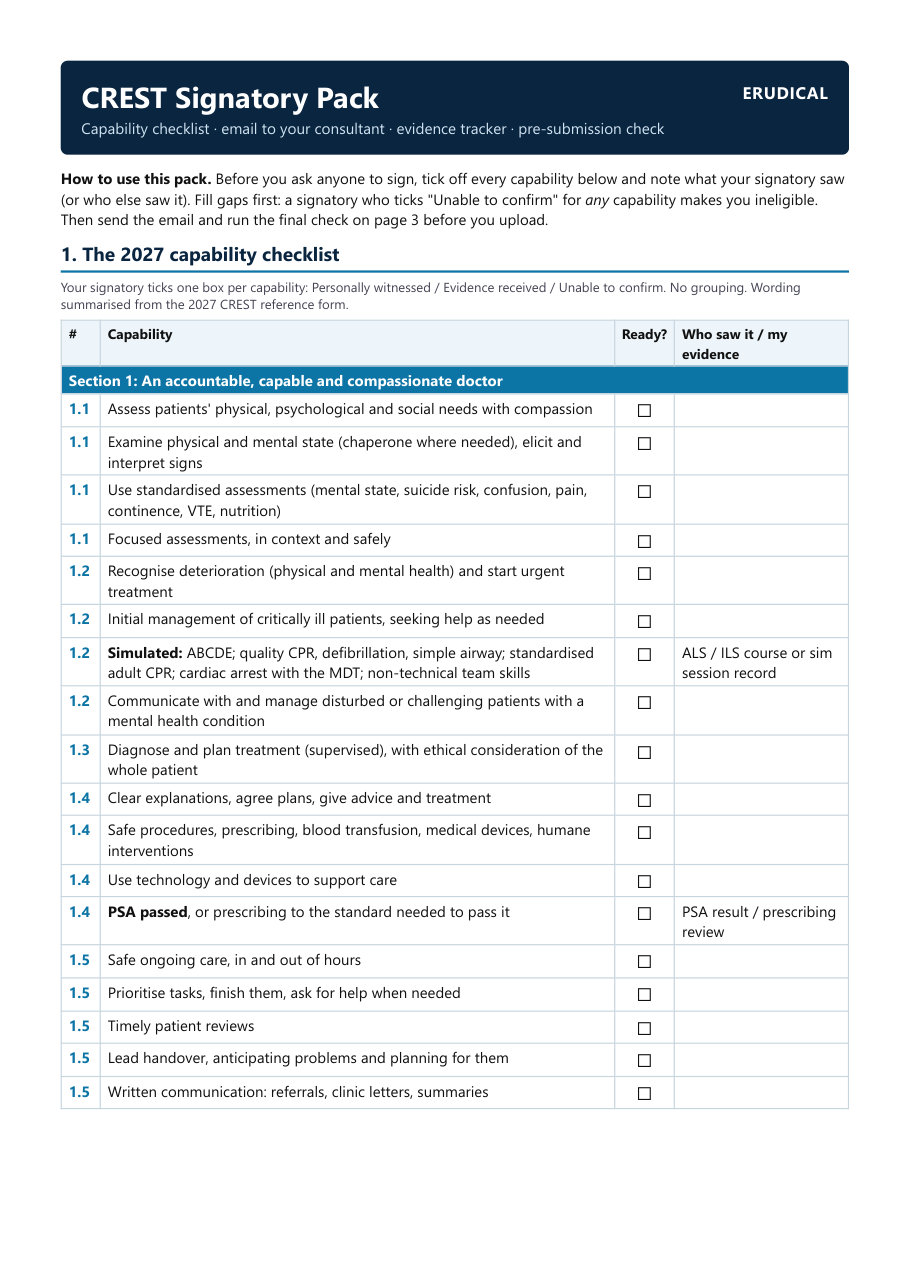
For each capability your signatory ticks one box: Personally witnessed, Evidence received or Unable to confirm. A single “Unable to confirm” makes you ineligible for CT1 or ST1. The signatories’ guide requires “each and every professional capability listed on the certificate”: “There are no exceptions to this rule.”
Declaration C lets your signatory rely on evidence “that I know to be reliable from a colleague (if the colleague is a trainee, they must be working satisfactorily at ST5 or above)”. Each colleague goes on the evidence page with the capabilities they saw, their status, training level, work address, email and dates. Recruiters may contact them to confirm.
You can also bring your signatory additional evidence, which they may accept “in lieu of direct observation”. But “Provision of training certificates alone is insufficient to evidence competence.”
What your signatory must fill in
- One box per capability. “Do not group capabilities together.”
- The foot of each capabilities page: their signature, your name and the date of completion.
- Their details: name, professional status, current post, employer and post when they supervised you, dates supervised, address and email.
- Their registration: a UK GMC number, or their regulator’s name and their registration number, with evidence of current registration.
- Declarations A to D: they have viewed the Foundation Programme curriculum (A), the three-month rule (B), they observed or received reliable evidence for every capability (C), and they are not related to you (D). “This form is invalid unless boxes A, B C and D above are checked.”
- The hospital stamp, or, if there is none or it is not in English, a confirmation on hospital letterhead.
- The evidence page, if any capability is marked “Evidence received”.
If the form is signed digitally, “an email from the signatory’s work email address, confirming authenticity, should be scanned and uploaded with the certificate.” The CREST and any registration evidence go to Oriel as one single document.
Mistakes that get a CREST rejected
Recruitment teams do not check forms before you submit, and if required evidence is missing at submission, you will not get another chance to upload it.
Grouped ticks, or any “Unable to confirm”
Signatories should “tick only one box against each capability on the form”. One “Unable to confirm” makes you ineligible, so gather evidence for weak areas before the form is signed.
Blank details or declarations
The form “MUST be complete in every detail”, and it is invalid unless all four declarations are ticked.
No current registration evidence for a non-GMC signatory
It must be current at the time of signing, and translated if not in English. Historic GMC registration is not accepted. Without it, the applicant is rejected.
A digital signature with no work email, or no evidence page
A digital signature needs the confirming email from the signatory’s work address. Any “Evidence received” tick needs the evidence page completed in full.
Time that does not count, or is not finished
Attachments, observer posts, unpaid work, telemedicine and locum bank work do not count, and the three months must be finished by the application deadline.
How to ask a consultant to sign
- Pick the right person: someone in the table above who supervised you for three continuous months inside the window.
- Ask early, by work email, weeks rather than days before the deadline.
- Send the links: the signatories’ guide and the Foundation Programme curriculum, which declaration A says they have viewed.
- Map your evidence to each capability, and name the consultants or ST5+ colleagues who saw what they did not.
- Check it before you upload, using the CREST checklist, while your signatory can still correct it.
To make the request easier, get the free CREST signatory pack, which includes an email template you can adapt.
Teaching and QI: where service posts often fall short
Two capabilities rarely come from ward work alone. Capability 2.4 asks you to “Take an active part in processes to improve the quality of care”. Capability 2.5, headed “Teaching the teacher”, asks you to “Teach and present effectively”. Doctors in service posts often have no teaching role or QI project, so their signatory has nothing to witness.
Create something they can see or receive evidence of. Teach students, nurses or junior colleagues, ideally where your signatory or an ST5+ colleague can watch, and collect written feedback. Join a QI project or audit and present the results at a departmental meeting, or at a meeting such as NMERC.
Our Teach the Teacher course helps you teach well and leaves you with teaching you can show. It does not sign off 2.5 on its own. The signatories’ guide says training certificates alone are insufficient, so your signatory still has to see you teach, or receive evidence that you have.
Check you are eligible, then check your points
See whether you need a CREST for CT1 and ST1 applications.
Once eligible, your score decides shortlisting: use the application points calculators.
Eligible is not the same as prioritised. That depends on where you qualified, your immigration status and whether you completed the UK Foundation Programme: see specialty training prioritisation.
Frequently asked questions
Can a registrar sign my CREST form?
No. Only a consultant or equivalent can sign. A registrar working satisfactorily at ST5 or above can give your signatory evidence for capabilities they saw, and is listed on the evidence page.
Can a consultant from my home country sign my CREST?
Yes, if you worked with them for three continuous months, whole-time equivalent, within 3.5 years of the advertised start date. They must give you evidence of current registration, with a certified translation if not in English.
Does a clinical attachment count towards the three months?
No. Clinical attachments, observer posts, unpaid work, telemedicine posts and locum bank work cannot be used. A locum post counts only if it is continuous and meets all other criteria.
Can I use two signatories or two CREST forms?
No. You submit one CREST and cannot combine certificates. Colleagues who saw capabilities your signatory did not can give them evidence instead.
Can my consultant sign the CREST digitally?
Yes, with an email from their work address confirming authenticity, scanned and uploaded with the certificate.
Does a signed CREST form expire?
The form “will remain valid for future rounds of application provided that those conditions still apply to the new intended start date.” Your three months must still fall within 3.5 years of the new start date, and that version of the form must still be accepted.
Last checked against Medical Hub’s CREST page, the Evidence of Foundation Competence signatories’ guide and the CREST form (reference version): 30 October 2026.
Related: CREST form guide, CREST eligibility checker, specialty training prioritisation and the application points calculators.