Intensive Care Medicine ST3 · Latest published criteria
Intensive Care Medicine ST3 self-assessment 2027: points calculator and scoring guide
Pick the option that fits your evidence at each step to see your score out of 36, and what you can still add before the deadline.
Applications expected to close 4pm, Thu 10 Dec 2026
- 527 doctor reviews
- 4.7/5 rated for relevance
ICM ST3 points calculator
The ICM ST3 self-assessment has nine domains, each worth up to 4, so the most you can award yourself is 36; a Consultant Intensivist assessor then verifies your evidence and adds a global rating of 0 to 8 for how well it’s organised, which makes the verified score out of 44. That verified score decides who is shortlisted (in 2026 “a minimum verified score of 12 or above is required to be invited to online interview”) and is then added to your interview mark out of 144 for ranking, so by our arithmetic it carries about 23% of the combined 188 marks. ICMNRO hasn’t published 2027 dates or a 2027 matrix, so the scoring here is the 2026 version and the dates are expected ones: ICM recruited in Round 2 last cycle, and the national 2027 Round 2 window runs from 10am on Thursday 19 November until 4pm on Thursday 10 December 2026, with evidence uploaded after the close (in a seven-day window last cycle).
ICM ST3 self-assessment (portfolio verified by a Consultant Intensivist assessor) points at a glance
Your score is the total of the domain scores, out of a maximum of 36.
Self-score is out of 36: 'Applicants can award themselves a maximum of 36 marks in unverified Self-Assessment.' Assessors then add a global rating: 'Verified Self-Assessment has a maximum of 44 marks available, inclusive of the 8 marks available in the 2026 ICM ST3 Self-Assessment Global Rating score.' The self-assessment shortlists ('a minimum verified score of 12 or above is required to be invited to online interview') and also counts in ranking: 'The applicant's Verified Self-Assessment score will then be combined with their interview score' (interview out of 144). That makes it 44 of a combined 188 (about 23%). This is derived; no percentage is published.
| Domain | What scores (official wording) | Max |
|---|---|---|
| Additional degrees & qualifications |
Scores the single best option you can evidence, up to 4 points. Highest applicable descriptor only (0-4). | 4 |
| Additional achievements and prizes relevant to medicine |
Scores the single best option you can evidence, up to 4 points. Highest applicable descriptor only (0-4). | 4 |
| Publications (excluding audit, and publication of posters) |
Scores the single best option you can evidence, up to 4 points. Highest applicable descriptor only (0-4). | 4 |
| Presentations (excluding teaching trainees/students) |
Scores the single best option you can evidence, up to 4 points. Highest applicable descriptor only (0-4). 'National means that participation is routinely extended to, and accepted by, anyone in the country (this includes any of the UK home nations meetings e.g. a meeting run by the Scottish Intensive Care Society or Welsh Intensive Care Society). International means participation extends beyond this'. | 4 |
| Clinical audit and quality improvement projects |
Scores the single best option you can evidence, up to 4 points. Highest applicable descriptor only (0-4). | 4 |
| Teaching skills |
Scores the single best option you can evidence, up to 4 points. Highest applicable descriptor only (0-4). A teaching course alone reaches 1 of 4. | 4 |
| Progress through training and excellence |
Scores the single best option you can evidence, up to 4 points. Scored 0, 2 or 4 only. | 4 |
| Achievements specific to ICM training |
Scores the single best option you can evidence, up to 4 points. Highest applicable descriptor only (0-4). | 4 |
| Leadership and management |
Scores the single best option you can evidence, up to 4 points. Scored 0, 2 or 4 only. | 4 |
| Total | 36 |
Dates for this round
- Applications open expected source
- Applications close expected source
- Date not published yet Self-assessment evidence upload window expected source
- Interview window (Round 2) expected source
- Initial offers released by expected source
- Hold deadline expected source
- Upgrade deadline expected source
What you can still add before 10 December 2026
What each of these adds is the difference between the option you would reach and the one you already hold, so it can be nothing if you hold that option already. The calculator works out the gain from your own answers.
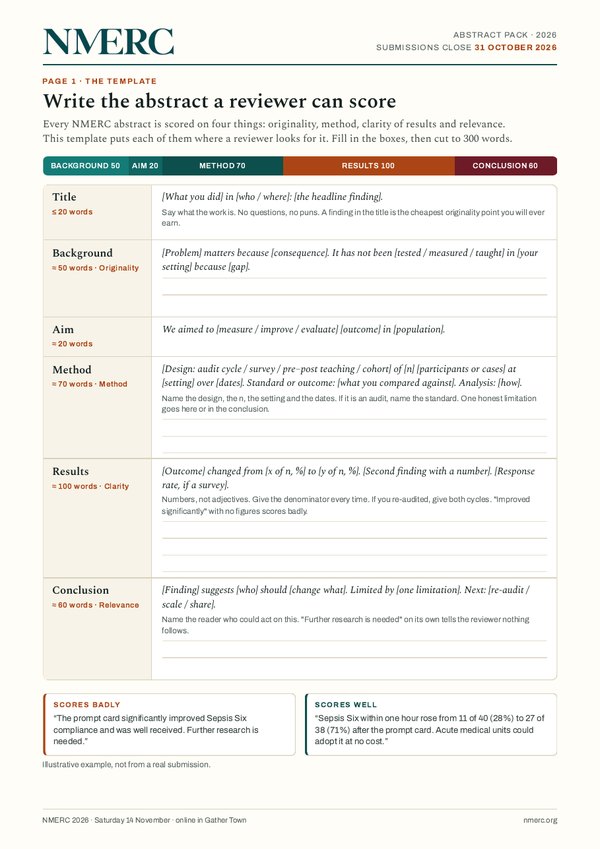
- Presentations (excluding teaching trainees/students). Present at a national meeting held before you apply, for example NMERC 2026 (online, Saturday 14 Nov 2026; free to submit). Keep the programme or abstract book listing your name and title, plus the organiser's letter. For a poster, also keep the poster text. An NMERC oral is delivered in its lecture hall, the meeting's only oral room, and is claimed at 4 ('presented orally in the main auditorium'). An NMERC poster is presented in a timed poster session and is claimed at 3 ('poster presentation sessions'). The NMERC talk is delivered on Sat 14 Nov 2026, and the evidence letter and abstract book are issued by 16 Nov 2026, 16:00. That is before the expected ICM 2027 window (19 Nov to 10 Dec 2026), so it can be in your self-score: 'all domains are measured as at the time of application'. Evidence gained after you apply, before the upload window, can still be uploaded with a request that the assessor consider upgrading your score.
- Teaching skills. Attend a basic teaching methodology course and upload the certificate, e.g. Erudical's teach-the-teacher course (live online day 09:00-17:00 plus a self-paced course, each with its own certificate). Or deliver teaching to healthcare professionals or medical students and collect formal feedback that names you. Applications are expected to close at 4pm on 10 Dec 2026. 'All domains are measured as at the time of application', so aim to attend a live course date and have the certificate before you submit. A course attended after you apply can still be uploaded in the evidence window with a request that the assessor consider upgrading your score; upgrades are at the assessor's discretion.
- Achievements specific to ICM training. Attend a regional or national ICM meeting (1), or complete two ICM-related courses such as a critical care transfer course (2), and keep certificates in your name. Start by 10 December 2026. Aim to attend and have the certificate before you submit (the close is expected at 4pm on 10 Dec 2026). Evidence gained after that, before the upload window, can go in with an upgrade request; upgrades are at the assessor's discretion.
Evidence traps
- One piece of work earns points in one domain only. If you present your audit, you can't also score it in the audit domain. A prize-winning presentation counts as a prize or a presentation, not both.
A single piece of work (e.g. audit project) cannot be credited in the presentation section and audit section, similarly a presentation which wins a prize cannot be credited in both the `prizes' section and 'presentation' section so choose which section you wish the work to be credited.
source - Slides or a poster on their own aren't evidence. Upload the programme or the organiser's acceptance letter with your name and title on it.
An email or letter of acceptance from the conference organiser, etc. (`PowerPoint' slides alone are not sufficient) ... plus text of poster (poster alone is not sufficient)
source - Teaching talks go in Teaching skills, not Presentations. Presenting at regional trainee teaching doesn't count as a presentation.
Teaching presentations (e.g. at regional trainee teaching or for medical students) are not credited in `presentations' but can be credited in the `teaching' section (domain 6)
source - Messy or excessive evidence costs global-rating points. The assessor adds 0-8 for how well your portfolio is organised.
Applicants will be marked down if evidence is difficult to find, not labelled and not clear to the assessor.
source - Your Oriel self-score can't be amended after you submit, so claim only what you can evidence then. Evidence you gain before the upload window can still be uploaded with a request that the assessor upgrade your score; upgrades are at the assessor's discretion.
You may have gained additional evidence in a domain(s) between your initial application and the evidence upload window that you think may give you a higher score than you initially submitted. If this is the case, please upload the additional evidence and mention in the comments for that domain that you would like the assessor to consider upgrading your score
source
Sources
- 2026 ICM ST3 National Recruitment - Self-Assessment Matrix (ICMNRO), 2026 recruitment (Aug 2026 start); live PDF 219,849 bytes; Wayback copy 16 Apr 2026. 2027 matrix not published (2027 filenames return 404; Downloads page lists 2026 only)
- 2026 Intensive Care Medicine Recruitment: Self-Assessment Applicant Guidance (ICMNRO), 2026 recruitment
- 2026 ICM ST3 Self-Assessment Portfolio Global Rating (ICMNRO), 2026 recruitment
- ST3 ICM Applicant Guidance, Round 2 August 2026 (ICMNRO), Round 2 August 2026; Copyright 2025 NHS England
- ICMNRO Recruitment page (timetable and vacancies), Still shows the August 2026 round (Round 2) on 10 Oct 2026
- ICMNRO Downloads page, Lists 2026 documents only
- Intensive Care Medicine ST3 2027 person specification (NHS England Medical Hub), 2027 recruitment
- Recruitment timeline (NHS England Medical Hub), Recruitment timelines for 2027, Round 2, 2027 Round 2 tab
- 2025 competition ratios (NHS England Medical Hub), 2025, Round 2
- 2025 ICM ST3 Self-Assessment Matrix (Wayback copy), for year-on-year comparison, 2025 recruitment; snapshot 4 Aug 2025
- 2025 ICM ST3 Self Assessment Applicant Guidance (Wayback copy), for year-on-year comparison, 2025 recruitment; snapshot 27 Jul 2025
- NMERC 2026 home, programme, submit, help and certificates pages (Erudical), Live pages
Where an ICM applicant can still gain before 10 December 2026
Six of the nine domains can’t really move before the close, because degrees, prizes, publications, a completed audit, supervisor reports and a six-month leadership role aren’t things you can add in time. Teaching skills is the simplest gain: if you score 0 there, a basic teaching methodology course or teaching with formal, positive feedback that names you moves it to 1, and Erudical’s live dates before the close are 24 October, 31 October, 7 November, 15 November, 28 November and 5 December. Presentations offers the biggest step: send NMERC an abstract at nmerc.org/submit, give the talk on 14 November, and the oral is claimed at 4, which is 3 more than a local or regional poster. In Achievements specific to ICM, a regional or national ICM meeting takes you from 0 to 1 and two ICM-related courses such as a critical care transfer course reach 2, and since “all domains are measured as at the time of application”, plan for every certificate to be in hand when you submit (the next section covers evidence that arrives later).
How the evidence is checked
You enter the self-score on Oriel without uploading anything, and “Self-Assessment scores cannot be amended once an application is submitted on Oriel.” The documents go to Qpercom later (14 to 21 January 2026 last cycle), and ICMNRO says “We will not be accepting evidence outside this window/process”. Something you gain after applying can still reach that window, because the 2026 applicant guidance says: “You may have gained additional evidence in a domain(s) between your initial application and the evidence upload window that you think may give you a higher score than you initially submitted. If this is the case, please upload the additional evidence and mention in the comments for that domain that you would like the assessor to consider upgrading your score”. Upgrades are at the assessor’s discretion. The global rating rewards “organisation, planning and quality of the evidence”, so a well-founded claim can still lose marks if the assessor can’t find it: “Applicants will be marked down if evidence is difficult to find, not labelled and not clear to the assessor.”
Worked example: a CT2 anaesthetics trainee on 9 of 36
This doctor is a CT2 in anaesthetics with the Primary FRCA, which is their eligibility exam. They have no prizes, are co-author on a case report that isn’t PubMed-cited, showed a poster at a regional meeting and designed and led a completed audit. They’ve given some teaching, though without formal feedback, and have never attended a teaching course. One educational supervisor report calls their work excellent, they’ve been to a regional ICM meeting, and they held a local rota-improvement role for six months, with a letter confirming its impact. Scored on the 2026 matrix:
- Additional degrees and qualifications: 0, because the Primary FRCA is what makes them eligible.
- Additional achievements and prizes: 0.
- Publications: 1, as co-author on a publication that isn’t PubMed-cited.
- Presentations: 1, for a poster at a local or regional meeting.
- Clinical audit and quality improvement: 2, for designing or leading a completed project.
- Teaching skills: 0, since teaching without formal, positive feedback doesn’t meet the 1-point descriptor.
- Progress through training and excellence: 2, for one supervisor report citing excellent performance.
- Achievements specific to ICM: 1, for CPD at a regional ICM meeting.
- Leadership and management: 2, for a local role of 6 months or more with evidence of positive impact.
That’s 9 out of 36. Completing a teaching methodology course before applying lifts Teaching skills by 1, from 0 to 1. A first-author oral at NMERC on 14 November, on a different project from the audit, takes Presentations from 1 to 4, a gain of 3. Together they bring this doctor to 13, a gain of 4; if the abstract were accepted as a poster instead, Presentations would rise to 3 and the total would be 12. All of these figures are out of 36. The assessor’s global rating is added on top, and the 2026 interview line of 12 applies to that verified total out of 44, so at 9 this doctor would need every claim verified and at least 3 for evidence quality to reach it, while at 13 the self-score alone clears it if nothing is marked down. For comparison, the mean verified score in the 2025 round was 24 out of 44.
Choose the descriptor your evidence supports in each domain and the calculator adds up your self-score out of 36 and the gain from anything you could still add; the global rating isn’t included, because only the assessor awards it. We’ll show your result and email you a copy.
Go to the ICM ST3 calculator at the top of this page
Want the ICM ST3 table on one printable page, with an alert if the scoring changes for 2027? Leave your email.
Email me the printable version
Check your inbox. Your printable cheat sheet is on its way to .
While you wait, work out your score with the calculator. If the email isn't there in a few minutes, check your junk folder.
Does a teach the teacher course count for ICM ST3?
Yes, for 1 point in Domain 6, Teaching skills, at the tier “I have taught healthcare professionals or medical students with evidence of formal, positive feedback OR I have attended a basic teaching methodology course”. The evidence ICMNRO asks for is “A certificate of attendance or completion of teaching methodology course”, in your name, and the matrix sets no minimum length, number of live hours or approved provider. Because the descriptor is either/or, the course adds 0 if you already hold that tier or higher: teaching with formal, positive feedback earns the same point, and a course alone can’t take the domain past 1, since the higher tiers need regular course teaching or instructor status (2), a regional programme or over half of a PGCert (3), or a national programme or completed higher teaching qualification (4). Erudical’s course is training in teaching methods, a live online day from 09:00 to 17:00 plus a self-paced course, each with its own certificate. It doesn’t prepare you for ICM selection or the interview, and its only role in this application is the Domain 6 descriptor above. Try to attend before submitting your application, and keep the certificate for the evidence window; a course attended after you apply can still be uploaded there with a request that the assessor consider upgrading your score. Doctors who want to teach rather than train can ask about tutoring, since Erudical is always recruiting people to deliver its teaching course. NMERC and Erudical roles may qualify. See the NMERC and Erudical websites and contact us for details. The Teach the Teacher course for ICM ST3 page has the dates; our teaching points by specialty page compares what the same training is worth elsewhere.
What an NMERC talk or poster adds for ICM
NMERC is an online meeting held in Gather Town on Saturday 14 November 2026, the week before ICM applications are expected to open. Every doctor and medical student is eligible to submit, which matters for ICM because many applicants work in non-training posts, and presenting is free; abstracts can be submitted at nmerc.org/submit, and the evidence letter and abstract book are issued by 4pm on 16 November, so the talk is delivered and documented before you apply. Both name each co-author and where they sit in the author order, which is how a first or second author shows their place on a poster. ICM’s test for a national meeting is openness, “National means that participation is routinely extended to, and accepted by, anyone in the country”. The top Presentations tier reads “I have presented orally in the main auditorium at a national or international medical meeting”, and NMERC’s whole oral programme, along with the opening and the prizes, runs in its lecture hall, its only oral room, so we treat that as the main auditorium and an oral there is claimed at 4. NMERC’s posters are shown in two timed poster sessions, which we treat as “poster presentation sessions” under the 3-point tier. What you gain depends on where Presentations stands now: an oral adds 3 to a regional poster, a poster adds 2 to it, and someone who already has a main-auditorium oral gains none. The 4 belongs to the person who gives the talk, and the assessor verifies each claim against the organiser’s letter or programme, since slides on their own aren’t accepted. Present a different piece of work from anything you’re claiming in audit, because “A single piece of work (e.g. audit project) cannot be credited in the presentation section and audit section”. The same applies to Publications: if NMERC publishes a full write-up of your abstract, it can’t score there once the work has scored under Presentations, and the guidance says “Publication of a poster abstract (if the same poster has gained credit in another domain) doesn’t score here”. Acceptance of an abstract isn’t guaranteed.
ICM ST3 scoring questions
How many points is a national oral presentation worth for ICM ST3?
Up to 4. The 4-point tier is an oral “in the main auditorium at a national or international medical meeting”. A poster presented orally, a side session or a poster presentation session at a national meeting scores 3, and since 2026 an oral at a regional meeting also scores 3. A poster displayed at a national meeting is 2, and a local or regional poster is 1. Teaching sessions given at regional trainee teaching or to medical students go in Teaching skills, not here.
What score do you need for an ICM ST3 interview?
For the 2026 round, 12 out of 44: “a minimum verified score of 12 or above is required to be invited to online interview”. The 44 is your self-score of up to 36 plus the assessor’s global rating of up to 8. Reaching 12 isn’t a guarantee, because invitations also depend on interview capacity, and ICMNRO warns that “If application numbers far exceed the interview capacity further shortlisting may be required.” In the 2025 round 537 people applied for 181 ICM ST3 posts, a ratio of 2.97, and the mean verified score was 24.
When do ICM ST3 2027 applications open?
ICMNRO hadn’t published 2027 dates by 10 October 2026. ICM recruits in Round 2, and NHS England’s 2027 Round 2 timeline runs from 10am on Thursday 19 November to 4pm on Thursday 10 December 2026. Its interview window is 11 January to 9 April 2027, and first offers are due by 5pm on Tuesday 13 April 2027. In the previous cycle ICM closed at 4pm on 11 December 2025 and took evidence from 14 to 21 January 2026, with online interviews in March.
Does the exam I needed to apply count as an extra qualification?
No. ICMNRO says “Eligibility for application for ICM training requires full MRCP (Parts 1, 2 and PACES) for physicians, MRCEM/FRCEM Intermediate for EM trainees and Primary FRCA for Anaesthesia core trainees, therefore these do not count as additional qualifications”. A further exam beyond your route’s requirement can score, such as the Final FRCA for an anaesthetic trainee (2). A PGCert in education is scored under Teaching skills and EDIC under Achievements specific to ICM, not in Domain 1. If you’re also applying to anaesthetics for a dual CCT, that specialty runs its own self-assessment with different domains; see our Anaesthetics ST4 self-assessment scoring.