Paediatrics ST1 and ST3 · Latest published criteria
Paediatrics ST1 and ST3 shortlisting scoring framework 2027: points calculator and scoring guide
Pick the option that fits your evidence at each step to see your score out of 30, and what you can still add before the deadline.
ST1: applications close 4pm, Thu 19 Nov 2026ST3: applications expected to close 4pm, Thu 10 Dec 2026
- 527 doctor reviews
- 4.7/5 rated for relevance
Paediatrics points calculator
Paediatrics has two entry points with their own RCPCH frameworks, ST1 and ST3, and both work the same way: two assessors each mark your written Oriel answers out of 30, giving a total of 60, and no documents are uploaded. ST1 has five areas, one of which carries a +1 for a research qualification, and ST3 has five areas with two such bonus points. The values here are RCPCH’s 2026-27 frameworks, because the 2027-28 versions aren’t out yet; the RCPCH ST1 page says “Up-to-date guidance and interview dates coming soon”. The score is only a shortlisting tool, used “in the case of needing to ensure interview numbers are within the interview capacity”, and “Shortlisting scores will not be carried over to interview.” ST1 applications run from 10:00 on Thursday 22 October to 16:00 on Thursday 19 November 2026. RCPCH hasn’t dated ST3 for 2027, which should follow the national Round 2 timetable (opening 10am, 19 November; closing 4pm, Thursday 10 December 2026). At both levels the answers lock when you submit, so submission is your real deadline.
Paediatrics shortlisting scoring framework (application form answers on Oriel, scored by two assessors; no evidence uploaded) points at a glance
Paediatrics ST1 (Round 1, posts from Aug/Sep 2027)
Your score is the total of the domain scores, out of a maximum of 30.
Per assessor: “Total score for application form: 30 (per assessor)”; two assessors, “The maximum score available, per assessor, is 30. The Total score is therefore 60.” Used only for shortlisting when over capacity: “The score will be used in the case of needing to ensure interview numbers are within the interview capacity for ST1.” “Shortlisting scores will not be carried over to interview.”
| Domain | What scores (official wording) | Max |
|---|---|---|
| Transferable clinical capabilities |
Scores the single best option you can evidence, up to 8 points. Scored on all five entries together. Glossary: “e.g. 5 examples but two are demonstrating the same capability - max score would be 6.” Max 2 practical procedures. | 8 |
| Personal achievements and reflection |
Scores the single best option you can evidence, up to 8 points. Scored on all five entries together. Glossary: “e.g. 5 examples but two are very similar - max score would be 6.” | 8 |
| Quality Improvement Project (QIP)/Audit |
Scores the single best option you can evidence, up to 5 points. Best single project of up to two counts. | 5 |
| Research and academic achievements |
Scores the single best option you can evidence, up to 3 points. Out of 3, plus a separate +1 for a research qualification (modelled as the next domain). Best single example counts. Erudical’s reading: a poster doesn’t count as a presentation, so present an oral. | 3 |
| Research qualification (+1, part of Area 4) |
Each item you can evidence adds its points, up to 1 point for the domain. Adds to the Area 4 score; Area 4 total max 4. | 1 |
| Education – involvement in delivering education/teaching |
Scores the single best option you can evidence, up to 5 points. Best single example of up to two counts. No qualification bonus at ST1. | 5 |
| Total | 30 |
Paediatrics ST1 (Round 1, posts from Aug/Sep 2027): Dates for this round
- Advert appears source
- Applications open source
- Applications close (answers locked on submission) source
- Shortlisting window opens source
- Shortlisting window closes source
- Invite to interview & applicant declaration sent source
- Interview booking & declaration deadline source
- Interview window opens source
- Interview window closes source
- Offers released source
- Hold deadline source
- Upgrade deadline source
- Paperwork deadline source
Paediatrics ST1 (Round 1, posts from Aug/Sep 2027): What you can still add before 19 November 2026
What each of these adds is the difference between the option you would reach and the one you already hold, so it can be nothing if you hold that option already. The calculator works out the gain from your own answers.
- Transferable clinical capabilities. No new activity is needed. Choose five clearly different capabilities you already have (at most two procedures) and write each one with a reflection linked to paediatrics, within the 50-word limits. Start by 22 October 2026. Applications open 10:00 Thu 22 Oct 2026 and close 16:00 Thu 19 Nov 2026; answers cannot be amended after submission.
- Personal achievements and reflection. Mostly a writing task. Pick five clearly different achievements and reflect on each. A new achievement completed before you submit (e.g. a charity or community project) can also be used. Start by 22 October 2026. Answers are locked when you submit; the application closes 16:00 Thu 19 Nov 2026.
- Quality Improvement Project (QIP)/Audit. If you planned or coordinated an audit/QIP that has results, present it as an oral (a poster doesn’t count as a presentation) at a regional or national meeting held before you submit (e.g. NMERC, online, Sat 14 Nov 2026), then submit. This moves you from 4 (local, with results) to 5. The NMERC meeting is 14 Nov 2026, before the 16:00 19 Nov 2026 close. You must submit after presenting because answers cannot be amended.
- Research and academic achievements. Give an oral presentation of research or academic work (a poster doesn’t count as a presentation) at a national meeting held before you submit, e.g. NMERC (online, Sat 14 Nov 2026; free abstract submission at nmerc.org/submit). Select “Presentation at national/international meeting” and describe your role in detail. NMERC is delivered 14 Nov 2026, before the 16:00 Thu 19 Nov 2026 close. Submit after presenting: “it is not possible to amend answers after submission.”
- Education – involvement in delivering education/teaching. Design and lead a teaching session, collect learner evaluation (4), then deliver a later session shaped by that feedback (5); the later session must already have happened when you submit. Describe each step: “Describe your involvement, including any evaluation and subsequent modifications that you carried out”. Start by 29 October 2026. Planning estimate, not an official date: allow about three weeks for a session, feedback and a revised session before the 16:00 Thu 19 Nov 2026 close.
Paediatrics ST3 (Round 2, posts from Aug/Sep 2027)
Your score is the total of the domain scores, out of a maximum of 30.
“Total score for application form white-space answers: 30” per assessor; “The maximum score available, per assessor, is 30. The Total score is therefore 60.” Used only if applicants exceed interview capacity: “The score will be used in the case of needing to ensure interview numbers are within the interview capacity for ST3.”
| Domain | What scores (official wording) | Max |
|---|---|---|
| Clinical capabilities |
Scores the single best option you can evidence, up to 8 points. Scored on all five entries together. Scores 6–8 require examples “including acute general paediatric assessment skills, neonatal resuscitation and safeguarding”. Max 2 practical procedures. | 8 |
| Quality Improvement Project (QIP)/Audit |
Scores the single best option you can evidence, up to 6 points. One project only. | 6 |
| Leadership/management |
Scores the single best option you can evidence, up to 5 points. One role only. Glossary: roles “should not be a clinical leadership role, where you led a clinical situation/team.” | 5 |
| Research and academic achievements |
Scores the single best option you can evidence, up to 4 points. Out of 4, plus a separate +1 for a research qualification (next domain). Best single example counts. A national/international presentation appears in both tier 3 and tier 4, so it can be claimed at either; the panel decides. Erudical’s reading: a poster doesn’t count as a presentation, so present an oral. | 4 |
| Research qualification (+1, part of Area 4) |
Each item you can evidence adds its points, up to 1 point for the domain. Adds to Area 4; Area 4 total max 5. | 1 |
| Education – involvement in delivering education/teaching |
Scores the single best option you can evidence, up to 5 points. Out of 5, plus a separate +1 for an educational qualification (next domain). Best single example counts. | 5 |
| Educational qualification (+1, part of Area 5) |
Each item you can evidence adds its points, up to 1 point for the domain. Adds to Area 5; Area 5 total max 6. | 1 |
| Total | 30 |
Paediatrics ST3 (Round 2, posts from Aug/Sep 2027): Dates for this round
- Applications open (national Round 2, expected for paediatrics ST3) expected source
- Applications close (answers locked on submission) expected source
- Interview window opens (national) expected source
- Interview window closes (national) expected source
- Initial offers released by expected source
- Hold deadline expected source
- Upgrade deadline expected source
Paediatrics ST3 (Round 2, posts from Aug/Sep 2027): What you can still add before 10 December 2026
What each of these adds is the difference between the option you would reach and the one you already hold, so it can be nothing if you hold that option already. The calculator works out the gain from your own answers.
- Clinical capabilities. Writing task: make sure your five examples cover acute general paediatric assessment, neonatal resuscitation and safeguarding, each with reflection on ST3 readiness. Start by 19 November 2026. Expected opening of the national Round 2 (10am Thu 19 Nov 2026); the 2027 paediatric ST3 dates are not yet on the RCPCH page.
- Quality Improvement Project (QIP)/Audit. If you led an audit/QIP with results, present it as an oral (a poster doesn’t count as a presentation) at a regional or national meeting before you submit (e.g. NMERC, online, Sat 14 Nov 2026): 4 → 5, or 6 with evidence of change. The NMERC meeting (14 Nov 2026) is before the expected Round 2 close (4pm Thu 10 Dec 2026).
- Research and academic achievements. Give an oral presentation of research or academic work (a poster doesn’t count as a presentation) at a national meeting before you submit, e.g. NMERC (online, Sat 14 Nov 2026; free abstract submission at nmerc.org/submit). NMERC is delivered 14 Nov 2026, before the expected Round 2 close (4pm Thu 10 Dec 2026). “There will also be no opportunity to amend or add more evidence to your application form after it has been submitted”.
- Education – involvement in delivering education/teaching. Design and lead a session, collect learner evaluation (4), then deliver a later session changed by that feedback (5), and describe each step. The later session must already have happened when you submit. Start by 12 November 2026. Planning estimate, not an official date: about four weeks before the expected Round 2 close (4pm Thu 10 Dec 2026).
Evidence traps
- Saying you designed, led or delivered something without explaining how scores nothing for that element. Spell out what you actually did in the 50 words.
it is not sufficient for an answer to simply state ‘I designed and led...’ etc – such responses will not be awarded with marks. Answers must include a succinct description of how the applicant carried out these actions, where requested.
source - You cannot edit or add anything after you submit, and nothing is uploaded. If you are presenting at a meeting before the close, present first and submit afterwards.
Applicants will be required to answer questions at time of application, it is not possible to amend answers after submission.
source - A teaching qualification does not score in the ST1 Teaching area. The only ST1 qualification credit is +1 for a research qualification in Area 4. At ST3 the education +1 is limited to a PG Cert, PG Dip or MSc. A teach-the-teacher course scores in neither.
Additional points awarded for a research qualification on top of the score for the above criteria … PG Cert, Postgraduate diploma, MSc, MD (University research award), PhD +1
source - Five examples that overlap cap you at 6 in the clinical and achievements areas. At ST3, the 6–8 tiers also need acute assessment, neonatal resuscitation and safeguarding among your examples.
e.g. 5 examples but two are demonstrating the same capability - max score would be 6.
source - At ST3, a leadership example where you led a clinical situation or team does not count; use a non-clinical lead role (rota, committee, teaching programme, chief registrar).
Roles could be outside or within your work environment, but importantly, should not be a clinical leadership role, where you led a clinical situation/team.
source
Sources
- ST1 Scoring Guidance for Shortlisting 2026-27 inc. Glossary (RCPCH), v.4, file dated 27 Oct 2025; includes “Update 28 October 2025”
- Paediatric ST3 Recruitment 2026-2027 Shortlisting Scoring Framework & Guidance (RCPCH), 2026-27, uploaded Nov 2025
- ST1 Paediatrics Applicant Guidance R1 August 2026, final v.3, 15 Oct 2025
- ST3 Paediatrics Applicant Guidance R2 August 2026, Nov 2025
- RCPCH: Applying for paediatric specialty training at ST1 - guidance (2027-28 timeline), Last updated 9 October 2026
- RCPCH: Specialty training at ST3 - application guidance, Last updated 6 March 2026 (still shows 2026 recruitment)
- NHS England Medical Hub: Recruitment timeline (2027 Round 1 and Round 2), Page last reviewed 24 February 2026
- Paediatrics ST1 person specification 2027, 2027
- Paediatrics ST3 person specification 2027, 2027
Paediatrics ST1: five written areas worth 30
The ST1 form asks for short entries, 50 words per box, under Transferable clinical capabilities (8), Personal achievements and reflection (8), QIP/Audit (5), Research and academic achievements (3, plus 1 for a research qualification) and Teaching (5). The first two areas reward variety: up to five examples, each with a reflection tied to paediatrics, and the 6 to 8 tiers need “clear and distinctly different” ones, with at most two practical procedures. The glossary gives the cap in plain terms (“e.g. 5 examples but two are demonstrating the same capability – max score would be 6.”) and treats an answer as minimal when it is “so generic that it could be linked to any specialty.” In QIP/Audit, Research and Teaching only the better of two examples counts. The top audit tier is “Evidence of having planned/coordinated and presented a good quality audit/QIP at a regional/national/international meeting as well as description of results/recommendations”, and the top research tier needs a detailed account of your role “with at least one of: national/international presentation, publication as first or last author”. The research +1 covers “PG Cert, Postgraduate diploma, MSc, MD (University research award), PhD”, and since the October 2025 update you claim it “by naming the qualification at the end of your entry in the last text-box”.
Paediatrics ST3: working at ST3 level, scored out of 30
ST3 swaps the achievements question for Leadership/management and asks how ready you are to work at ST3 level. Clinical capabilities is out of 8, and the 6 to 8 tiers need your examples to include “acute general paediatric assessment skills, neonatal resuscitation and safeguarding”, so five strong examples that leave one out stop at 5. QIP/Audit is out of 6 and scores a single project: tiers 4 to 6 say “led”, where 2 and 3 only say “planned/coordinated”, and 6 adds “evidence of change” to a regional, national or international presentation. Leadership/management is out of 5 and excludes the obvious example, since roles “should not be a clinical leadership role, where you led a clinical situation/team.” Research is out of 4 with a +1 for “PG Cert, Postgraduate diploma, MSc, PhD”, and Teaching is out of 5 with a separate +1 for an educational qualification, “PG Cert, Postgraduate diploma, MSc”. One quirk matters for presenters: a national presentation appears in both the 3-point research tier (beside co-authorship) and the 4-point tier (beside first or last authorship), so you can claim it at either, with the panel deciding; our worked figures use 3. For paediatrics we count only an oral as a presentation, since on our reading a poster doesn’t count.
What paediatric applicants can still change
Much of the ST1 score depends on how you write things up. Before 16:00 on 19 November you can rework Areas 1 and 2 so that five capabilities and five achievements are clearly different from each other and each carries a reflection, which can move either area up its 0 to 8 scale without any new activity. Teaching can rise too: design and lead a session, collect learner evaluation for 4, then deliver a later session that uses that feedback for 5, which needs the later session to have happened before you submit; as a planning estimate rather than an official date, start around 29 October for ST1 (about three weeks before the close) or 12 November for ST3 (about four weeks before). Research and audit move if you give an oral presentation before you submit. Submitting to NMERC (nmerc.org/submit) and giving the talk on 14 November takes ST1 Research from 1 to 3 for someone with a detailed role but no presentation, or ST1 QIP/Audit from 4 to 5 for an audit already presented locally with results. At ST3 the same talk can lift a led project from 4 to 5, or 6 with evidence of change, and there’s until 10 December to submit. An ST3 leadership role is hard to start now, because tiers 4 and 5 need delivery and impact you can describe.
Where written answers lose marks
Assessors only have your words, and RCPCH is blunt about thin ones: “It is not sufficient for an answer to simply state ‘I designed and led…’ etc – such responses will not be awarded with marks.” The research glossary adds that you “cannot just state “I was involved in…”, “I was part of…”, etc”, so say what you did, how, and what came of it.
Worked example: an FY2 applying for ST1 on 16 of 30
This FY2 can describe three clear but overlapping capabilities relevant to paediatrics and two achievements with reflection. They coordinated an audit and presented it at a departmental meeting with results, can explain their role in a research project in detail but haven’t presented it, and designed and delivered one teaching session. Scored per assessor:
- Transferable clinical capabilities: 5, for “Three clear examples relevant to a career in paediatrics with reflection”.
- Personal achievements and reflection: 4, for two clear examples with reflection.
- QIP/Audit: 4, for planning, coordinating and presenting locally “as well as description of results/recommendations”.
- Research and academic achievements: 1, for “Detailed description of involvement in research/academic work”.
- Research qualification: 0.
- Teaching: 2, for “Evidence of involvement in designing and delivering education/teaching”.
That’s 16 out of 30 from each assessor. Giving the research as an oral on 14 November at NMERC and submitting afterwards takes Research from 1 to 3, a gain of 2, so 18 per assessor, or up to 4 more on the combined 60 if both assessors agree. Presenting the audit there instead would take QIP/Audit from 4 to 5, a gain of 1. A teaching course would change nothing on this form. At ST3, the same national presentation moves Research from 2 for a local or regional one to 3, or to 4 if the panel reads the higher tier literally.
Pick the descriptor that matches what your written answer would show in each area, and the calculator gives your score per assessor out of 30 and what each remaining step would add before you submit. We’ll show your result and email you a copy.
Go to the Paediatrics calculator at the top of this page
To get both paediatric frameworks as a printable sheet, with an alert when RCPCH publishes the 2027-28 versions, add your email.
Email me the printable version
Check your inbox. Your printable cheat sheet is on its way to .
While you wait, work out your score with the calculator. If the email isn't there in a few minutes, check your junk folder.
Does a teach the teacher course count for Paediatrics?
No, at either level, and it scores 0 however you enter it. The Education area at ST1 and ST3 scores “involvement in delivering education/teaching”, from “Very limited evidence of involvement in delivering education/teaching” (1) up to “Clear evidence of designing, delivering and leading education/teaching, including evaluation from learners and utilisation of feedback for future sessions” (5), and no tier credits training in how to teach. The ST3 framework says so directly: “This domain is assessing your experience in involvement in delivering teaching.” The bonus points don’t help either. At ST3 the +1 is for an educational qualification listed as “PG Cert, Postgraduate diploma, MSc”, and at ST1 there is no education credit at all, because the only +1 is for a research qualification in Area 4. A course might help you plan and evaluate a session, but the marks come from the teaching you then deliver and describe. Delivering teaching yourself is what builds that evidence, and Erudical is always looking for doctors to teach on its Teach the Teacher course, so get in touch if that appeals. Our table of teaching course points across specialties shows where a course does score.
NMERC and the paediatric research and audit areas
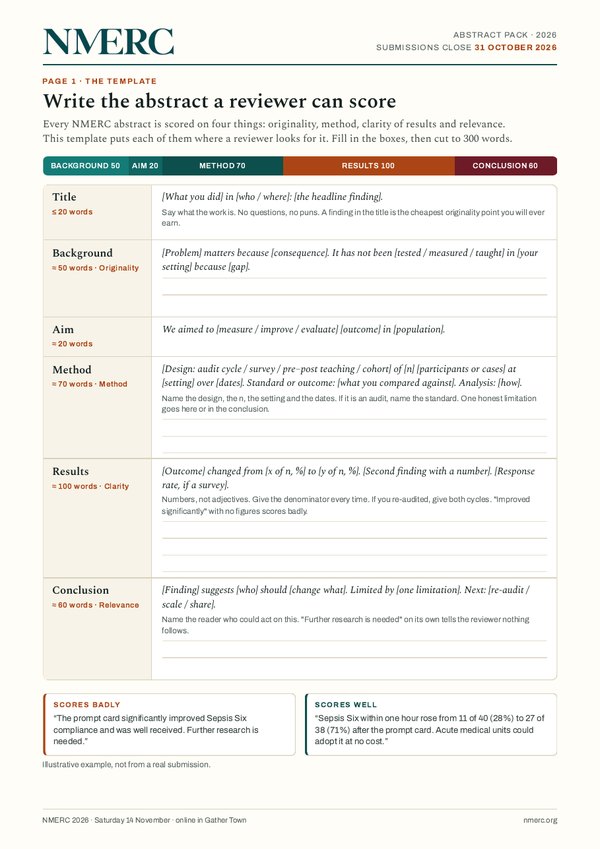
NMERC is a free-to-present meeting held online on Saturday 14 November 2026, and doctors and medical students can submit from anywhere. Abstracts can be submitted at nmerc.org/submit, you’ll know the outcome inside five days, and presenters have their evidence letter and the abstract book by 4pm on Monday 16 November. The meeting falls five days before the ST1 close and nearly four weeks before the expected ST3 close, and since “it is not possible to amend answers after submission”, give the presentation first and submit afterwards. At ST1 it can meet “Detailed description of involvement in research/academic work with at least one of: national/international presentation, publication as first or last author” (3, the Area 4 maximum before the +1), or, for an audit with results, the 5-point QIP tier. At ST3 it reaches research tier 3 or 4 (either is a fair claim, and the panel decides) and, for a project you led, QIP tier 5, or 6 with evidence of change. Submit it for an oral slot, because a poster won’t count as a presentation for paediatrics on our reading, and what you gain depends on where you stand now. Acceptance of an abstract isn’t guaranteed.
Paediatric shortlisting: common questions
How is the paediatric ST1 application scored?
Two consultant paediatricians mark your Oriel answers against the RCPCH framework, each out of 30, for a total of 60. There’s no supporting statement and no upload: “Scoring will be based purely on the written examples, that are input directly onto the Oriel application form.” The score is used to trim the list when eligible applicants exceed interview places, which RCPCH says has happened “by a good number” in recent years, and appointability is then decided at interview.
Does a national presentation count for paediatrics ST1 and ST3?
Yes, in the research area at both levels, and in the audit area if it’s your audit or QIP with results. At ST1 a national or international presentation reaches the 3-point research tier, and an audit presented regionally or nationally with its results reaches 5. At ST3 it scores 3 or 4 out of 4 in Research, and a project you led reaches 5 or 6 in QIP/Audit. It needs to be an oral, since a poster doesn’t count as a presentation here on our reading, and it only counts if you’ve presented before you submit.
When do paediatrics ST1 applications close for 2027?
At 16:00 on Thursday 19 November 2026. The RCPCH 2027-28 timeline has the advert appearing by 17:00 on 21 October, applications opening at 10:00 on 22 October, shortlisting from 16 December 2026 to 11 January 2027, and interviews between 2 February and 25 March 2027, with offers by 17:00 on 6 April. Paediatrics ST3 used national Round 2 last year, and that round is expected to run from 19 November to 10 December 2026.