You apply for IMT in the autumn of FY2, and most of the points in your IMT portfolio take months to earn. On the 2027 scale the IMT self-assessment is scored out of 30. In 2025, the last round scored out of 30, the interview cut-off was 15 and the median applicant scored 14.
FY1 is when the slow points are won or lost: a teaching programme, two cycles of a QI project and a national presentation. This plan sets out what each of the six domains is worth, what to start in each part of FY1 and FY2, and the evidence to keep as you go.
What the IMT portfolio is scored on in 2027
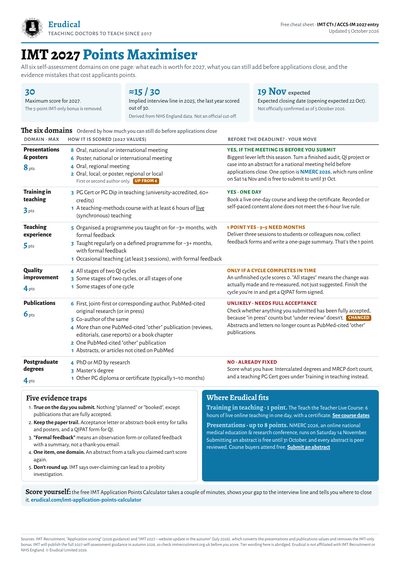
IMT Recruitment published its 2027 application scoring on 30 September 2026. Two things moved: presentations went up from 6 to 8, publications came down from 8 to 6, and the five bonus points for applying only to IMT were removed. These are the six domains an FY1 plan has to cover.
| Domain | Maximum | What scores the maximum | Realistic route from FY1 |
|---|---|---|---|
| Presentations and posters | 8 | Oral presentation at a national or international meeting, first or second author | Turn a QI project, audit or case into an abstract and present it nationally before you apply |
| Publications | 6 | First, joint-first or corresponding author of PubMed-cited original research | A PubMed-cited case report or review scores 3, or 4 for two or more |
| Teaching experience | 5 | Organised a teaching programme with local tutors and taught on it regularly for about three months, with formal feedback | Set up a programme for medical students on your rotation |
| Quality improvement | 4 | Every stage of two completed cycles | Join or start a project early enough to finish two cycles |
| Postgraduate degrees and qualifications | 4 | PhD or MD by research | Usually 0 at this stage, unless you already hold a qualification |
| Training in teaching | 3 | University-accredited PG Cert or PG Dip in teaching, 60 credits or more | 1 point from a course with at least six hours of live teaching |
| Total | 30 | Your score decides whether you are invited to interview. Offers are then ranked on the interview alone. | |
Where do you stand today? Calculate My Score → Six questions, one per domain, and a plan for the points you can still add.
Six rules that shape an FY1 plan
The scoring rules decide the order you do things in. Each of these comes from IMT Recruitment’s application scoring guidance.
- Everything must be finished by the closing date. In IMT’s words, “An achievement gained even on the day after the closing date for applications cannot be counted.” Publications that are in press, with the publisher’s acceptance, are the exception.
- A presentation counts once it has been given. An accepted abstract or a slot in a programme is not enough.
- A QI project needs a completed cycle. With no completed cycle it scores 0. The top tier needs every stage of two cycles, and the second cycle must include at least the data collection and analysis.
- Every teaching tier needs formal feedback. Teaching without feedback scores 0, however much of it you did.
- Presentations must report new data. Research, a complex case or a QI project counts. A talk that is mainly teaching does not, and presenting only because you paid a fee scores 0.
- Achievements count from the start of your medical degree. There is no limit in years, so a presentation you give in FY1 can go on the application you make in FY2.
Your plan from FY1 to the application
Work backwards from the closing date in the autumn of FY2. The bands below assume a standard August start to FY1.
- FY1, August to November: start the slow things. Join or start a QI project and agree your role with the lead in writing. Offer to teach the medical students on your firm and collect formal feedback from the first session onwards. Start one evidence folder and keep everything in it. A course with at least six hours of live teaching takes a day, so it can go anywhere in the plan; book it when your rota allows.
- FY1, December to March: build. Finish every stage of your first QI cycle. Turn occasional teaching into a defined programme: work with a local tutor or the undergraduate team, fix a timetable and run it for three months or more, with feedback after each session. Pick the piece of work you will present: the QI project, an audit or an unusual case.
- FY1, April to July: present and write up. Write the abstract and submit it to a national meeting; many close for abstracts months before they run. Start the second QI cycle. Write up a case report or review for a PubMed-indexed journal. Ask for the letters confirming your role in the teaching programme and the QI project before your rotation ends and the people who can sign them move on.
- FY2, August to the closing date: close the gaps. Run your score through the calculator, finish anything that can still be completed and evidenced before applications close, and make sure any accepted presentation is delivered before then. Claim only what you can evidence.
Domain by domain
Presentations and posters: up to 8
This is the largest single domain for 2027, and you score your one highest presentation, not the sum of several. A national or international oral presentation as first or second author scores 8, a national poster 6, a regional oral 4, and a local oral or a regional or local poster 2. The tier depends on who could take part, not on how many attended: national meetings must be open to anyone in the country. Our guide to getting a national presentation covers the route step by step, and how presentations are scored has the full table.
Publications: up to 6
First, joint-first or corresponding authorship of PubMed-cited original research scores 6, and co-authorship 5. Other PubMed-cited publications, such as editorials, reviews and case reports, score 2 for one and 4 for two or more; a book chapter that is not self-published scores 4. From 2027, abstracts and letters no longer count as PubMed-cited publications. For most FY1s, a case report is the realistic route: start it as soon as you see the case, because journals can take months to accept.
Teaching experience: up to 5
Five points need you to have worked with local tutors to organise a programme of sessions and taught on it regularly for about three months or more, with formal feedback. Regular teaching within someone else’s defined programme for three months or more scores 3. At least three sessions over less than three months, with formal feedback, scores 1. The top two tiers also need a letter confirming your role and the programme’s timetable, so ask for both while you are still on that rotation.
Quality improvement: up to 4
Every stage of two completed cycles scores 4. Every stage of one cycle, or some stages of two, scores 3. Some stages of one cycle score 1. It is easy to claim 1 point for a cycle you took part in from start to finish, when that is worth 3. On a long-running project you can only claim the cycles you were directly involved in, so join early.
Training in teaching: up to 3
A university-accredited PG Cert or PG Dip in teaching, worth at least 60 credits, scores 3, but it takes about a year. Below that level, a course in teaching methods scores 1 if it was delivered with “at least six hours (i.e. a one-day course) of synchronous (live) teaching time”. An e-learning module on its own does not count. Our comparison of teach the teacher courses lists every provider and price.
Postgraduate degrees and qualifications: up to 4
A PhD or MD by research scores 4, a Masters-level degree of eight months or more full-time equivalent 3, and another postgraduate diploma or certificate 1. Few FY1s will add to this domain before applying, so the plan above leaves it out.
An example FY1 plan, and what it scores
This is a worked example on the published 2027 scale, not a prediction. It shows how far a plan built in FY1 can go without a higher degree.
| Domain | What this doctor did by the closing date | Points (2027 scale) |
|---|---|---|
| Quality improvement | Every stage of two cycles of one project | 4 |
| Teaching experience | Organised a three-month teaching programme for medical students, with formal feedback | 5 |
| Training in teaching | A one-day course with six hours of live teaching | 1 |
| Presentations and posters | A poster at a national meeting, as first author | 6 |
| Publications | One PubMed-cited case report | 3 |
| Postgraduate degrees | None | 0 |
| Total | 19 of 30 |
The 2025 interview cut-off was 15, and 3,850 of the 8,728 applications considered in Round 1 were interviewed. Cut-offs move every year, so treat 15 as a reference point rather than a target.
Evidence to collect as you go
Nobody normally checks your evidence at shortlisting, but claims can be verified later, and IMT’s guidance says that if you supply no evidence, or none for three or more of your scored achievements, your application will not proceed. Collect it at the time; letters are much harder to get a year later.
- Quality improvement: a QIPAT form, or a document from your supervisor on headed paper.
- Teaching experience: a summary of the formal feedback, a letter on headed paper confirming your role, and the programme timetable.
- Training in teaching: the certificate, plus a course outline showing the hours and how the course was delivered.
- Presentations: the organiser’s letter or certificate, the abstract-book listing, and your abstract and slides or poster.
- Publications: the PubMed link and a screenshot, or the publisher’s acceptance if the paper is in press.
- Degrees: the certificate, or a letter from the awarding body.
Check where your IMT portfolio stands
Answer six questions and get your score out of 30, how it compares with the 8,728 applications scored in 2025, and the points you can still add.
Frequently asked questions
When should I start my IMT portfolio?
In FY1. You apply in the autumn of FY2, and the highest-scoring achievements take months: a teaching programme of about three months, two completed QI cycles, and a presentation that has to be delivered before applications close. Starting in FY2 usually leaves time only for the quicker points.
What IMT score do I need to get an interview?
In 2025, the last round scored out of 30, the interview cut-off was 15 and the median score was 14; 3,850 of the 8,728 applications considered were interviewed. The cut-off changes every year. Your score only decides whether you are interviewed: offers are ranked on interview performance.
Do I need a PG Cert in medical education for IMT?
No. A university-accredited PG Cert or PG Dip of at least 60 credits scores 3 in the training-in-teaching domain, but it takes about a year. A course below that level scores 1 if it includes at least six hours of live teaching.
Does an online teaching course count for the IMT teaching point?
Only if at least six hours of it were delivered live, at the same time as you took part. IMT asks for “at least six hours (i.e. a one-day course) of synchronous (live) teaching time”. An e-learning or self-paced module on its own does not score the point.
Can I claim an FY1 presentation when I apply in FY2?
Yes. IMT counts achievements gained after you started your medical degree and sets no limit in years. The presentation must have been given, as first or second author, before the closing date for applications.
Will the IMT scoring change before I apply?
It might. For 2027, presentations went up from 6 to 8, publications came down from 8 to 6, and the five-point bonus for applying only to IMT was removed. Check the scoring page for your own application year when IMT Recruitment publishes it, and adjust the plan then.
Last checked against IMT Recruitment’s application scoring guidance (2027 values, published 30 September 2026): 8 October 2026. Score data: NHS IMT recruitment, application score data, 2025 Round 1.
Related: IMT application points calculator, how to get a national presentation for IMT, IMT presentation points and teaching points for IMT and ST3.